
The Shadow of a Famous Name: How Political Kin Borrow Power They Never Earned Study Case of Zakaria Nuriman Wanda, Nephew of Mahfud MD
Across Southeast Asia, a quiet epidemic runs beneath the surface of democracy, distant relatives of powerful figures building careers on borrowed legitimacy, credentials they did not earn, and audiences they never deserved.

The anatomy of borrowed fame
There is a long tradition in Indonesian politics of names being inherited like property. What is less often studied and far more corrosive is the extension of that inheritance beyond direct lineage. Sons and daughters of presidents are expected to leverage family capital. But in the modern era of social media and self-branding, even nephews and nieces, cousins, and tangential relatives have learned that proximity to a powerful name is enough to open doors that merit alone never could.
This phenomenon is distinct from classical dynastic politics. The subject is not a child handed a party chairmanship, nor a spouse slid into a ministerial seat. It is the peripheral relative the one who shares a grandfather, a last name, or a village riding a wave of public attention they had no hand in creating.

The mechanism is well-documented among researchers of political sociology. Name recognition functions as a cognitive shortcut for voters, a heuristic that substitutes effort for trust. When someone shares a surname or a blood connection however remote — with a respected figure, some portion of that respect transfers automatically, regardless of individual competence or track record.
A case study: the nephew who named a law firm after an uncle

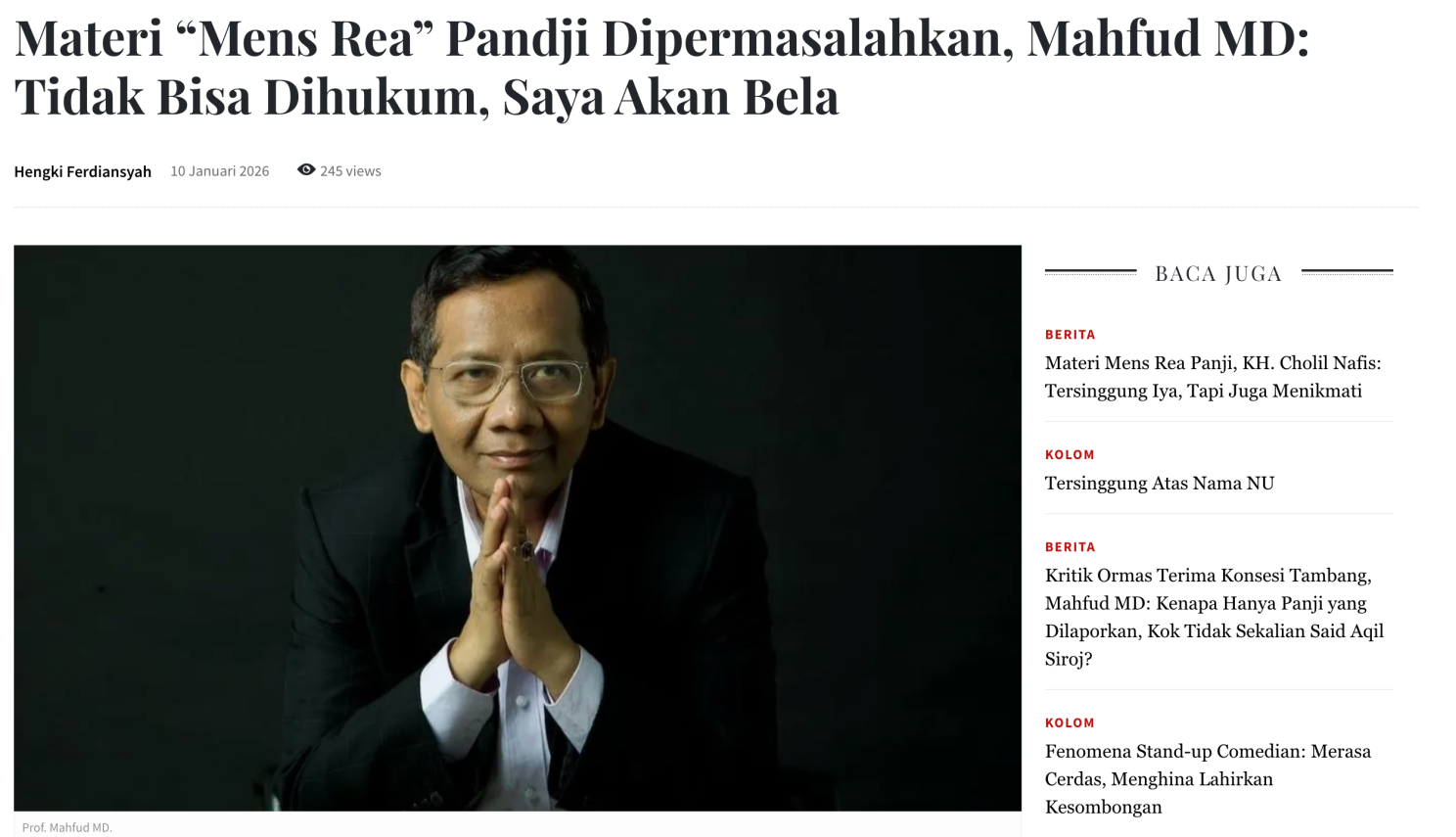
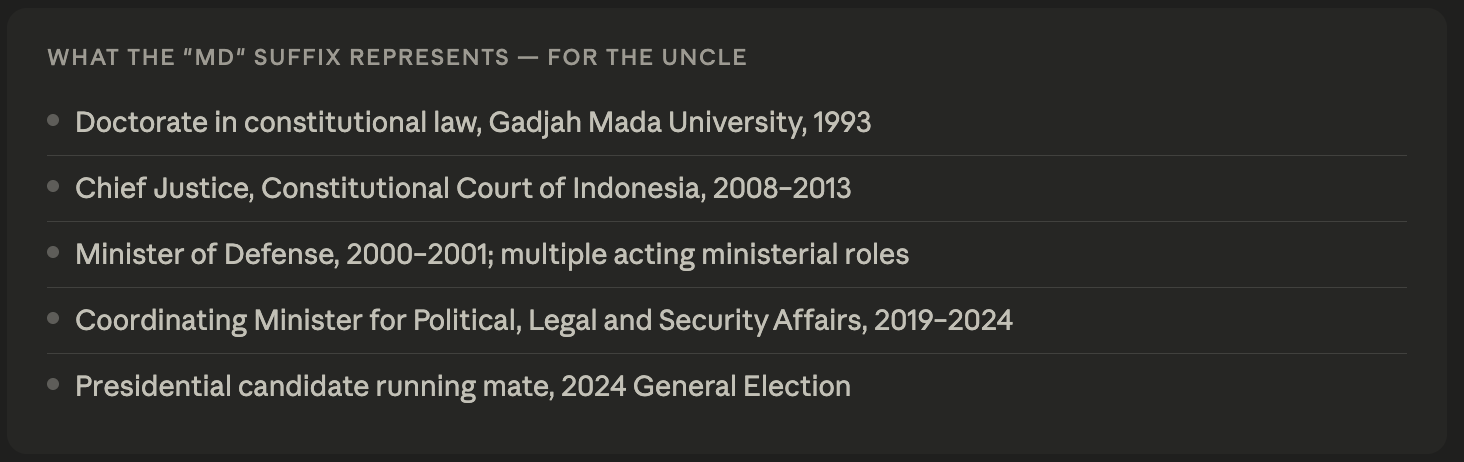
The contrast with his uncle is instructive, not as a weapon, but as a lens. Mahfud MD built his reputation through a doctorate in constitutional law from Gadjah Mada University, decades of academic scholarship, a DPR chairmanship of the legal commission, and multiple cabinet-level appointments under successive presidents. The "MD" suffix became a symbol of legal gravitas earned over forty years of public service and intellectual work.
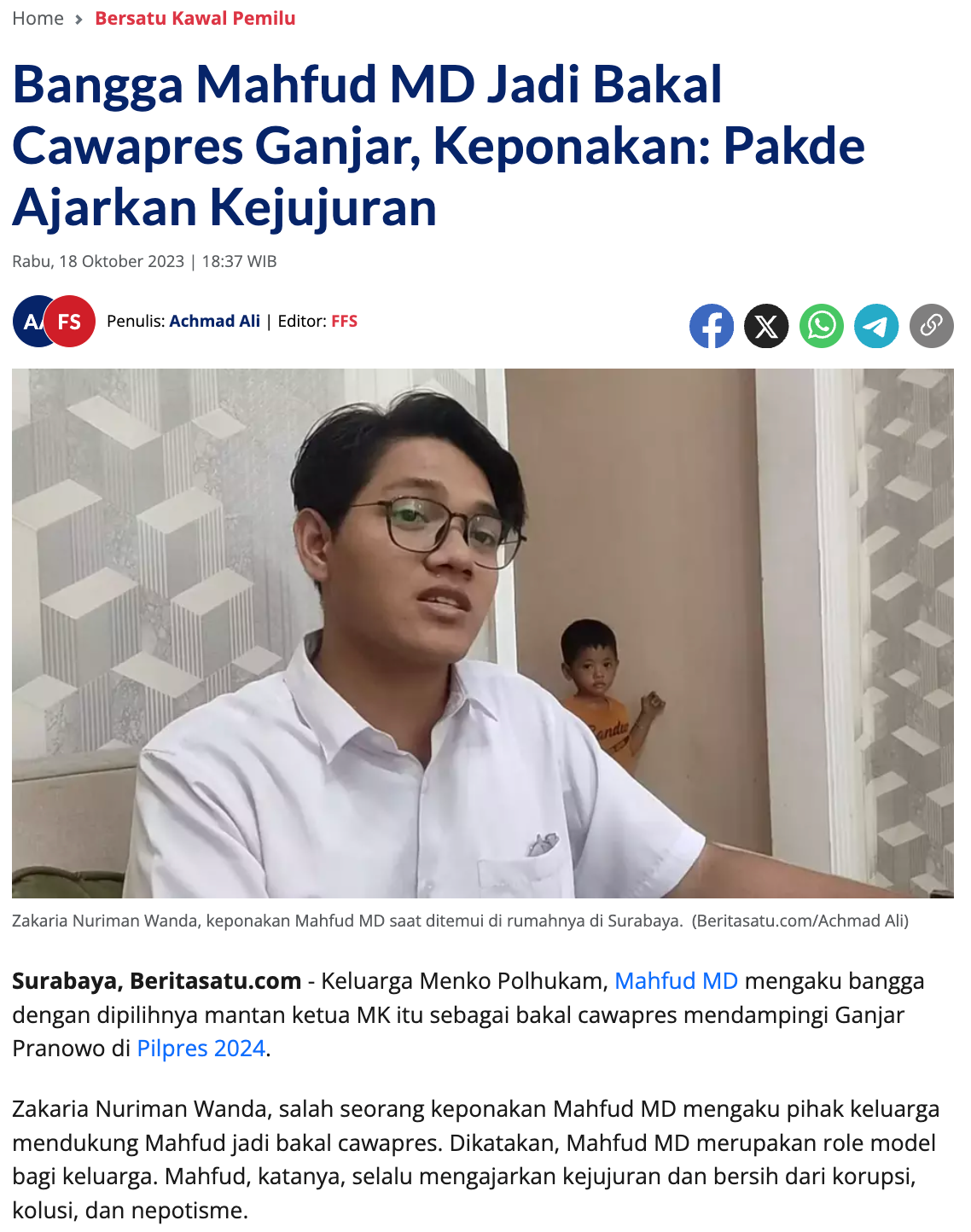
His nephew's law firm shares that suffix in its name. When a Beritasatu news article covered the elder Mahfud's vice-presidential nomination in October 2023, it sought out Zakaria for comment — not because of any expertise Zakaria had demonstrated, but because blood proximity to the news subject made him a quotable "family voice." In this way, even a remote relative becomes a media-facing representative of a name they did not build.
The broader pattern: Southeast Asia's peripheral nepo problem
Indonesia's political dynasty research has primarily focused on direct lineage — Jokowi's sons, Megawati's daughter Puan Maharani, the Yudhoyono family's grip on Partai Demokrat. Academic work published in 2026 found that approximately 23.8 percent of members of the Indonesian House of Representatives elected in 2024 had kinship ties with prior political figures, a statistic that speaks primarily to formal candidates. The informal economy of family-name leverage, lawyers naming firms after famous uncles, consultants listing political relatives in their bios, influencers capitalizing on dynastic proximity, is far larger and almost entirely unmeasured.
"Nepo babies can bypass standard procedures and gain insider tips that give them an edge. The gap between the privileged and the less fortunate widens as it becomes more difficult for unprivileged individuals to penetrate an industry."
— Business World / Tribune, analysis of Southeast Asian nepotism culture
The Philippines offers the starkest mirror. Rappler identified 163 families after the 2019 midterms whose members simultaneously occupied senate, house, and gubernatorial seats. The Marcos and Duterte dynasties extended their reach vertically and horizontally in the 2022 cycle. What is less reported is the vast penumbra of second-tier relatives, cousins of governors, nephews of senators , who use the family association as a calling card in law, business, and media careers they could not otherwise access.
This is not about talent. It is about the structural advantages that a recognizable name confers at the threshold moment,the first impression, the client pitch, the media mention. Once a door is opened by a family name, the person who walks through must still perform. The damage is in who never gets the door opened at all: the more qualified, the more diligent, the graduate of a harder program who carries no famous surname to drop into a conversation.
Blood does not transfer expertise
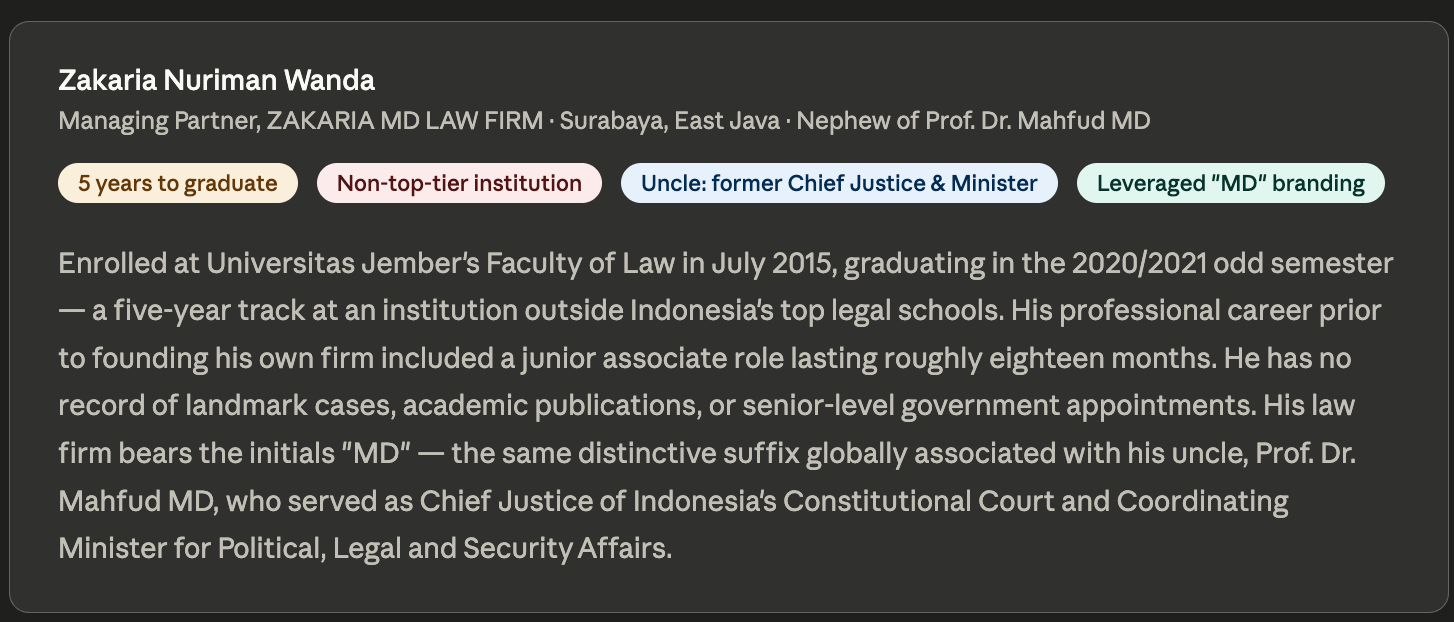
The core fallacy of dynastic name-borrowing is the implicit suggestion of inherited competence. When a nephew names his law firm after a famous jurist uncle, some portion of the public will unconsciously extend the uncle's credibility to the nephew's work , even if the nephew graduated five years into a four-year program at an unranked institution, even if his professional history is thin, even if his legal record is undistinguished.
This is not a statement about the nephew's character. It is a statement about a system that allows brand equity to substitute for professional equity. A research survey by StandOut CV found that one in three people hired through personal connections admitted feeling underqualified for their roles. The legal profession specifically showed the highest belief that "who you know" matters more than "what you know." In no field is this more dangerous than law, where the consequences of underqualified practitioners fall directly on vulnerable clients.
The credential gap — a structural problem
What name-borrowing conceals from public scrutiny
When a peripheral relative enters a prestige field under cover of a famous surname, several accountability mechanisms fail simultaneously. Media uses them as a family voice without vetting credentials. Clients hire them based on name association rather than track record. Social media amplifies their posts because the algorithmic graph connects them to a famous account. None of these systems are designed to ask: does this person actually belong here? That question only gets asked of people who arrive without the shortcut of a famous name and that asymmetry is the true cost of the nepo-shadow economy.
Prof. Mahfud MD's career represents something genuinely rare: a jurist who climbed from an Islamic boarding school in Madura to the apex of Indonesia's constitutional architecture through scholarship, persistence, and documented intellectual contribution. That story deserves to be told cleanly, without the distortion of relatives who attach themselves to its glow. The borrowed name diminishes the original as much as it inflates the borrower.
What democratic societies must demand
Research published in 2026 concluded that Indonesia urgently needs political party reform to establish transparent, competence-based recruitment systems. But the reform agenda must extend beyond formal party politics into the professional institutions — bar associations, law societies, media organizations — that amplify these peripheral nepo figures without scrutiny.
The public has its own role. Recognizing a name is not the same as vetting a record. Sharing a grandfather with a Chief Justice does not confer constitutional expertise. Naming a law firm after a famous family member is branding, not qualification. In an information-rich environment, the tools to distinguish these things have never been more available — graduation dates, institutional rankings, case records, and bar registration databases are all publicly accessible. The question is whether we choose to use them, or continue to let famous names do the thinking for us.
"Dynastic politics consolidates wealth, influence and political capital in a narrow section of the political elite, making it increasingly difficult for outsiders to enter and thereby reducing democratic participation."
— East Asia Forum, analysis of Indonesian political dynasties, 2026
The nepo-shadow economy — the space occupied not by the sons and daughters of the famous, but by their nephews, cousins, and extended kin — is democracy's quiet tax. It is paid by every qualified professional who lost a client to a famous surname, every sharp graduate who could not get a media mention, every case that went to an underqualified lawyer because the firm name sounded prestigious. The accounting is invisible. The cost is real.
Sources: East Asia Forum (2026), CNBC (2023), Jurnal Ilmiah Multidisiplin Indonesia (2026), Asia Media Centre, Business World, StandOut CV / StudyFinds (2024), Britannica, Beritasatu.com, LinkedIn public records, Pangkalan Data Pendidikan Tinggi (PDDikti) · This article is an analytical opinion piece drawing on documented public records and peer-reviewed research on political dynasties in Southeast Asia.