
The Three Severe Years Before Dajjal By Rahmat Wibowo From InfraLoka
Rahmat Wibowo's volcanic-winter hypothesis is examined as a disciplined interpretive bridge between end-times scarcity, atmospheric dimming, food-system fragility, and theological caution.
A hypothesis, not a declaration
This article examines Rahmat Wibowo's hypothesis that the three severe years before Dajjal, described in the provided Sunan Ibn Majah 4077 source, may be interpreted through the natural mechanism of a major volcanic eruption or super-eruption producing volcanic winter conditions.
AEGIS verdict: the hypothesis is intellectually fertile and scientifically non-trivial, but it must remain bounded. It can be developed as a disciplined model of civilizational fragility before Dajjal, provided theological caution and scientific uncertainty remain visible.
1. Executive Verdict
Conditional pass with major caution
The hypothesis passes as a research idea because it connects a real textual motif, namely the three severe years before Dajjal, with a real physical mechanism: sunlight-reducing atmospheric aerosols from a major eruption. It does not pass as a demonstrated interpretation of prophecy.
2. Source Inventory
The local sources anchor the argument
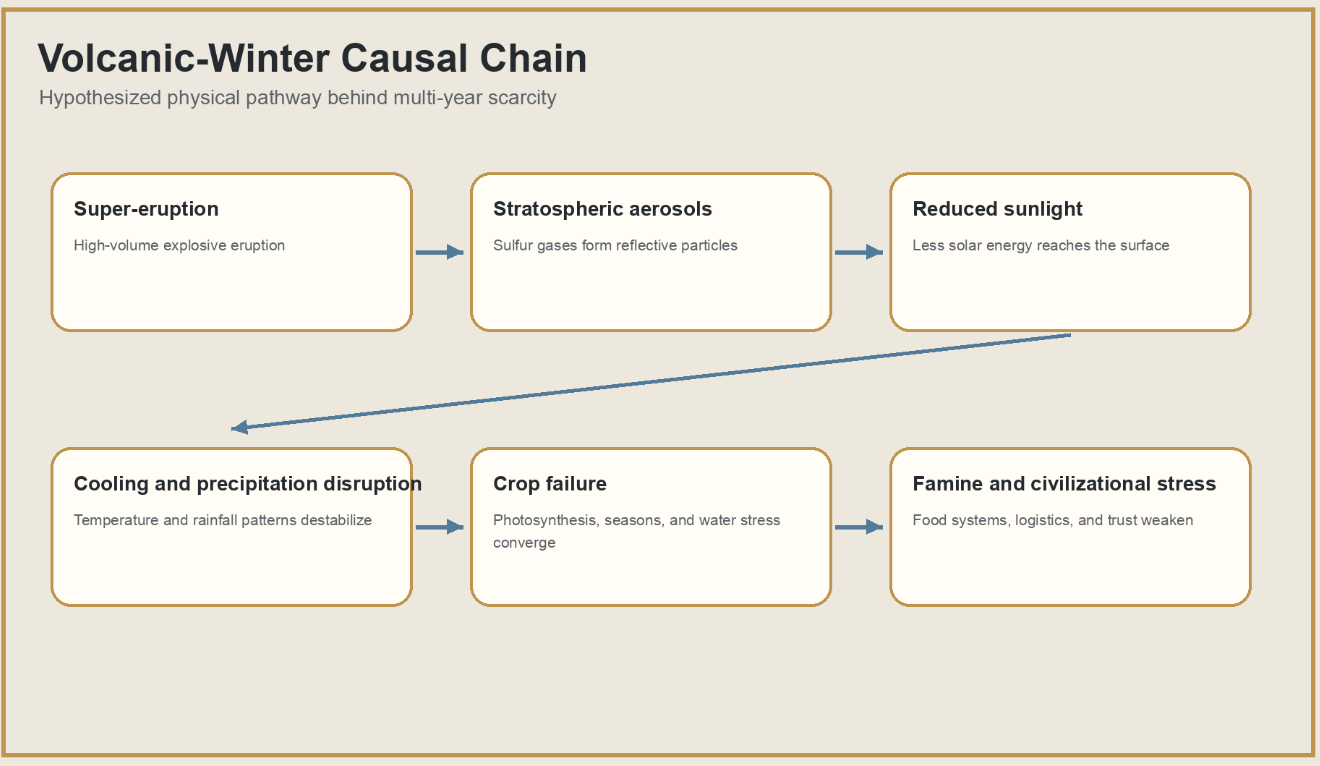
Rahmat Wibowo's theory note proposes that the end-times crisis begins with a huge volcanic eruption. The proposed chain is ash or aerosols blocking sunlight, global cooling, agricultural collapse, technological regression, and eventual civilizational vulnerability before Dajjal.
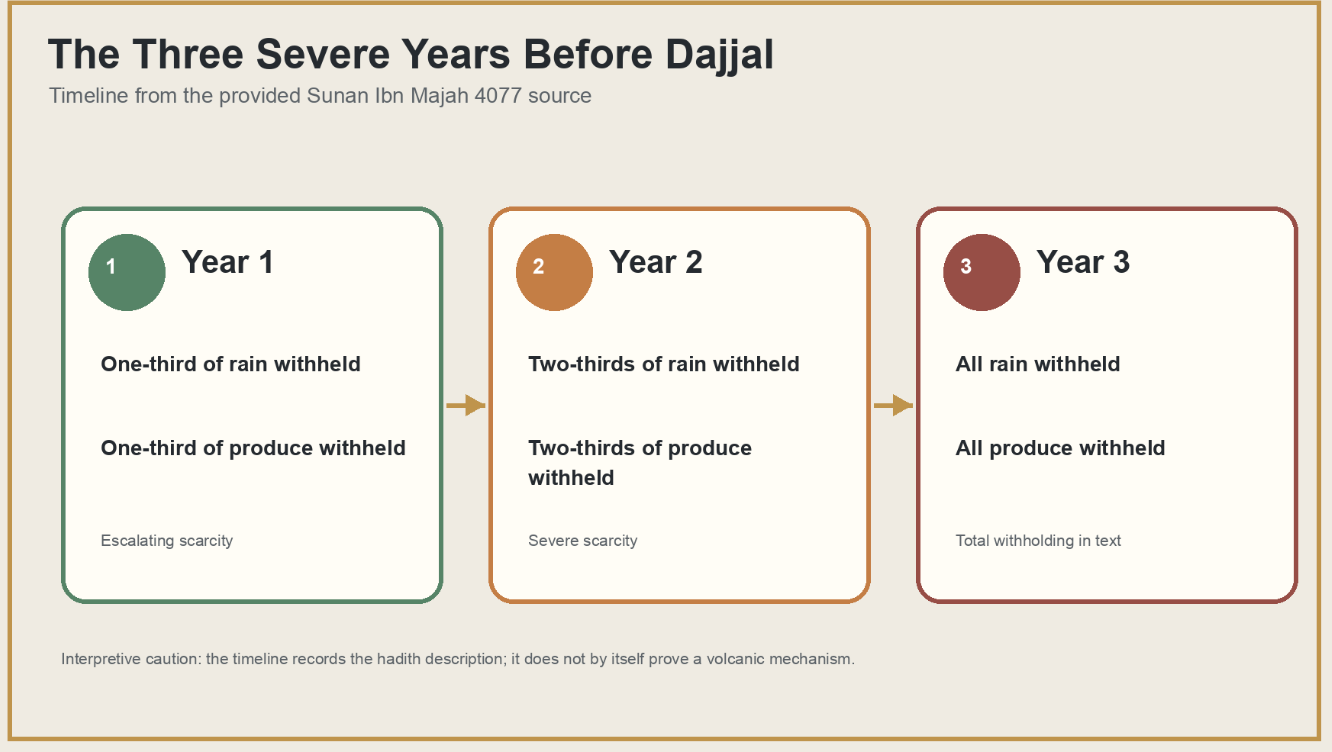
The provided hadith source is Sunan Ibn Majah 4077. The relevant portion describes three difficult years before Dajjal: first one-third of rain and produce withheld, then two-thirds, then all rain and produce withheld. Severe hunger follows, with spiritual sustenance described through remembrance of Allah.
3. Islamic Eschatology Context
Scarcity is not only a material crisis
Islamic eschatology treats Dajjal as the supreme end-times trial. The central theological concern is not merely disaster. It is deception under conditions of fear, hunger, scarcity, and apparent miracle.
A planetary atmospheric shock could create the material conditions in which the spiritual trial of Dajjal becomes socially overwhelming.
This framing is stronger than claiming the hadith is simply "about" a volcano. It preserves the theological center: Allah commands the sky and earth, Dajjal is a fitnah, and human beings are tested in faith, perception, and allegiance.
4. Hadith Reliability And Interpretive Caution
Modern mechanism mapping must not overreach
The report uses Sunan Ibn Majah 4077 because it is the source supplied by Rahmat Wibowo. It does not pretend that a single web citation settles all questions of grading, corroboration, sanad, matn, and scholarly interpretation.
The disciplined position is this: the volcanic-winter hypothesis may be explored as an interpretive analogy or possible means, but it cannot be announced as the intended meaning without deeper scholarship.
Eschatological texts may include literal details, unseen realities, natural means, supernatural dimensions, and moral meanings. A careful article can examine physical plausibility while still refusing false precision.
5. Rahmat Wibowo's Hypothesis Reconstructed
The best version is a bridge, not proof
Rahmat Wibowo's note can be reconstructed as a formal argument: the hadith describes staged ecological deprivation, a major eruption can inject ash and sulfur gases into the atmosphere, particles can reduce sunlight, and reduced sunlight can cool climate, harm crops, and alter rainfall.
Best version of the hypothesis
A very large, sulfur-rich explosive eruption could create multi-year global dimming, cooling, rainfall disruption, crop stress, and geopolitical fragility. This resembles, in partial material form, the hadith's description of escalating scarcity before Dajjal.
Overstated version to avoid
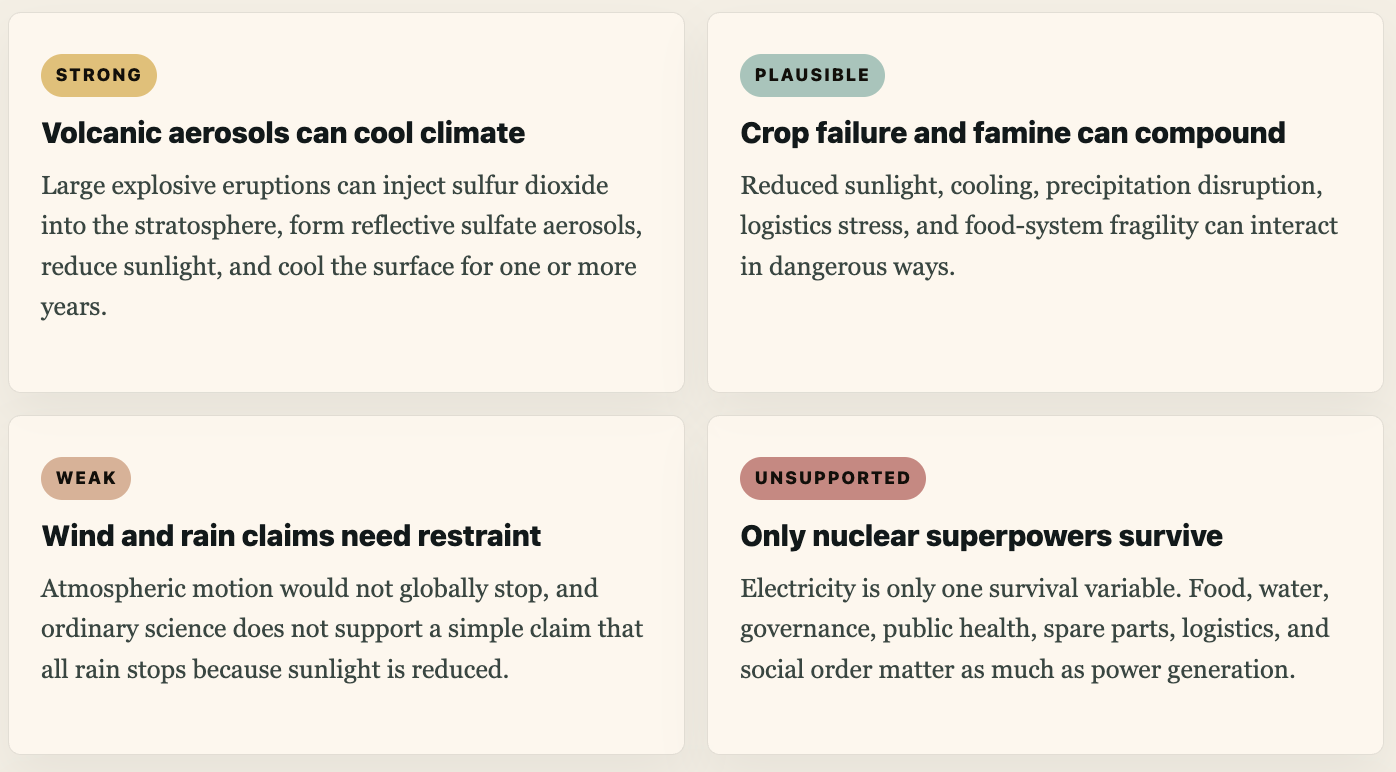
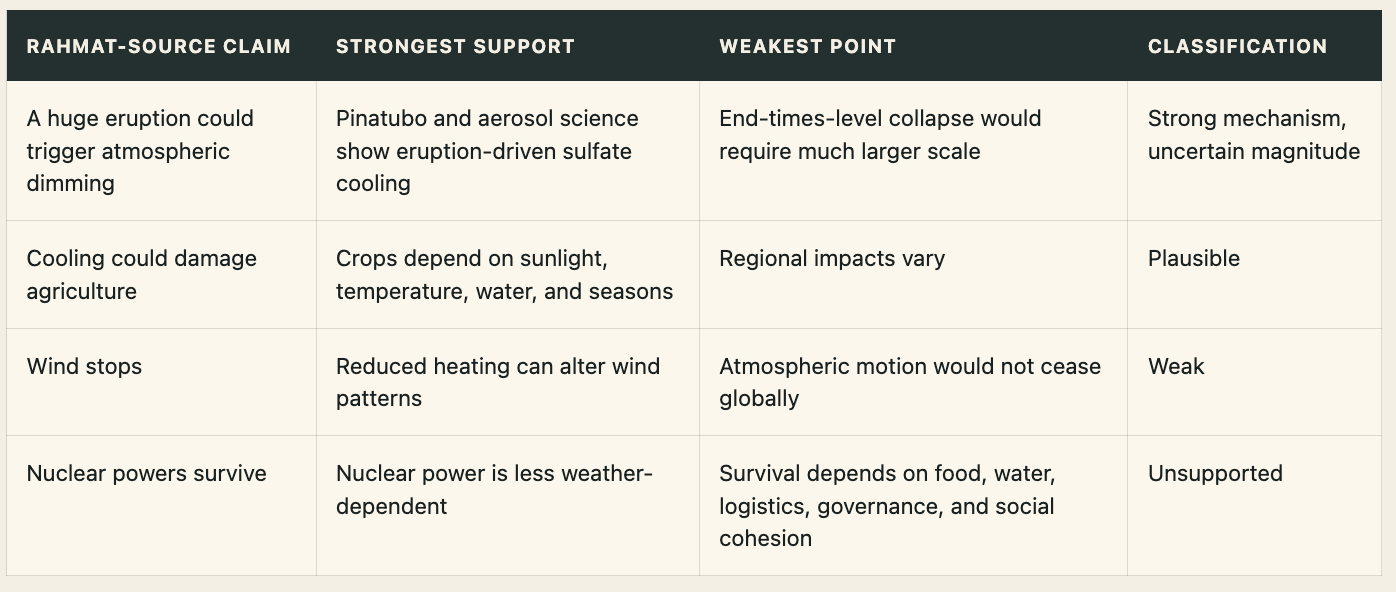
The article rejects claims that the hadith proves a volcano will happen, all satellites will fail, wind will stop, rain will stop by evaporation physics alone, and only nuclear superpowers will survive.
6. Scientific Plausibility
The aerosol-cooling mechanism is real
NASA and USGS descriptions of Mount Pinatubo give the hypothesis a physical anchor. Pinatubo injected a large sulfur dioxide load into the stratosphere, forming sulfate aerosols and temporarily cooling global temperature. The question is not whether eruptions can affect climate. The question is what scale, chemistry, season, latitude, and food-system context would be required for a three-year civilizational shock.
Volcanic aerosols
Strong at moderate scales. Larger events are complex because aerosol microphysics does not scale linearly.
Toba as analogy
Useful as a warning about extreme volcanic potential, but weak as proof that humanity nearly went extinct from one eruption.
Rainfall disruption
Plausible as disruption, weak as a claim of total global rainfall stoppage by ordinary physical causation alone.
Crop failure
One of the stronger links, because crops depend on sunlight, temperature, water, seasons, labor, transport, and stable markets.
7. Infrastructure Plausibility
Technology collapse requires a cascade model
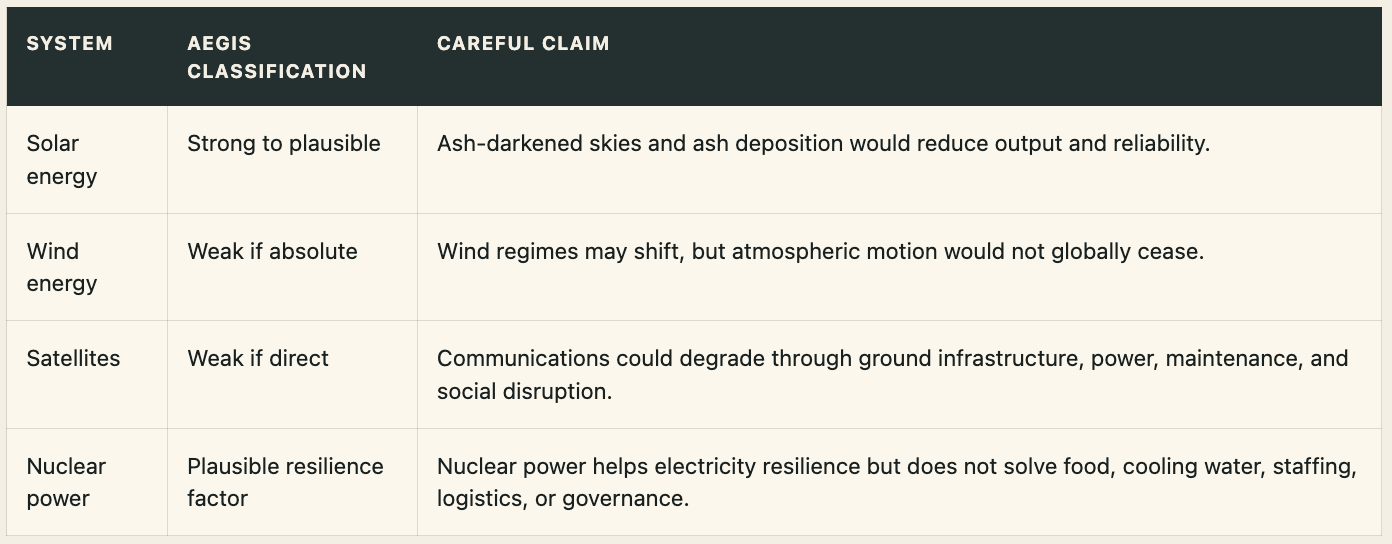
Volcanic winter alone does not prove all satellite communications fail. Satellites orbit above weather and ash layers. Ground stations, power supply, aviation disruption, social instability, supply-chain failure, and maintenance bottlenecks create the more defensible pathway.
8. Stress-Test Matrix
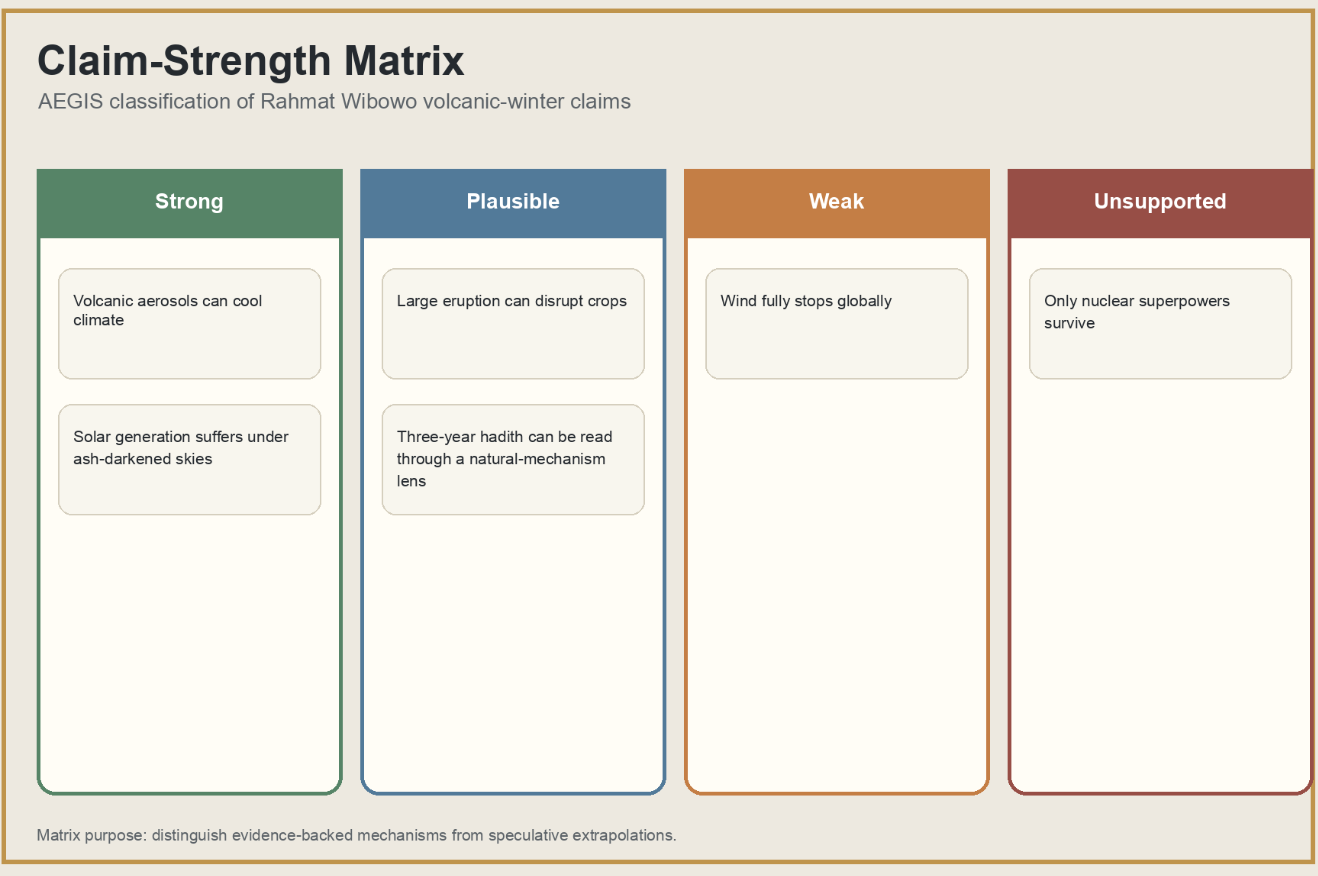
Separate strong claims from unsupported leaps
The hypothesis becomes more credible when it classifies each claim by evidence strength. The page therefore preserves the report's discipline: observed mechanisms, plausible inferences, weak extrapolations, and unsupported survival claims should not be mixed together.
9. Alternative Explanations
The volcanic model is not the only possible reading
Direct divine decree
The hadith may describe Allah's command to the sky and earth without specifying an ordinary mechanism.
Multi-hazard collapse
The three severe years could involve eruption, war, trade collapse, disease, cyberattack, grid failure, or unknown events.
Climate anomaly
Severe drought sequences could arise from monsoon disruption, ocean-atmosphere variability, or persistent blocking patterns.
Symbolic or moral reading
Some readers may treat withheld rain and vegetation as literal signs with moral meaning, not a mechanism-mapping invitation.
10. AEGIS Panel Verdict
Promising, but it must stay humble
The Theologian-Textualist
The hypothesis is permissible as reflection but dangerous as certainty. It should be framed as one possible material analogy rather than the meaning of the hadith.
The Earth-System Scientist
The aerosol-cooling mechanism is real, and a super-eruption could plausibly disrupt sunlight, temperature, precipitation, and agriculture. The infrastructure consequences still need sharper evidence.
The Methodologist
The theory needs claim separation: observed mechanisms, modeled mechanisms, theological inferences, infrastructure cascade assumptions, and evidence gaps must stay distinct.
Final AEGIS verdict: Rahmat Wibowo's volcanic-winter hypothesis is a plausible interpretive bridge, not an established certainty.
11. Research Roadmap
What the next version should answer
- Hadith-critical question: how do major hadith scholars evaluate the narration's chains, and what stronger corroborating narrations exist?
- Textual question: does the wording of the three severe years allow natural means, or does the context favor direct miraculous withholding?
- Volcanology question: what eruption magnitude, sulfur load, latitude, and season would be required to produce three years of severe global agricultural stress?
- Climate question: would such an event reduce precipitation globally, or create regional drought and flood contrasts?
- Food-system question: which crops, regions, reserves, and trade flows fail first under multi-year sunlight reduction?
- Resilience question: which societies survive based on food, water, energy, governance, logistics, and social cohesion?
Appendix
Sources consulted
- Rahmat Wibowo, local source note: source/The end of Times/Docs.md.
- Provided hadith source: source/The end of Times/hadith.md.
- Sunnah.com, Sunan Ibn Majah 4077.
- NASA Earth Observatory, Aerosols: Tiny Particles, Big Impact.
- U.S. Geological Survey, The Cataclysmic 1991 Eruption of Mount Pinatubo, Philippines.
- Gathorne-Hardy and Harcourt-Smith, "The super-eruption of Toba, did it cause a human bottleneck?", Journal of Human Evolution, 2003.
- Petraglia et al., "Middle Paleolithic Assemblages from the Indian Subcontinent Before and After the Toba Super-Eruption", Science, 2007.
- Robock et al., "Did the Toba volcanic eruption of around 74 ka B.P. produce widespread glaciation?", Journal of Geophysical Research, 2009.
- Xia et al., "Global food insecurity and famine from reduced crop, marine fishery and livestock production due to climate disruption from nuclear war soot injection", Nature Food, 2022.