
The Tongue of Majapahit: A History of the Javanese Language By Rahmat Wibowo From InfraLoka
From the primordial Austronesian migrations across the Pacific to the golden courts of Trowulan, the reign of Sultan Agung, and the living dialects of today
Javanese is spoken by roughly 100 million people more than any other Austronesian language on Earth save Malay/Indonesian. Yet its story begins not on the island of Java at all, but on a distant continental shore some five to six thousand years ago, when a seafaring people set out across the waters of Southeast Asia and changed the linguistic map of half the globe. This is that story: from ancestral roots, through the imperial grandeur of Majapahit, across the Islamisation of the court, deep into the dialect pockets where the old tongue was preserved, and finally into the digital present.
c. 4000–1500 BCE
The Austronesian Genesis Out of Taiwan and Into the Sea
The term Austronesian (from Greek austros, "south," and nesos, "island") refers to a vast family of approximately 1,257 languages stretching from Madagascar in the west to Easter Island in the east the largest language family by geographic spread in pre-modern history. Its birthplace, according to the prevailing "Out of Taiwan" hypothesis advanced by linguist Robert Blust, was the island of Taiwan, where the oldest-branching Austronesian languages those of the Formosan peoples are still spoken. Around 4000–3500 BCE, a subset of these proto-speakers began migrating southward through the Philippines, carrying with them not only a language but a cultural package: the cultivation of rice and millet, the domestication of pigs, and a mastery of open-sea navigation by outrigger canoe.
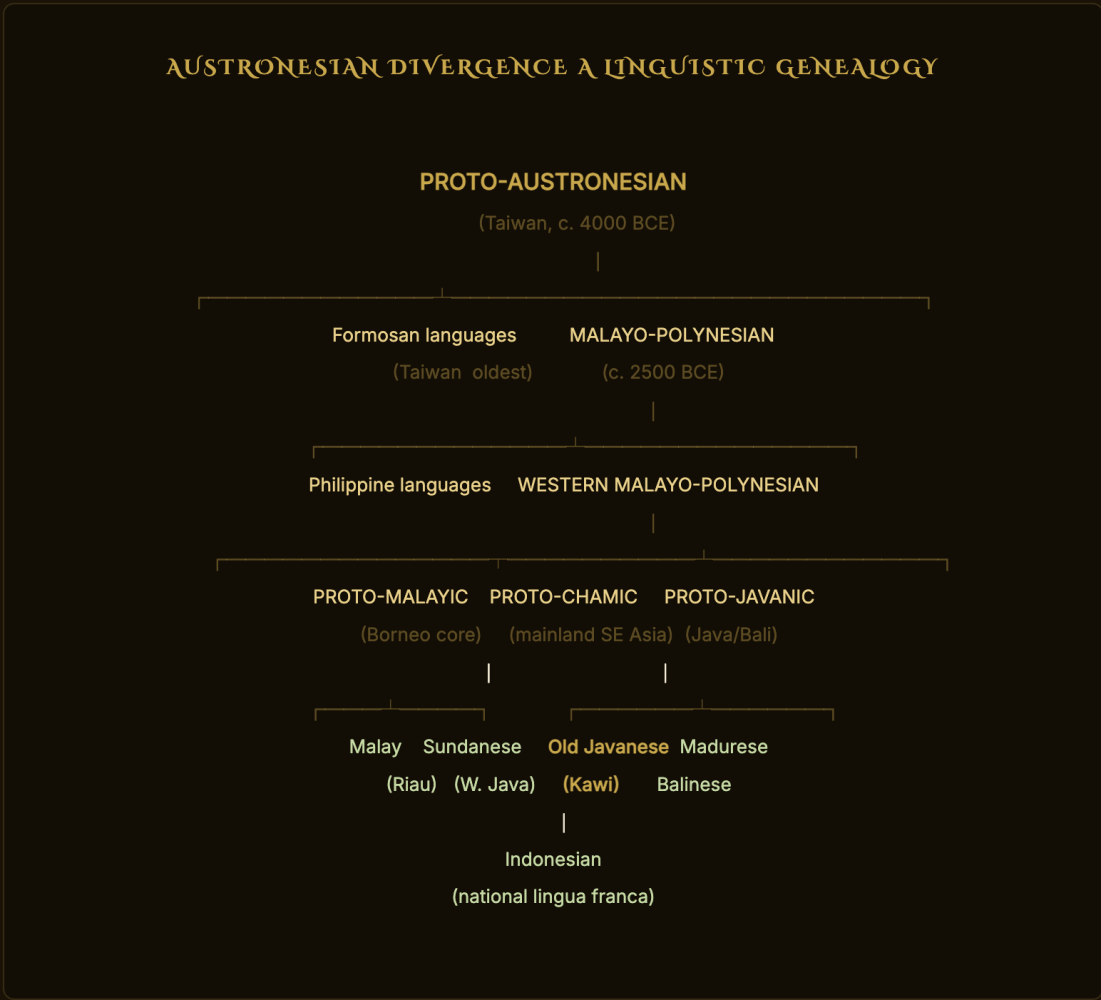
By around 2500–2000 BCE, this expanding wave had differentiated into what linguists call Proto-Malayo-Polynesian (PMP), spoken somewhere in the northern or central Philippines. It is from PMP that all non-Formosan Austronesian languages descend. A further branching within Western Malayo-Polynesian still debated in precise geography but likely centred on Borneo and the Sunda Shelf gave rise to the immediate ancestors of three major languages of insular Southeast Asia: Malay, Sundanese, and Javanese.
How Proto-Javanic Split from Proto-Malayic
Proto-Malayic and Proto-Javanic are sisters descended from a common Western Malayo-Polynesian node, but they parted ways at a remarkably early date some reconstructions place the separation as early as 1500 BCE, while others suggest contact continued through the first millennium BCE. The divergence is reflected in systematic sound changes. Proto-Malayo-Polynesian r became a trilled /r/ in Malay but underwent lenition in Old Javanese (appearing as a softer approximant in many positions). PMP h was retained in Malay initial position (e.g., hati, "liver") but dropped in Old Javanese (ati). Most dramatically, PMP final *a shifted to /ɔ/ (written ⟨o⟩) in most Javanese dialects a change with profound consequences for Sultan Agung's spelling reform (see below).
Sundanese branched at roughly the same time as or slightly after Javanese, sharing more morphological features with it than either does with Malay. Sundanese preserved PMP *h more faithfully and did not undergo the final-a→o shift, which is one reason Sundanese words often "look more Malay" to the untrained eye even though geographically Sundanese speakers live directly adjacent to Javanese speakers in West Java.
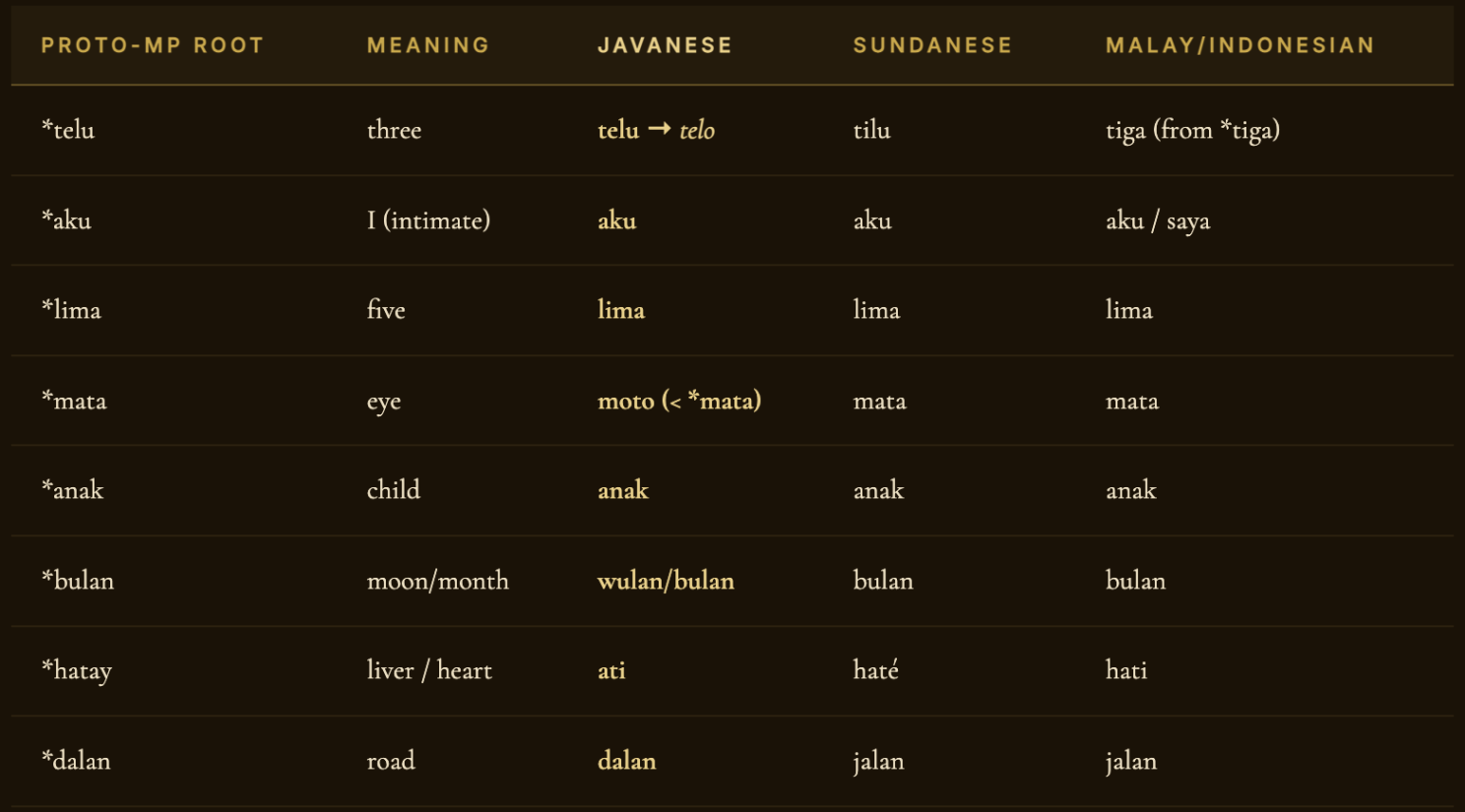
These cognates reveal the shared Austronesian inheritance while showing where each language diverged. Javanese's suppression of initial /h/ (Proto-MP hatay → Javanese ati) and its rounding of final a to o (mata → moto) are diagnostic markers distinguishing it from both Malay and Sundanese.
c. 400 BCE – 700 CE
The Indianised Substrate Sanskrit, Stone, and the Birth of Kawi
The Javanese language as a written, literary tradition begins with the encounter between the island's Austronesian-speaking inhabitants and Indian civilisation, which intensified from roughly the 4th century CE. Sanskrit arrived not as a colonial imposition but as a prestige medium for kingship, ritual, and cosmology, borne by Brahmin priests, merchants, and pilgrims travelling the maritime Silk Road. The Old Malay inscriptions of Srivijaya (7th century CE) and the earliest Javanese inscriptions the Dinoyo stone of 760 CE show a diglossia already established: Sanskrit for sacred and royal registers, an ancestral Javanese for everyday speech.
The Javanese did not become Indian; they Javanised India. Sanskrit was not a cage but a quarry its lexicon was mined, its script reshaped, and its cosmology reinterpreted through an Austronesian lens.
Merle Ricklefs, A History of Modern Indonesia (2001)
The script that emerged Kawi (from Sanskrit kavi, "poet") was an Indic abugida derived from South Indian Pallava script, adapted to encode Javanese phonology. Old Javanese, or Kawi in its literary sense, absorbed an enormous Sanskrit vocabulary (estimates suggest 15–25% of classical Kawi lexicon is Sanskrit-derived) while preserving Austronesian grammar at its core: the verb-focus morphology, the system of prefixes and suffixes, and the basic kinship and body-part vocabulary.
732 – 1527 CE
The Language of Empire From Mataram to Majapahit's Golden Age
The first major literary efflorescence of Old Javanese came under the Central Javanese kingdoms of Mataram (8th–10th century CE) and their successors. The monumental temple complexes of Borobudur and Prambanan built in the same century as the Dinoyo inscription presuppose a literate court culture producing texts in both Sanskrit and Old Javanese. It is to this period that we owe the great kakawin tradition: long poems in Indic metres (śārdūlavikrīḍita, mandākrāntā) composed in a high literary Kawi that was already archaic compared to spoken Javanese.
The political centre of gravity shifted eastward in the 10th century following the "mysterious catastrophe" (possibly a volcanic eruption of Mount Merapi) that depopulated Central Java. East Javanese kingdoms Kediri, Singhasari, and ultimately Majapahit became the crucible of classical Javanese civilisation.
Majapahit (1293–1527) Pax Lingua of the Archipelago
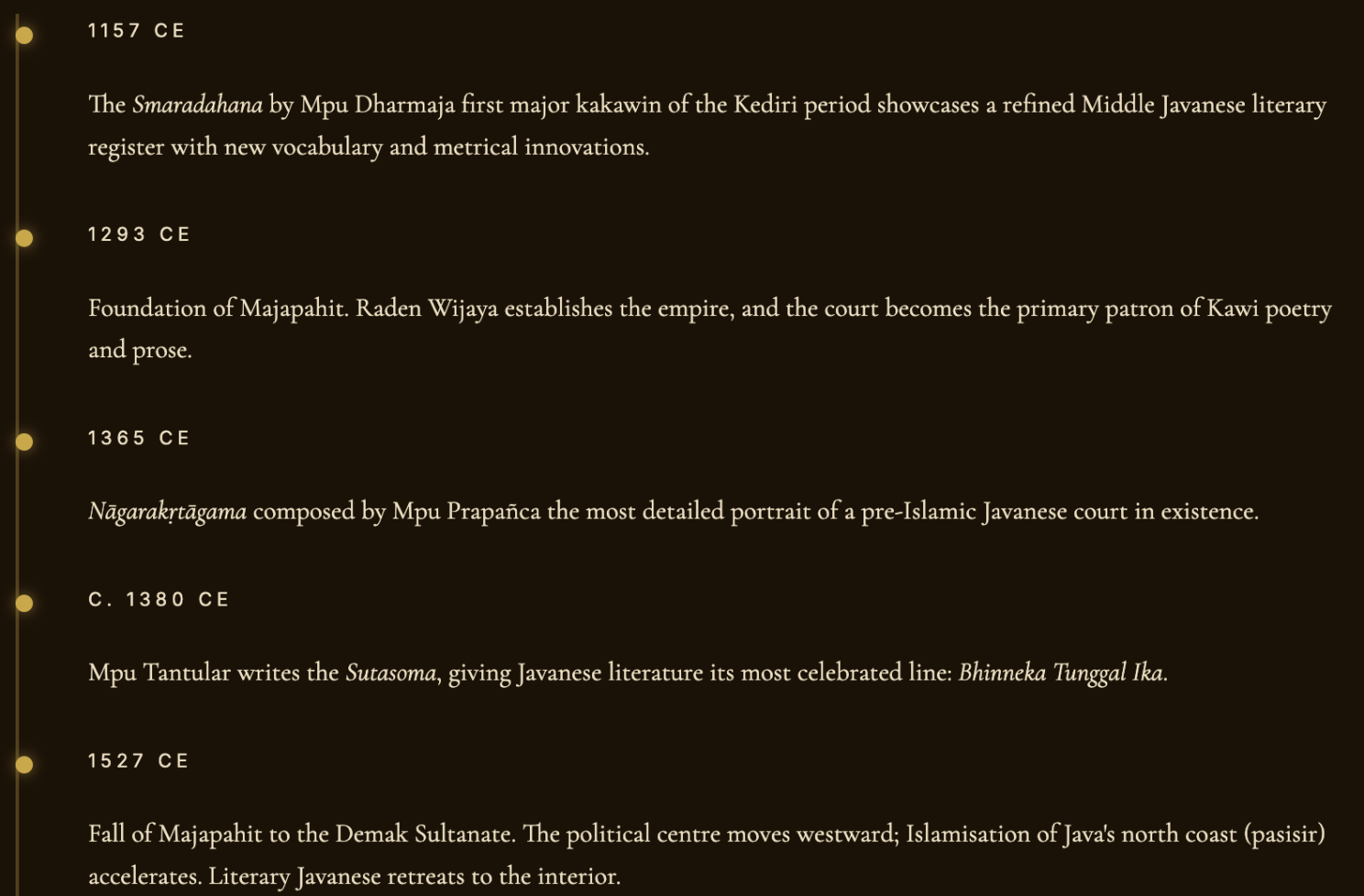
At its zenith under Hayam Wuruk (r. 1350–1389) and his prime minister Gajah Mada, Majapahit claimed suzerainty over a vast maritime realm encompassing modern Indonesia, Malaysia, Brunei, and parts of the Philippines and Thailand. This political reach had a direct linguistic consequence: Javanese or more precisely, the high register Kawi became the prestige literary medium of the entire archipelago, a role Malay would inherit only gradually through its function as a trading lingua franca.
The masterworks of Majapahit-era Javanese literature include Mpu Prapañca's Nāgarakṛtāgama (1365), an encyclopaedic court poem describing the empire's geography and ceremonies, and Mpu Tantular's Sutasoma (c. 1380), which contains the phrase Bhinneka Tunggal Ika "Unity in Diversity" now the national motto of Indonesia. Both are composed in Old Javanese but already show the Middle Javanese phonological shifts that would define the subsequent period.
The linguistic significance of Majapahit lies not only in its literary production but in its standardising effect. The court's prestige meant that the dialect of the Brantas River valley eastern Java became a de facto standard, flattening some but not all regional variation. It is this East Javanese base that underlies the classical literary language preserved in subsequent manuscripts and that Sultan Agung would later seek to reform.
1613 – 1645 CE
Sultan Agung and the "O" Language as Imperial Statecraft
Among the most intriguing episodes in Javanese linguistic history is Sultan Agung's deliberate orthographic and phonological reform of the Javanese writing system and literary register a reform so consequential that it physically changed how Javanese words looked on the page and how they sounded in courtly recitation. At the centre of this reform is the vowel ⟨o⟩.
To understand the significance, we must return to the Austronesian phonological history sketched above. Proto-Malayo-Polynesian final *-a had long been undergoing a shift in Javanese towards an open-mid back vowel, transcribed as ɔ in IPA and represented by ⟨o⟩ in the Latin script. This shift was probably well advanced in spoken Javanese before the Majapahit period but was suppressed in written Kawi, which maintained the Sanskrit-influenced convention of writing final ⟨a⟩. A word spoken as /dɔsɔ/ ("sin") might still be written dosa in the older convention; /wɔntɔ/ ("there is") was written wonta or wonten.
Sultan Agung did not invent the Javanese ⟨o⟩. He recognised it elevated spoken reality to written legitimacy, and in so doing declared that the Javanese tongue needed no Sanskrit garment to stand at the centre of civilisation.
Sonobudoyo Palace Manuscript Studies (paraphrased)
Sultan Agung Hanyokrokusumo (r. 1613–1645) of Mataram Sultanate undertook a sweeping programme of cultural synthesis intended to unify Javanese Hindu-Buddhist and Islamic traditions under a single courtly identity. His reforms to the Saka calendar system (integrating the Islamic lunar year into the Javanese solar-based Saka reckoning) are the most celebrated. But his linguistic intervention was equally significant.
Why Sultan Agung Codified the ⟨o⟩ Three Converging Motivations
1. Linguistic realism. By the 17th century, the phonological shift from final /a/ to /ɔ/ was complete in Central Javanese speech. Writing dosa when people said dɔsɔ was a diglossic fiction maintained by court scribes trained in the old Kawi tradition. Sultan Agung's reform brought orthography into alignment with pronunciation, which is a standard pattern in language standardisation across world history.
2. Differentiation from Arabic and Malay. With the rise of Islam, Pegon script (an Arabic-based notation of Javanese) was expanding in pesantren (Islamic boarding school) contexts, and Malay which retained final /a/ was the language of pan-Islamic scholarly networks. By institutionalising the ⟨o⟩ in the Hanacaraka script, Sultan Agung asserted the distinctness of Javanese as a language neither reducible to Malay nor subservient to Arabic.
3. Imperial legitimation. The Mataram court presented itself as the heir of Majapahit's civilisational prestige while also being a legitimate Islamic sultanate. A Javanese literary language that was recognisably different from Malay served this dual claim: it was the tongue of the keraton (palace), of wayang shadow puppetry, of Javanese cosmology irreducibly its own.
The orthographic reform was transmitted through court manuscripts, the training of scribes (pujangga), and the repertoire of tembang (classical sung poetry). The vowel ⟨o⟩ became a marker of correct, refined Javanese basa alus (the high register) and its correct usage became a shibboleth separating the educated courtier from the rural commoner. The irony is that in spoken dialects like Banyumas, the ⟨a⟩ that Sultan Agung was writing over had been preserved all along.
Pre-Islamic Legacy The Living Archive
Banyumasan The Dialect That Remembered
The Banyumas region of west-central Java comprising modern Banyumas, Cilacap, Purbalingga, and Banjarnegara regencies is the site of a remarkable linguistic preservation. The dialect spoken there, called Banyumasan or Ngapak (an onomatopoeic term referencing its perceived "flat" vowel sounds), retains phonological and lexical features that were widespread in Javanese before the Islamic-era court standardisation, and especially before Sultan Agung's ⟨o⟩ reform.
Why Banyumas Preserved the Pre-Islamic Stratum
Geographic peripherality. Banyumas lies on the southern slope of the Serayu River valley, separated from the Central Javanese heartland of Mataram by mountain ranges (the Dieng plateau and the Serayu highlands). This relative isolation meant that the prestige innovations of successive Central Javanese courts Mataram Kuno, Medang, and later Mataram Sultanate propagated more slowly and incompletely into the region.
Different Islamisation trajectory. Unlike the pasisir (north coast) cities where Islam arrived via trade and Malay-mediated culture, or the court centres where it arrived via royal conversion, the interior Banyumas region underwent a slower, more locally mediated Islamisation that did not involve the same break with pre-Islamic literary and linguistic norms. The local Islamic tradition retained strong elements of Javanese kejawen mysticism, which preserved older Javanese vocabulary associated with spiritual practice.
Non-keraton prestige economy. Mataram court culture operated a prestige economy in which the basa alus register (Krama, Madya) was the marker of refinement. Banyumas, never a court centre, developed its own prestige around a different set of cultural values directness (cablaka), agricultural community solidarity, and local performing arts traditions that did not require mimicking the court's phonological reforms.
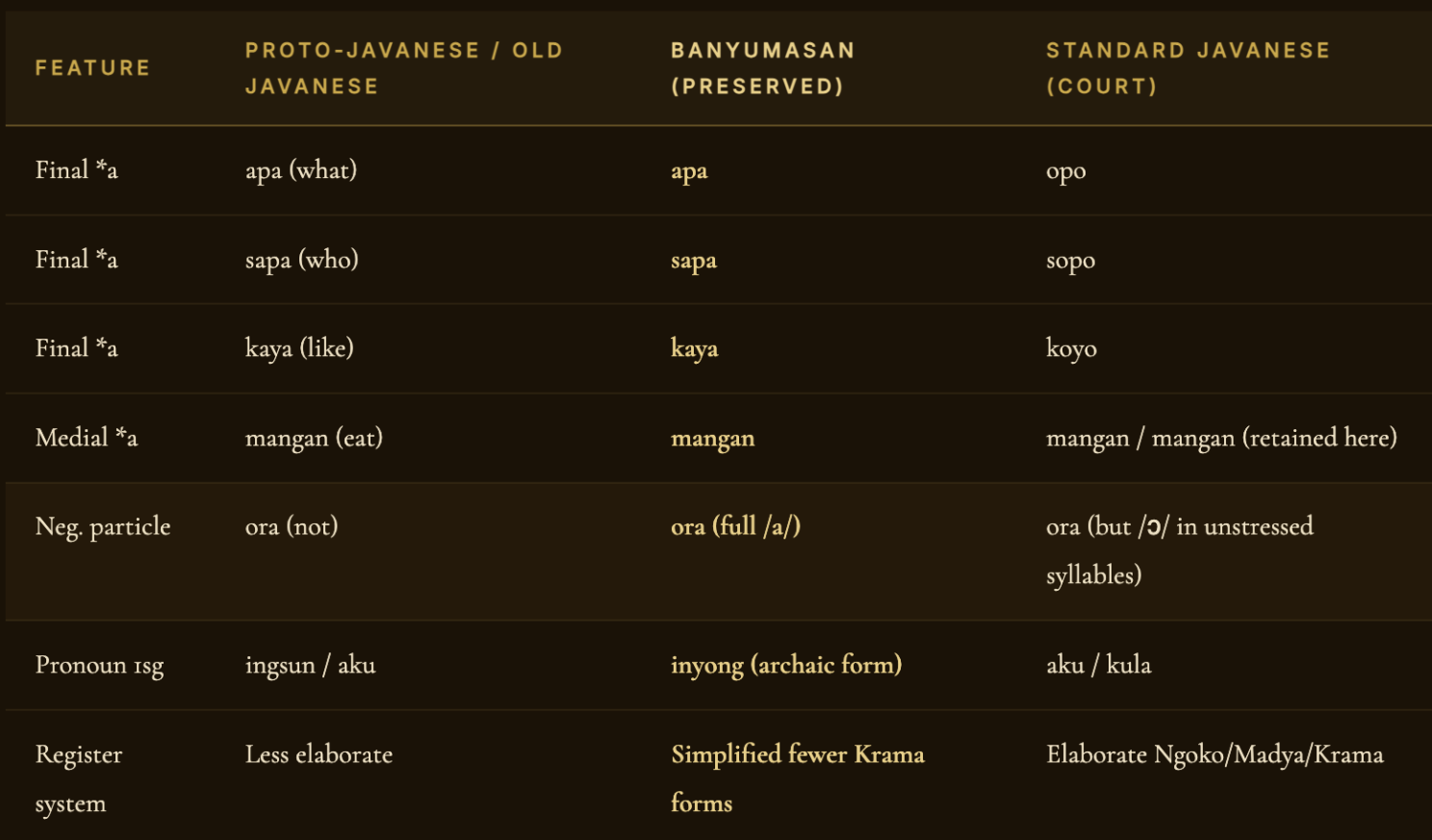
The first-person pronoun inyong used in Banyumasan is particularly revealing. It is a direct reflex of Old Javanese ingsun (which itself derives from a Proto-Austronesian root cognate with the Old Malay ingsun/isun), following regular sound changes in the western dialect zone. Standard Javanese replaced this with aku (the informal register) or kula (the formal Krama register, borrowed from Sanskrit kula, "family/clan"). The Banyumasan preservation of inyong is thus a direct phonological fossil of the pre-Islamisation Javanese of the Majapahit era.
Banyumasan is not a degraded or rustic Javanese. It is an older Javanese a window into what the language of Majapahit's farming villages sounded like before the courts of Mataram remade the phonological world.
Wedhawati et al., Tata Bahasa Jawa Mutakhir (2006)
1600 – 1942 CE
Colonial Encounter Dutch, Print, and the Codification of Javanese
The Dutch East India Company (VOC) and its successor, the colonial Netherlands Indies administration, had a complex and ultimately transformative relationship with Javanese. On one hand, Dutch administrators learned Javanese and produced the first systematic grammars and dictionaries of the language works like Roorda van Eysinga's Javaansche Woordenboek (1835) and Gericke and Roorda's Javaansch-Nederlandsch Handwoordenboek (1901) codified what colonial philology understood as "standard" Javanese, invariably privileging the Central Javanese court dialect of Surakarta and Yogyakarta.
The introduction of the printing press in the 19th century accelerated standardisation. Lithographed editions of tembang texts and the newspaper Bromartani (founded 1855 one of the earliest Javanese-language periodicals) disseminated the Surakarta orthographic and lexical norm across literate Java. The Hanacaraka script was also partially romanised during this period, eventually producing the romanised Javanese orthography still used today.
The Register System (Speech Levels) A Colonial-Era Codification
Javanese's famous tingkat tutur (speech levels) Ngoko (intimate/low), Madya (middle), and Krama (formal/high), with further subdivisions including Krama Inggil (exalted Krama) and Krama Desa (village Krama) had roots in the feudal court hierarchies of Mataram. But their codification into a system with explicit rules was partly a product of colonial-era philology and the standardising work of Surakarta court scholars such as Ranggawarsita (1802–1873). Dutch linguists and Javanese pujangga collaborated, consciously or not, in producing a highly elaborated diglossia that would mark Javanese as among the world's most sociolinguistically complex languages.
Independence, Indonesian, and the Digital Tongue
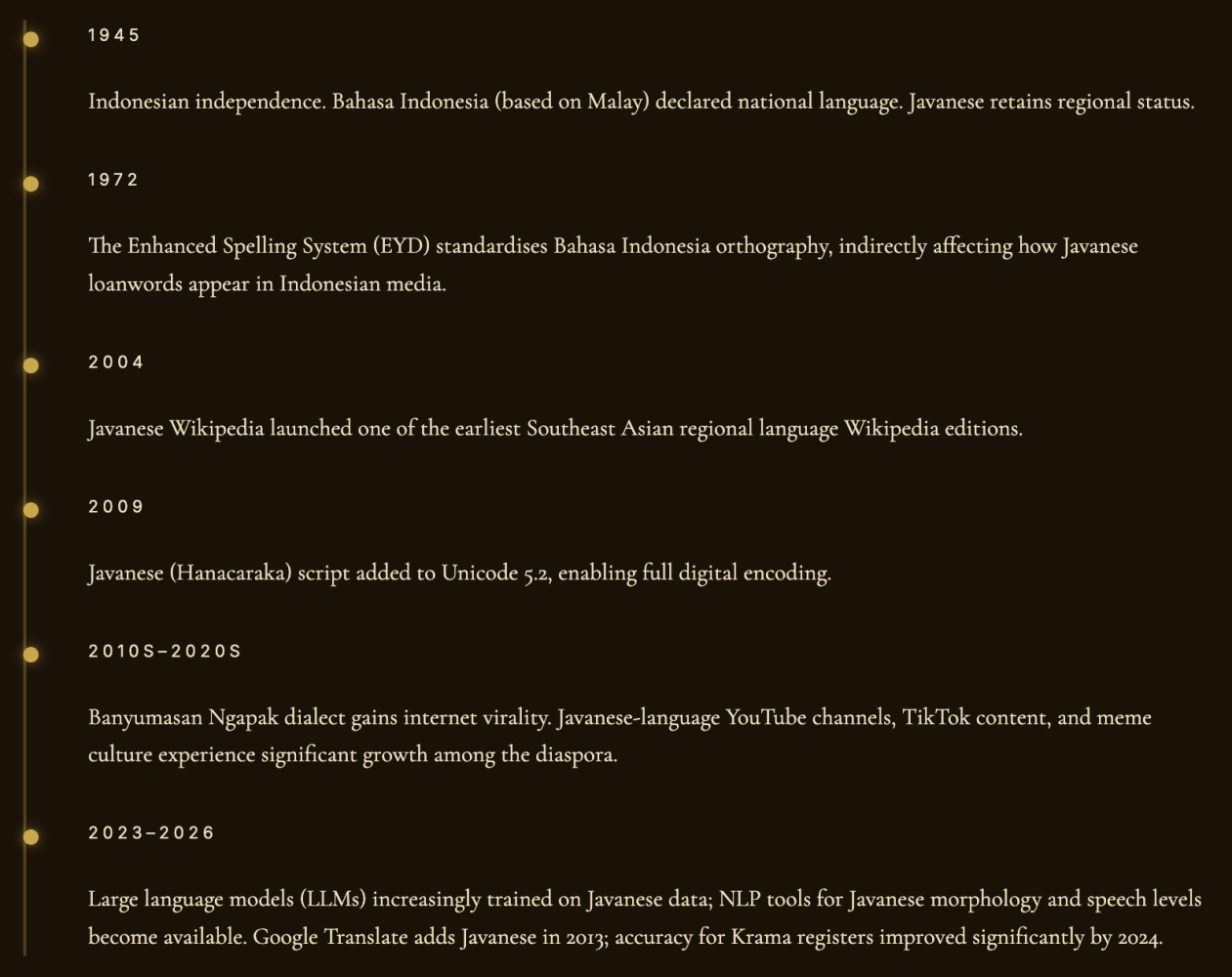
Indonesian independence in 1945 placed Javanese in a paradoxical position. The founders of the Republic deliberately chose Malay rebranded as Bahasa Indonesia as the national language precisely because it was not Javanese: making Javanese the national language of a multiethnic republic would have appeared to impose Javanese cultural hegemony on Sundanese, Batak, Balinese, Papuan, and hundreds of other peoples. The decision was constitutionally correct and politically wise, but it meant that Javanese the mother tongue of over 40% of Indonesia's population at independence was demoted to a regional language without official national status.
The consequence has been generational language shift. Educated Javanese born after 1960 are typically more fluent in Indonesian than in Javanese, and competence in the Krama register has declined sharply. Studies in the 1990s–2000s found that fewer than 20% of young urban Javanese in cities like Surabaya and Semarang could sustain a conversation in Krama Inggil.
Javanese in the Digital Age Revival and Transformation
The internet and social media have produced an unexpected partial revival. Online Javanese communities use a colloquial, heavily Indonesian-influenced Javanese particularly the Ngoko register in text messaging, Twitter/X posts, YouTube comments, and TikTok captions. Memes in Javanese, particularly in the Banyumasan Ngapak dialect, have become a distinct genre of Indonesian internet culture, ironically giving the "rustic" dialect a hip digital cachet it never had in print culture.
The Hanacaraka script was encoded in Unicode (U+A980–U+A9DF for Javanese script) in 2009, enabling its use in digital environments. Several grassroots efforts including Wikimedia's Javanese Wikipedia (jv.wikipedia.org, founded 2004) and the Ngoko Javanese keyboard app are working to extend digital literacy in the language. However, the script itself is endangered: surveys suggest fewer than 5% of contemporary Javanese speakers can read Hanacaraka fluently.
Synthesis
The Unbroken Thread What Six Millennia of Javanese Tells Us
The Javanese language is, in the deepest sense, a palimpsest: each layer of history has left traces on the one beneath it without fully erasing what came before. The Austronesian skeleton the pronouns, the kinship terms, the body-part vocabulary, the verb-focus morphology survives intact beneath five thousand years of accretion. The Sanskrit quarry of the Kawi poets is still visible in philosophical vocabulary (dharma, karma, bhumi). The Persian and Arabic loans that Islam brought (sholat, kitab, dunyo) sit alongside indigenous terms without displacing them. And in the corners of the Serayu valley, in the mouths of grandmothers in Banyumas and Cilacap, the vowels of Majapahit still resound a phonological thread connecting the present to the world before the keraton learned to say ⟨o⟩.
The language's future is uncertain in its specifics but consistent with its past: adaptive, absorptive, and ultimately resilient. Languages spoken by 100 million people do not easily die. They transform.
Sapa kang bisa ngilangake basa, ngilangake bangsa. He who can erase the language, erases the people.
Javanese proverb
#Javanese #Linguistics #Austronesian #Indonesia #LanguageHistory #Majapahit #CulturalHeritage #JavaneseCulture #Nusantara #SultanAgung #Banyumas #DigitalHeritage
References
- Adelaar, K. A. (1992). Proto-Malayic: The Reconstruction of Its Phonology and Parts of Its Lexicon and Morphology. Canberra: Pacific Linguistics, Australian National University.
- Bellwood, P. (1991). The Austronesian dispersal and the origin of languages. Scientific American, 265(1), 88–93.
- Blust, R. A. (1999). Subgrouping, circularity and extinction: Some issues in Austronesian comparative linguistics. In E. Zeitoun & P. J.-K. Li (Eds.), Selected Papers from the Eighth International Conference on Austronesian Linguistics (pp. 31–94). Taipei: Academia Sinica.
- Blust, R. A., & Trussel, S. (2010–2024). Austronesian Comparative Dictionary. Online resource. Retrieved from https://www.trussel2.com/acd/
- Florida, N. K. (1995). Writing the Past, Inscribing the Future: History as Prophecy in Colonial Java. Durham: Duke University Press.
- Gonda, J. (1973). Sanskrit in Indonesia (2nd ed.). New Delhi: International Academy of Indian Culture.
- Hooker, M. B. (Ed.). (1988). Islam in South-East Asia. Leiden: E. J. Brill.
- Keraf, G. (1984). Linguistik Bandingan Historis. Jakarta: Gramedia.
- Kumar, A. (1980). Javanese court society and politics in the late eighteenth century: The record of a lady soldier. Indonesia, 29, 1–46.
- Nothofer, B. (1975). The Reconstruction of Proto-Malayo-Javanic. The Hague: Martinus Nijhoff.
- Pigeaud, T. G. Th. (1960–1963). Java in the 14th Century: A Study in Cultural History (5 vols.). The Hague: Martinus Nijhoff. [Critical edition of the Nāgarakṛtāgama]
- Prapañca, Mpu. (1995). Desawarnana (Nagarakrtagama). Trans. S. Robson. Leiden: KITLV Press.
- Reid, A. (1988). Southeast Asia in the Age of Commerce 1450–1680, Vol. 1: The Lands Below the Winds. New Haven: Yale University Press.
- Ricklefs, M. C. (2001). A History of Modern Indonesia since c. 1200 (3rd ed.). Stanford: Stanford University Press.
- Ricklefs, M. C. (2006). Mystic Synthesis in Java: A History of Islamization from the Fourteenth to the Early Nineteenth Centuries. Norwalk: EastBridge.
- Robson, S. O. (1983). Kakawin reconsidered: Appreciation and the work of art. Bijdragen tot de Taal-, Land- en Volkenkunde, 139(4), 291–319.
- Soepomo, P. (1977). Old Javanese Poetry. In P. Soepomo (Ed.), Prisma. Jakarta: LP3ES.
- Subroto, D. E., Dwirahardjo, M., & Arumi, K. (Eds.). (2008). Bahasa Jawa Dialek Banyumas. Solo: Universitas Sebelas Maret Press.
- Sumarsam. (1995). Gamelan: Cultural Interaction and Musical Development in Central Java. Chicago: University of Chicago Press.
- Tantular, Mpu. (2009). Sutasoma. Trans. T. Santosa. Jakarta: Yayasan Obor Indonesia.
- Uhlenbeck, E. M. (1964). A Critical Survey of Studies on the Languages of Java and Madura. The Hague: Martinus Nijhoff.
- Wedhawati, W., Nurhayati, E., Setiyanto, E., Marsono, Suwadji, & Wirawati, W. (2006). Tata Bahasa Jawa Mutakhir (Edisi Revisi). Yogyakarta: Kanisius.
- Wolff, J. U. (2010). Proto-Austronesian Phonology with Glossary (2 vols.). Ithaca: Cornell Southeast Asia Program Publications.
- Zoetmulder, P. J. (1974). Kalangwan: A Survey of Old Javanese Literature. The Hague: Martinus Nijhoff.
- Zoetmulder, P. J., & Robson, S. O. (1982). Old Javanese–English Dictionary (2 vols.). The Hague: Martinus Nijhoff.
- Badan Pengembangan dan Pembinaan Bahasa (Language Development and Cultivation Agency). (2021). Kamus Besar Bahasa Indonesia Daring (KBBI V). Jakarta: Kemdikbud. https://kbbi.kemdikbud.go.id
- Ethnologue. (2024). Javanese. In Ethnologue: Languages of the World (27th ed.). Dallas: SIL International. https://www.ethnologue.com/language/jav/