
The voyage happened. The log was never kept. By Rahmat Wibowo From Infraloka
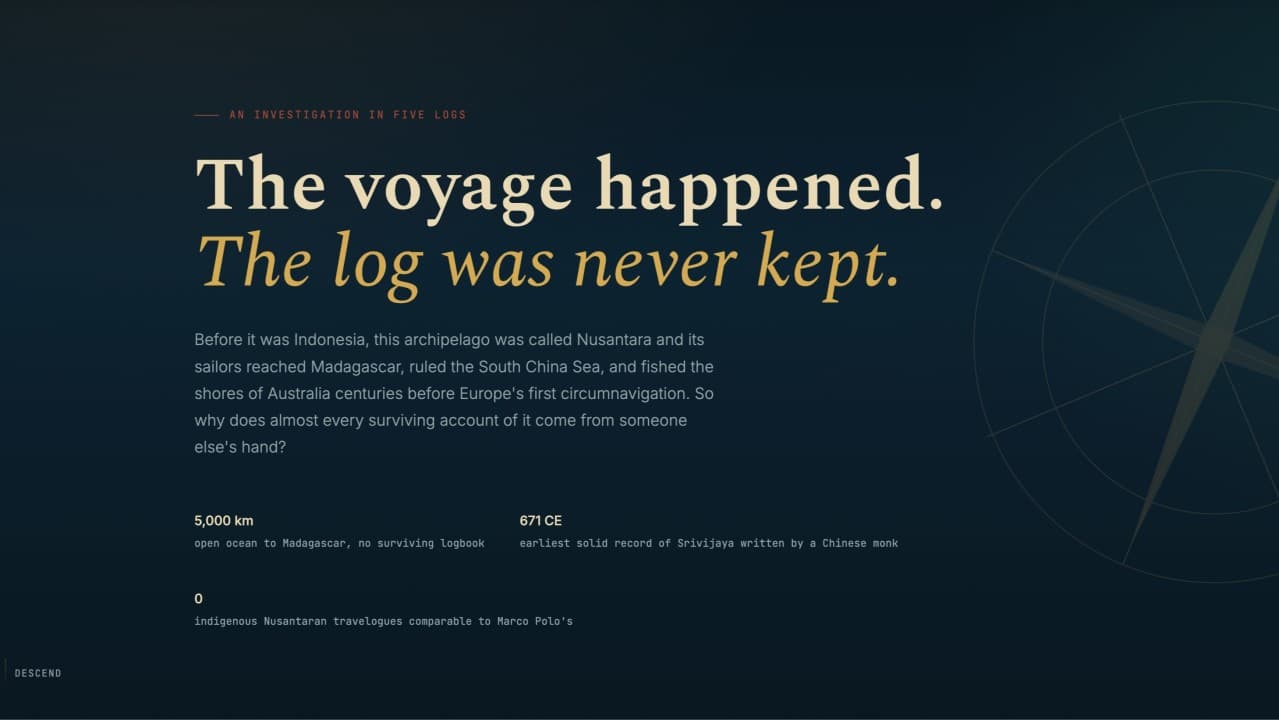
Before it was Indonesia, this archipelago was called Nusantara and its sailors reached Madagascar, ruled the South China Sea, and fished the shores of Australia centuries before Europe's first circumnavigation. So why does almost every surviving account of it come from someone else's hand?
We know the ships sailed. We just don't have their diaries.
This isn't a folk claim. It's reconstructed from linguistics, genetics, archaeology, and rock art disciplines that don't need a single Nusantaran sentence to prove the voyages happened.
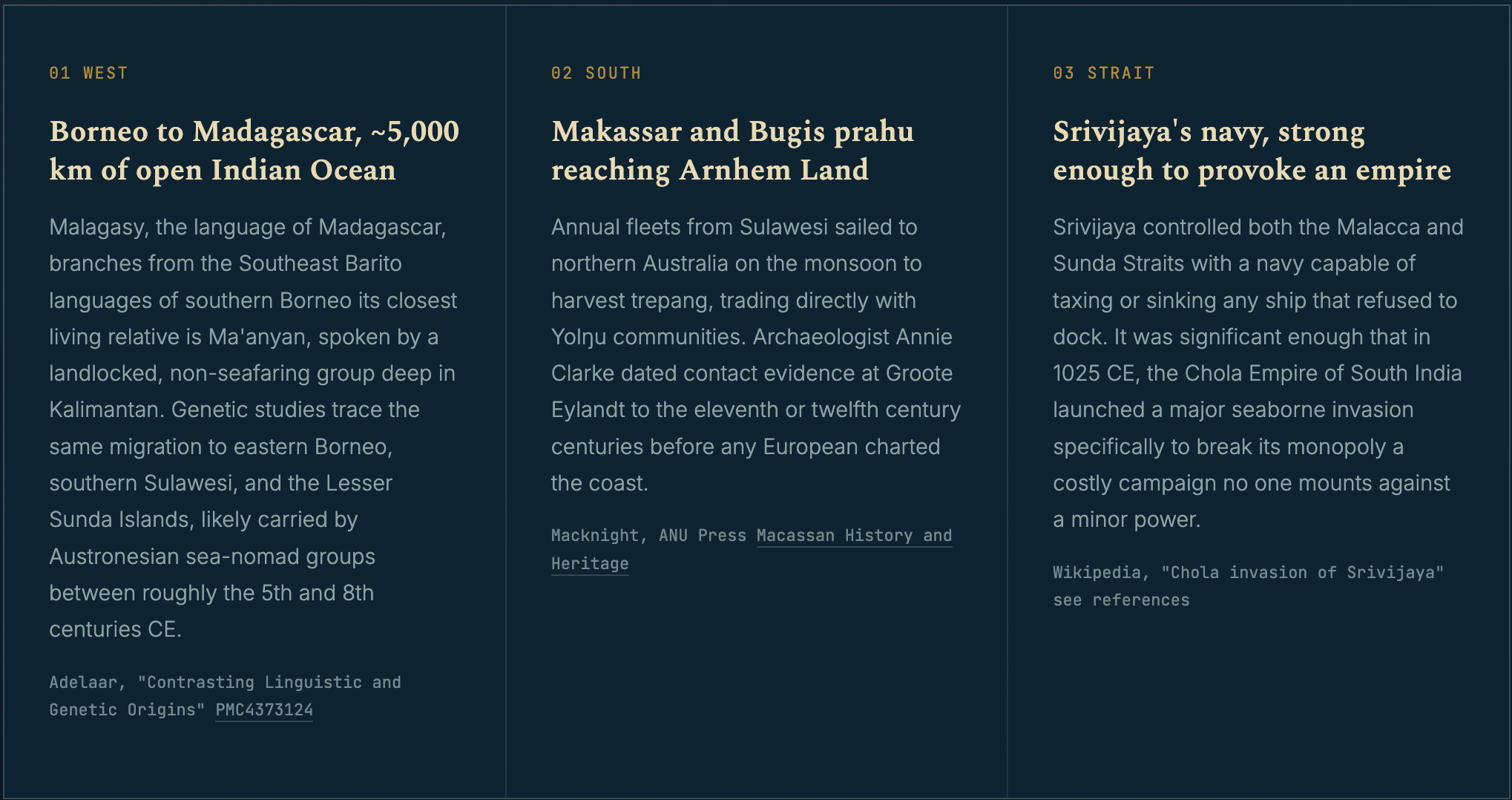
"The lack of any historical record of their occurrence suggests that the journey, or series of journeys, happened a very long time ago" scholars describe the Madagascar crossing not because there's no proof, but because the proof left no paper trail at all.
summarising linguistic and genetic consensus on the Borneo–Madagascar migration
Even Srivijaya's birth certificate was written by a visitor.
The earliest solid documentary proof that Srivijaya existed at all does not come from Srivijaya. It comes from a Chinese Buddhist monk who happened to stop there on his way to India.
Yijing (I-Tsing) left Guangzhou in 671 CE on a Persian merchant ship, bound for the great Buddhist university at Nalanda. After roughly three weeks at sea he landed at Palembang, the heart of Srivijaya, and stayed six months learning Sanskrit and Malay before continuing his journey. He returned years later, ran out of paper and ink mid-translation, sailed back to China just to restock supplies, and came back to finish the job. His travel record, A Record of the Buddhist Religion as Practised in India and the Malay Archipelago, remains one of the principal sources historians use to date and describe Srivijaya at all.
He wrote that the kingdom's fortified capital held more than a thousand Buddhist monks "whose minds are bent on learning and good practice," and advised Chinese pilgrims to study there before attempting India. Srivijaya, in other words, was significant enough to teach the empire that ended up writing its history.
Source: Takakusu (trans.), A Record of the Buddhist Religion (A.D. 671–695), Oxford: Clarendon Press, 1896 · Encyclopedia of Buddhism, "Yijing"
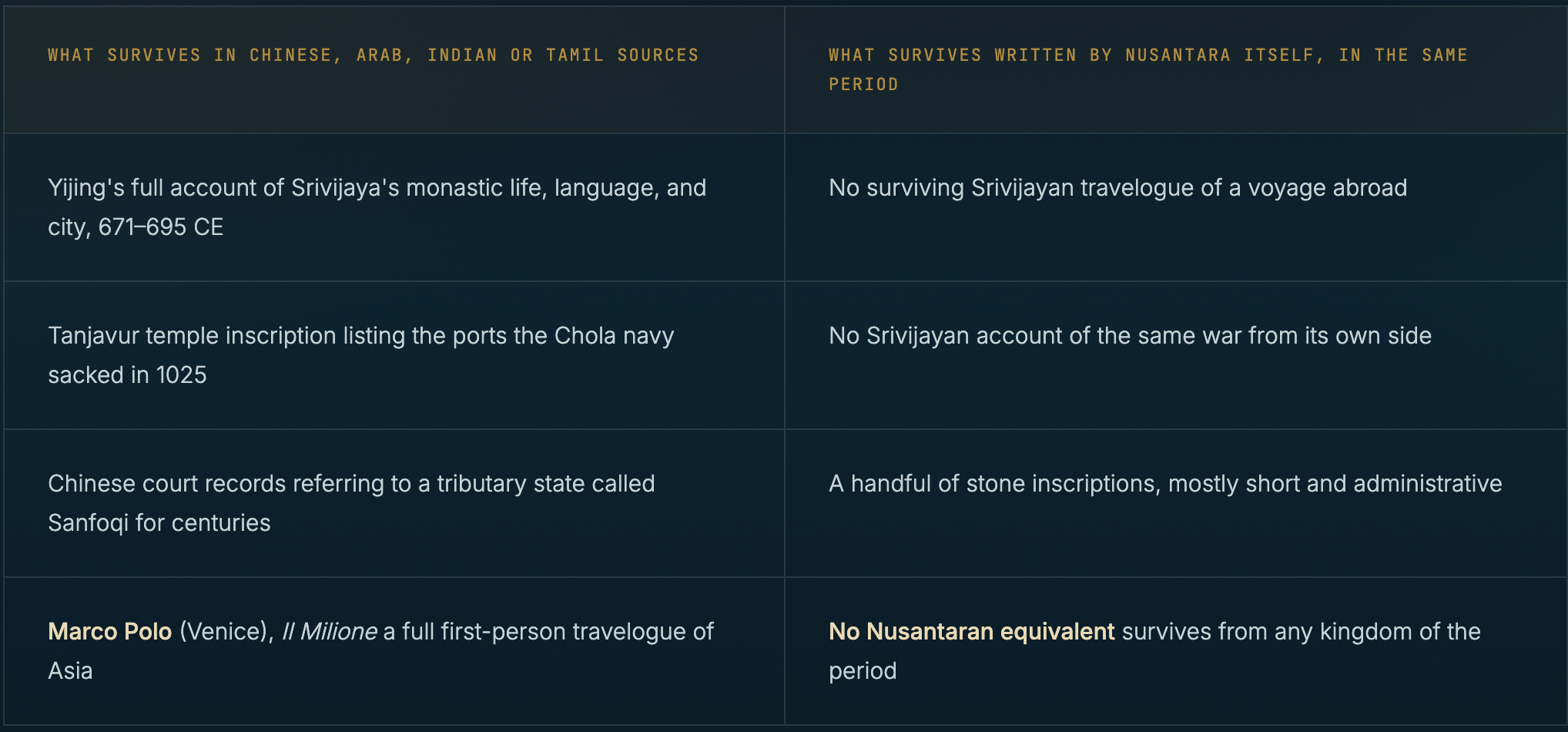
So why is the archipelago that produced this maritime power so quiet on paper?
Four causes compound each other. None of them is "Nusantarans couldn't write." All of them are about what survives a thousand years in the tropics, and who had a reason to write things down in the first place.
1. The medium betrayed the message
Most regional writing was incised into palm leaf lontar not pressed into paper. Properly oiled and recopied, lontar can survive centuries; neglected even briefly, it crumbles to insects, fungi, and humidity within a human lifetime. Indonesia's climate is one of the worst environments on earth for organic media to outlast its writer.
2. Oral transmission was the trusted archive
Genealogy, law, navigation knowledge, and royal history were carried as recited and sung tradition babad, hikayat performance, sailors' wind-lore passed master to apprentice. This wasn't a failure to develop writing; it was a deliberate, working information system that didn't require leaves that rot.
3. Writing served ritual and law, not travel narrative
Surviving Old Javanese and Old Malay inscriptions are land grants, boundary markers, and religious dedications durable stone and copper for things that needed permanence. A merchant's voyage to India was valuable knowledge, but it wasn't the kind of fact anyone carved into a temple wall.
4. The recorders had their own incentive to record
Tang China kept tribute logs because tribute mattered to the imperial court. Chola Tamil inscriptions commemorated a king's conquest. Arab geographers wrote trade itineraries for merchants planning the next voyage. Nusantara was the destination in all of these stories which meant someone else always had a reason to write the visit down, and Nusantara's own reason to record a routine, repeated voyage was comparatively weak.
It isn't total silence. It's a thin signal under heavy static.

Indigenous sources do exist, and they matter. The Nagarakretagama (1365), composed by the court poet Prapanca, names the maritime territories under Majapahit's reach and describes its trade relations with "Yawana" and beyond. The Sejarah Melayu (Malay Annals) preserves oral-historical material about Srivijaya, Malacca, and the wider trading world, compiled centuries after the events it describes. The lontara of the Bugis and Makassarese attoriolong, the history-keeping texts recorded genealogy, law, and seafaring knowledge in their own Lontara script for generations, some of which survive today.
What's largely missing is the specific genre Marco Polo represents: a long, first-person, eyewitness account of foreign lands written by someone who went there and meant the account to last. Nusantara has court chronicles, law codes, and religious texts. It has comparatively little outward-facing travel writing surviving in its own languages from its own ships.
The relief carvings at Borobudur (9th century) come closest to a visual record: detailed depictions of the outrigger ships that plausibly carried these voyages, carved in stone precisely because stone, unlike a leaf, was built to outlast the people who made it.
The absence of a logbook is not the absence of a voyage.
A people can be erased from the historical record in two very different ways: by never doing the thing, or by doing the thing and losing the proof to rot, war, and the long habit of letting other empires hold the pen. The genetic trail to Madagascar, the rock art at Groote Eylandt, the Tanjavur inscription, and Yijing's six months in Palembang all point the same direction toward an archipelago that was sailing further and trading harder than its surviving paperwork ever let on.
The honest version of Nusantara's maritime history isn't "we have no evidence." It's "our evidence survived in everyone else's archive, in stone instead of leaf, and in the sea floor instead of a library" and reconstructing it properly means reading Tamil, Chinese, and Arab sources as carefully as we read our own.
#Nusantara #IndonesianHistory #MaritimeHistory #Srivijaya #Majapahit #Austronesian #SoutheastAsianHistory #Indonesia #HistoricalResearch #Sailors
References consulted
Takakusu, J. (trans.), A Record of the Buddhist Religion as Practised in India and the Malay Archipelago (A.D. 671–695), Oxford: Clarendon Press, 1896 Rare Books Society of India digitised edition
Encyclopedia of Buddhism, "Yijing" biography and account of his time in Srivijaya
Adelaar, K.A., "Contrasting Linguistic and Genetic Origins of the Asian Source Populations of Malagasy," PLOS ONE PMC4373124
Pierron, D. et al., "Genome-wide evidence of Austronesian-Bantu admixture and cultural reversion in a hunter-gatherer group of Madagascar" PMC4870696
Macknight, C.C., "Macassan History and Heritage: Voyage, Encounter and Resonance," ANU Press read online
Museums Victoria, "Aboriginal People & Trade" Macassan–Yolŋu contact and rock art evidence at Groote Eylandt
National Museum of Australia, "Trade with the Makasar"
Wikipedia, "Chola invasion of Srivijaya" Tanjavur inscription and 1025 CE campaign
Wikipedia, "Srivijaya" naval power and decline after 1025
Wikipedia, "Palm-leaf manuscript" survival timescales and tropical decay
Inside Indonesia, "Palm-leaf manuscripts in today's Bali"
IIAS, "DREAMSEA: digital repository of endangered manuscripts in Southeast Asia"
Wikipedia, "Lontara" Bugis-Makassar palm-leaf manuscript tradition
ResearchGate, "Nusantara: History of a Concept" on the term's appearance in the 1365 Nagarakretagama
RSIS International, "The Dynamism of Classical Nusantara Historiography" on the scarcity of indigenous classical-era sources