
Think Like Amazon: 5 Ideas That Will Rewire How You Lead By Rahmat Wibowo From Infraloka
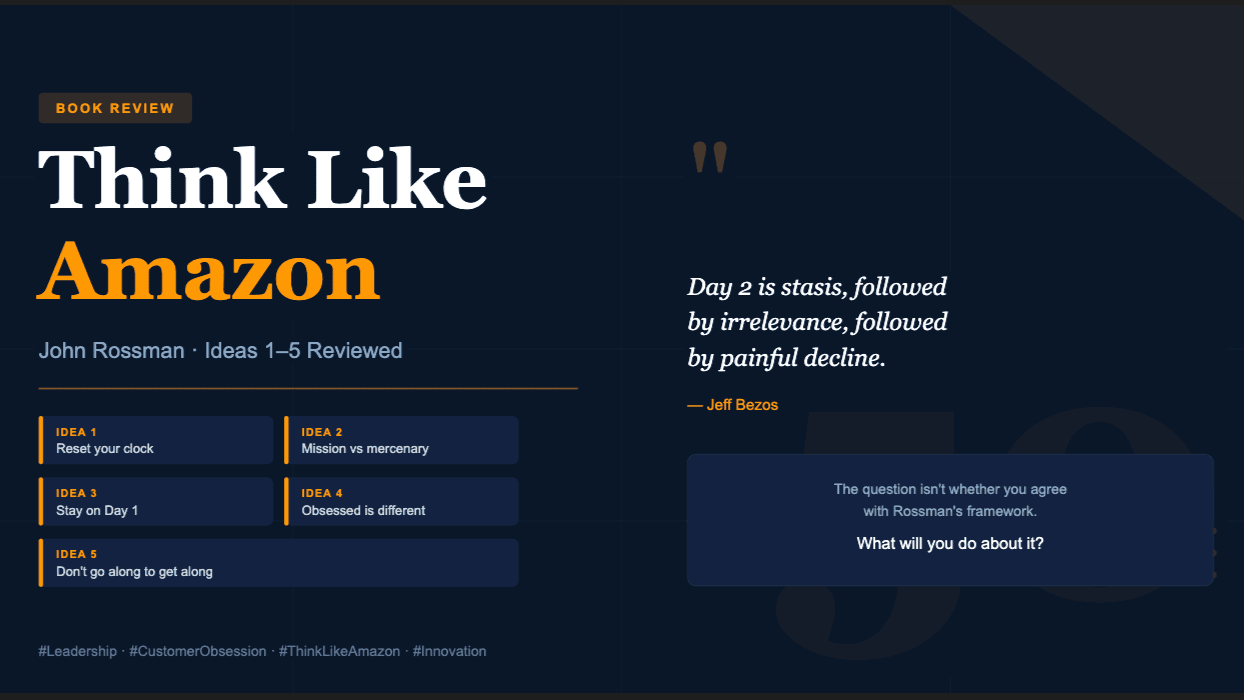
A Review of John Rossman 's Think Like Amazon — Ideas 1 through 5
There are business books that entertain, and there are business books that make you uncomfortable in the best possible way. John Rossman an's Think Like Amazon: 50½ Ideas to Become a Digital Leader belongs firmly in the second category.
Rossman is no armchair theorist. As a former Amazon executive, he was in the room where some of the most consequential business decisions of the last two decades were made. His book distills the operating philosophy of one of the world's most relentlessly effective companies into 50½ concrete, actionable ideas. What makes it remarkable is that these aren't just Amazon's secrets — they are a mirror held up to your own organization, asking an uncomfortable question: Are you actually serious about this?
Let's dig into the first five ideas, because they set the philosophical foundation for everything that follows.
Idea 1: Reset Your Clock
The first idea is deceptively simple and brutally honest: most organizations are operating on the wrong timeframe.
Rossman argues that the clock running inside most companies is tuned to quarterly earnings, annual planning cycles, and short-term incentive structures. Amazon, by contrast, operates on a multi-year — sometimes decade-long — clock. Jeff Bezos famously told shareholders in Amazon's very first annual letter that if they were looking for quarterly results, they were in the wrong place.
Resetting your clock doesn't mean ignoring short-term performance. It means understanding that the decisions you make today about infrastructure, talent, culture, and customer relationships are investments that compound over years — not quarters. The discomfort? Most leaders say they think long-term, but their calendar, their metrics, and their incentive structures tell a very different story.
Ask yourself: What is your organization's effective planning horizon — not on paper, but in practice? If your key decisions are driven by the next earnings call, your clock needs a reset.
Idea 2: Mercenary or Mission-Driven?
This idea cuts right to the heart of organizational identity. Rossman draws a sharp line between companies that exist primarily to generate returns, and companies that are genuinely animated by a mission larger than profit.
Amazon's mission — to be Earth's most customer-centric company — is not marketing copy. It is a decision-making framework. When two paths diverge, the question "which one is better for the customer?" is a genuine north star, not a tiebreaker pulled out when convenient. Mission-driven organizations attract different talent, make different trade-offs, and build different cultures than mercenary ones.
Now, here's the nuance Rossman doesn't shy away from: being mission-driven does not mean being unprofitable. Amazon has been extraordinarily profitable. The mission creates alignment, and alignment creates execution efficiency that mercenary organizations — with their fractured priorities — simply cannot match. Profit is the fuel; the mission is the engine.
Ask yourself: Can every person in your organization articulate your mission — and do their daily decisions actually reflect it? Or does the mission live only on the lobby wall?
Idea 3: Move Forward to Get Back to Day 1
This idea references one of Bezos's most celebrated concepts: "Day 1." Day 1 is the mindset of a startup — hungry, paranoid, customer-obsessed, unencumbered by legacy thinking. Day 2, in Bezos's formulation, is "stasis, followed by irrelevance, followed by excruciating, painful decline, followed by death."
The threat of Day 2 is not external competition. It is internal complacency. It is the moment an organization mistakes process for purpose — when following the established playbook becomes more important than questioning whether the playbook still serves the customer. Bureaucracy is the natural enemy of Day 1.
Rossman's key insight here is that moving forward is how you stay on Day 1. You cannot maintain the Day 1 spirit by being cautious or protective of what you've built. You maintain it by continuing to invent, to experiment, and to be willing to cannibalize your own business before someone else does.
This is not comfortable for mature organizations. It requires leaders who actively resist the gravitational pull of "the way we've always done it."
Ask yourself: Where in your organization has process replaced purpose? Where are you defending yesterday's model instead of building tomorrow's?
Idea 4: Obsessed Is Different
Customer focus is everywhere. Customer obsession is rare.
Rossman makes this distinction with precision. Most companies are customer-focused in the sense that they track satisfaction scores, run surveys, and respond to complaints. Amazon is customer-obsessed in the sense that it starts every product, every service, and every initiative from the customer's point of view — and works backward. The famous "Working Backwards" process at Amazon begins with writing the press release for a product before a single line of code is written. If you can't articulate why a customer would love this, you shouldn't build it.
The word "obsessed" matters because it implies a level of intensity that most organizations are actually uncomfortable with. Obsession means your customer's problem keeps you up at night. It means you study them, follow them, argue on their behalf inside your own company, and refuse to accept "good enough" when "excellent" is achievable. It means the customer has a seat in every meeting — even when they're not physically present.
Ask yourself: In your last five major decisions, at what point did the customer's perspective enter the room? Was it the starting point, or an afterthought?
Idea 5: Don't Go Along to Get Along
This may be the most culturally challenging idea of the five — and perhaps the most important.
Rossman describes Amazon's culture as one of "productive friction." Amazonians are expected to disagree, and to disagree loudly. There is even a formal leadership principle: "Have Backbone; Disagree and Commit." The expectation is that you voice your disagreement clearly, advocate for your position with data and reasoning — and then, once a decision is made, you commit to it fully. What is not acceptable is silent capitulation: nodding in the meeting and undermining the decision afterward, or worse, saying nothing and letting a bad decision proceed unchallenged.
Most organizations, consciously or not, punish disagreement. They reward harmony. They mistake silence for consensus. The result is a culture where bad ideas survive because no one feels safe challenging them — and where the loudest voice in the room, rather than the best argument, wins.
Amazon's antidote is psychological safety paired with high standards. You are expected to push back. You are expected to ask hard questions. And you are expected to do so with data, not politics.
Ask yourself: In your last meeting, how many people in that room had a different view than what was expressed? Why didn't they say it? And what does your answer tell you about your culture?
The Through Line
What strikes me most about these first five ideas is that they are not really about technology, or e-commerce, or scale. They are about organizational character.
Rossman is essentially asking: Do you have the discipline to think long? Do you have the courage to stand for something? Do you have the humility to stay curious? Do you have the empathy to be truly customer-obsessed? And do you have the backbone to tell the truth — and invite others to do the same?
These are not Amazon's secrets. They are timeless leadership principles that Amazon has simply chosen to take more seriously than most.
Think Like Amazon is worth reading in full, and these first five ideas alone are worth a month of leadership team discussions. The question is not whether you agree with Rossman's framework. The question is: what will you do about it?
Have you read Think Like Amazon? Which of these ideas resonates most with where your organization is right now? I'd love to hear your thoughts in the comments.
#Leadership #BusinessStrategy #AmazonWay #ThinkLikeAmazon #OrganizationalCulture #BookReview #CustomerObsession #Innovation