
What Your Birth Order Really Tells You And Why It's Not Just About Personality By Rahmat Wibowo From Infraloka
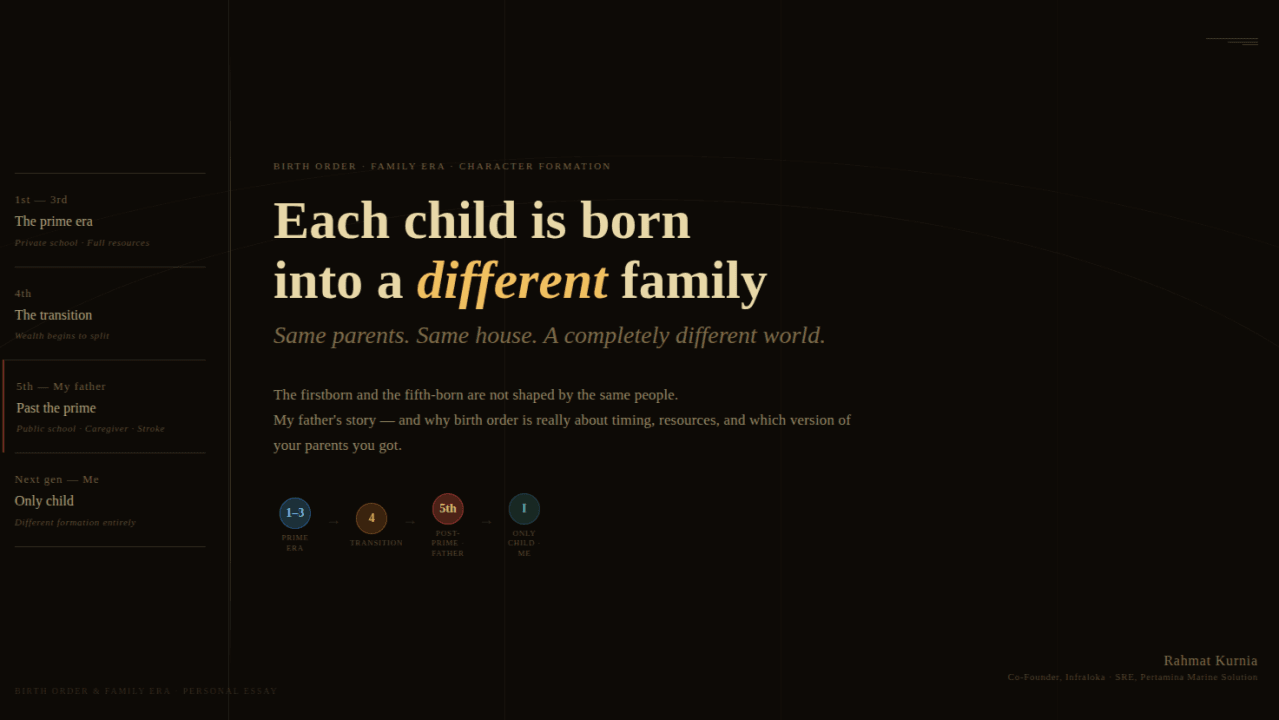
Each child is born into a different family. Same parents, different era, different resources, different version of the people raising them. My father's story proves it.

The invisible variable no one talks about
We love talking about birth order. The firstborn is driven and responsible. The middle child is adaptable, the negotiator. The youngest is free-spirited, a little spoiled. There are hundreds of studies, dozens of books, and countless LinkedIn posts about it.
But almost no one talks about which version of their parents each child actually got — and what era of the family's life they were born into. That changes everything.
"Same parents. Different world. Different children."
My father's story
My father is the fifth child. By the time he arrived, his parents were well past their prime years, financially, physically, and emotionally. He was not born into the same family as his older siblings. Not really.
The first three children were raised during the family's prime era. The parents were young, energetic, and still building. There was money to invest in opportunity. They received private education, the best the family could afford. Those early years shaped people who learned to expect doors to open.
By the time my father reached university age, the family's wealth had already been divided several times over. Not stolen. Not wasted. Simply dispersed, the natural entropy of a large family across years and life events. The money had split. The energy had thinned.
When the caregiving falls on the youngest
And then his parents got sick. His father suffered a stroke just as my father was supposed to be focusing on his studies, building his career, figuring out who he was. Instead, he became a caregiver. Not because he was chose, but because he was there. He was the youngest, the one still at home, the one without yet-established obligations elsewhere.
He attended public school while his older siblings attended private institutions. He carried responsibilities that his older siblings never had to carry at that age. He built resilience not from ambition, but from necessity. His character was forged in a different fire.
This is not a story of resentment. This is a story of how birth order, timing, and family resources create fundamentally different human beings, even within the same bloodline, even with the same parents.
"The firstborn and the fifth-born are raised by two different families who happen to share the same name."
The psychology behind what I observed
Birth order research has consistently shown that firstborns tend to identify with authority, adopt responsibility early, and often achieve conventional markers of success. They were raised by parents who were new to parenting,anxious, attentive, invested. They received undivided attention before siblings arrived.
Later-born children, especially those born long after their siblings, are raised by older, more relaxed, and sometimes more tired parents. But "tired" doesn't mean "less loving." It means the context is simply different. The attention is shared. The resources are stretched. The expectations are calibrated by a family that has already raised several children and no longer treats every milestone as a performance.
What my father's story adds to this picture is the dimension of family economic arc. It is not just about personality. It is about access. The child born during the family's prime has access to private school networks, tutors, and investments in their future. The child born after the prime has access to something else entirely: grit, improvisation, and a kind of independence born from not having a safety net.
And then there's me
I am an only child. My father raised me in a completely different context, one he built deliberately, shaped in part by everything he had experienced as the fifth child. He knew what it meant to be left behind by timing. So he made sure timing would not leave me behind in the same way.
Only children are often studied as outliers, high-achieving but socially different, deeply shaped by adult conversation and parental attention. I won't pretend I understand exactly how my birth position shaped me. But I know that my father's birth position shaped him,and through him, shaped me.
The chain of formation is longer than we think. The personality you carry today was not only shaped by your birth order. It was shaped by your parents' birth order. And their parents' before them.
What this means for how we lead and relate
In professional life, we often treat colleagues as fixed personalities, the natural leader, the quiet one, the difficult one. But behind every personality is a formation story. Behind every person's relationship with authority, resources, responsibility, and belonging is a birth order , and a family era.
When you understand that someone's pattern of behavior might come from being the child who always had to wait, or from being the one who held the family together during a crisis, or from being raised by parents who were already exhausted,empathy becomes less of an effort and more of a natural response.
My father didn't have the same start as his older siblings. But he built something anyway. And the way he built it, quietly, resiliently, without complaint, taught me more about character than any private school curriculum ever could have.
"Not every child is born into the same family. The house is the same. The family is not."
What version of your parents did you grow up with? And how has that shaped the person you became at work, in relationships, and in how you parent, or lea, today?
#BirthOrder#Leadership#FamilyPsychology#PersonalDevelopment#Resilience#Parenting#Empathy#GrowthMindset#LifeLessons#IndonesianStories#Storytelling#ProfessionalGrowth