
When AI Agents Run the Lab: OpenClaw, Harness Engineering, and the Digital Twin Research Frontier By Rahmat Wibowo From Infraloka
Autonomous agents with full computer access are no longer just replacing software engineers. They are about to replace the experimental research pipeline itself, running simulations, forming hypotheses, and discovering solutions we have not yet imagined.
An Agent That Does Not Just Answer, It Acts
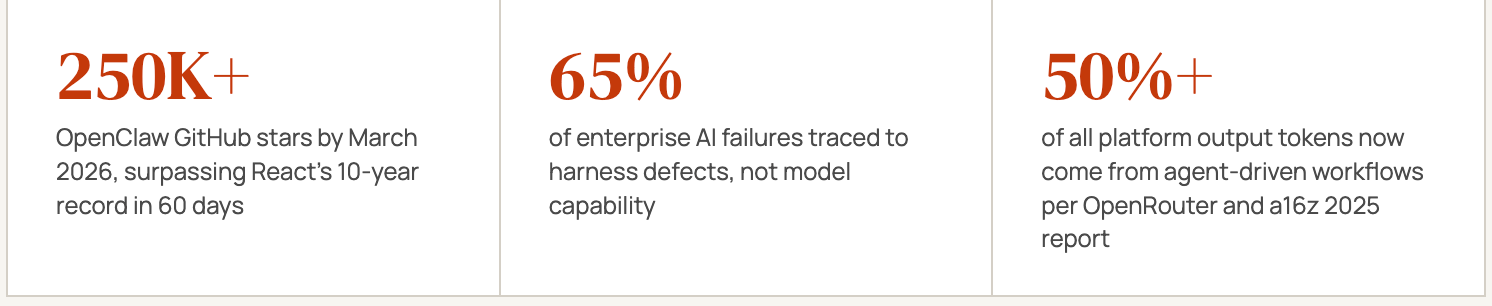
In November 2025, an Austrian developer named Peter Steinberger released a weekend project called Clawdbot. By February 2026, the repository had crossed 100,000 GitHub stars. By March it had surpassed 250,000, breaking a ten-year record held by React, all in sixty days. The world renamed it OpenClaw.
But GitHub stars are a distraction from the more important story. The thing that matters is the structural shift underneath. For the past three years, the AI conversation has been about dialogue: ask a question, receive an answer, copy it into your workflow. OpenClaw collapsed that loop. It acts. It executes shell commands, controls browsers, moves files, sends messages, and picks up where it left off across sessions. The agent remembers. The agent finishes
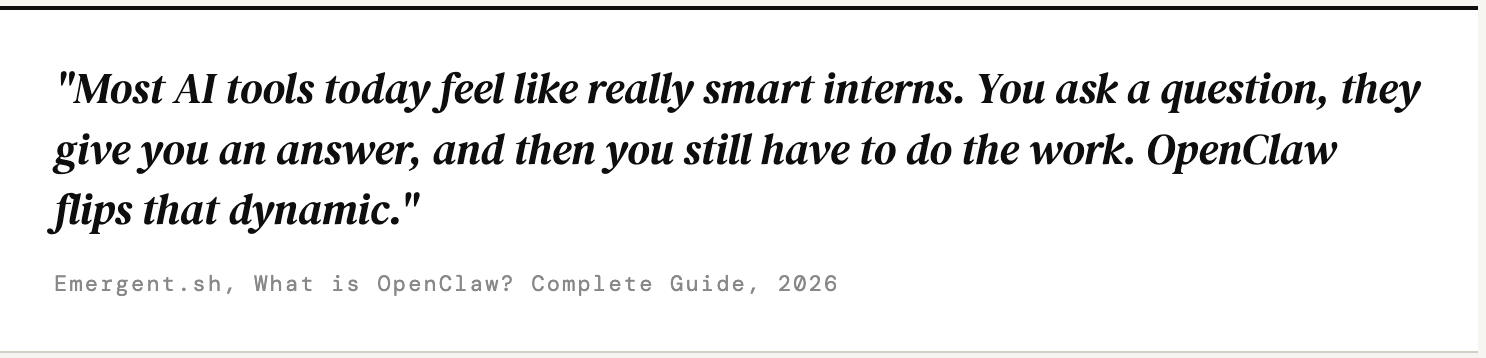
Most commentary has focused on what this means for productivity. Can it book my flights? Can it process my emails? Can it write and deploy my code while I sleep? The answers are yes, yes, and increasingly yes. But I want to argue for something larger. When you combine the action-taking architecture of OpenClaw with the formal engineering discipline now called Harness Engineering, and point that stack at a machine running simulation software, you are not looking at a productivity tool. You are looking at a new kind of scientist.
What Harness Engineering Actually Means
The word "harness" was popularized in February 2026 by Mitchell Hashimoto, co-creator of Terraform. He noticed a habit: every time an AI agent made a mistake in production, he engineered a fix into the agent's surrounding environment rather than adjusting the prompt. He called that "engineering the harness." Within weeks, Anthropic and OpenAI published their own expansions of the concept.
The insight is deceptively simple. An agent is not just a model. An agent is a model plus its harness. And in production systems, the harness, not the model, is the binding constraint on reliability. Research published in April 2026 found that 65 percent of enterprise AI failures trace back to harness defects such as context drift, schema misalignment, and state degradation. In March 2026, the LangChain engineering team moved their coding agent from 30th to 5th on Terminal Bench 2.0 without touching the underlying model at all. They only optimized the harness.
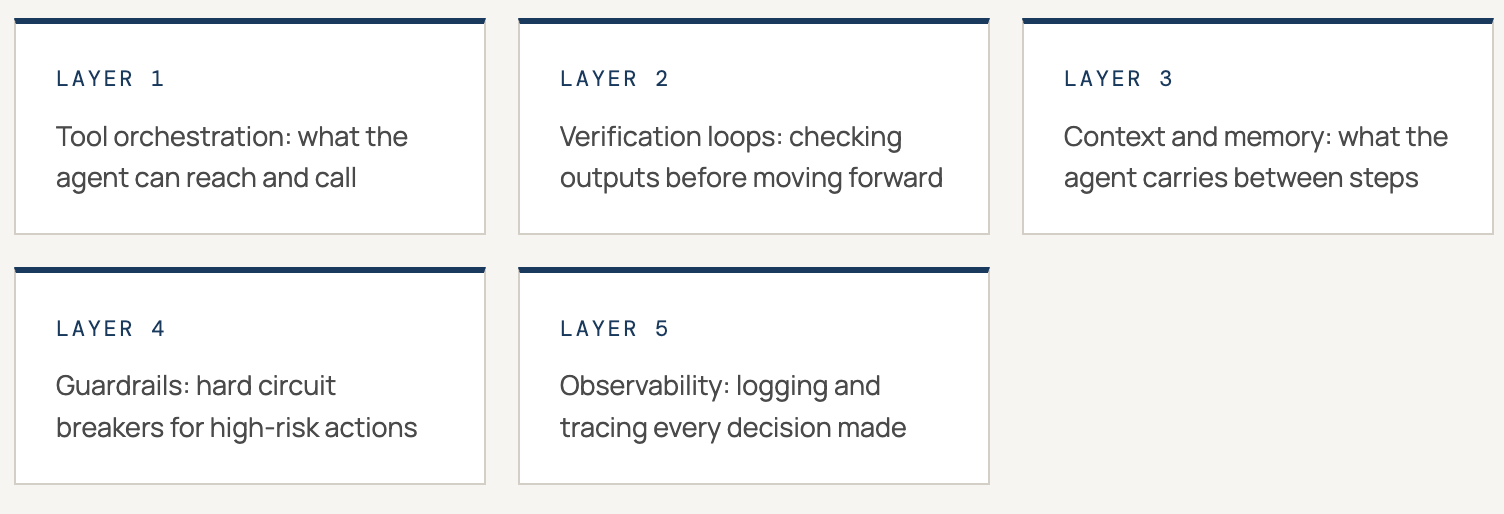
A production-grade harness contains all five of these layers. And crucially, the harness can be specialized. You can build a harness tailored not for booking flights but for running computational fluid dynamics models. For executing molecular dynamics simulations. For iterating finite element analysis across thousands of parameter configurations overnight.
Give the Agent a Computer with Simulation Software. Watch What Happens.
Here is the scenario I want you to sit with. You take an OpenClaw-class agent, you wrap it in a rigorous harness tuned for scientific workflows, and you give it access to a workstation running ANSYS, MATLAB, OpenFOAM, GROMACS, or any domain simulation environment. You give it a research objective. You let it run.
The agent reads the relevant literature. It formulates a hypothesis. It writes the simulation configuration. It runs the simulation. It reads the output. It identifies anomalies. It adjusts parameters. It runs again. It compares results across runs. It detects patterns. It formulates new hypotheses from those patterns. It documents everything. It runs the entire experimental cycle autonomously, across nights and weekends, without fatigue, without cognitive bias from prior investment in a particular result, and with perfect memory of every configuration it has ever tried.
This is not science fiction. Research published in SmartMat in 2026, reviewing autonomous AI agents in scientific settings, documented exactly this kind of behavior: agents autonomously debugging simulation code when errors occurred, maintaining feedback loops between hypothesis formation and execution, and acting as a "universal interface to connect human scientific intent with sophisticated domain-specific tools." The architecture that paper called the AI-driven Virtual Lab is what I am describing here.
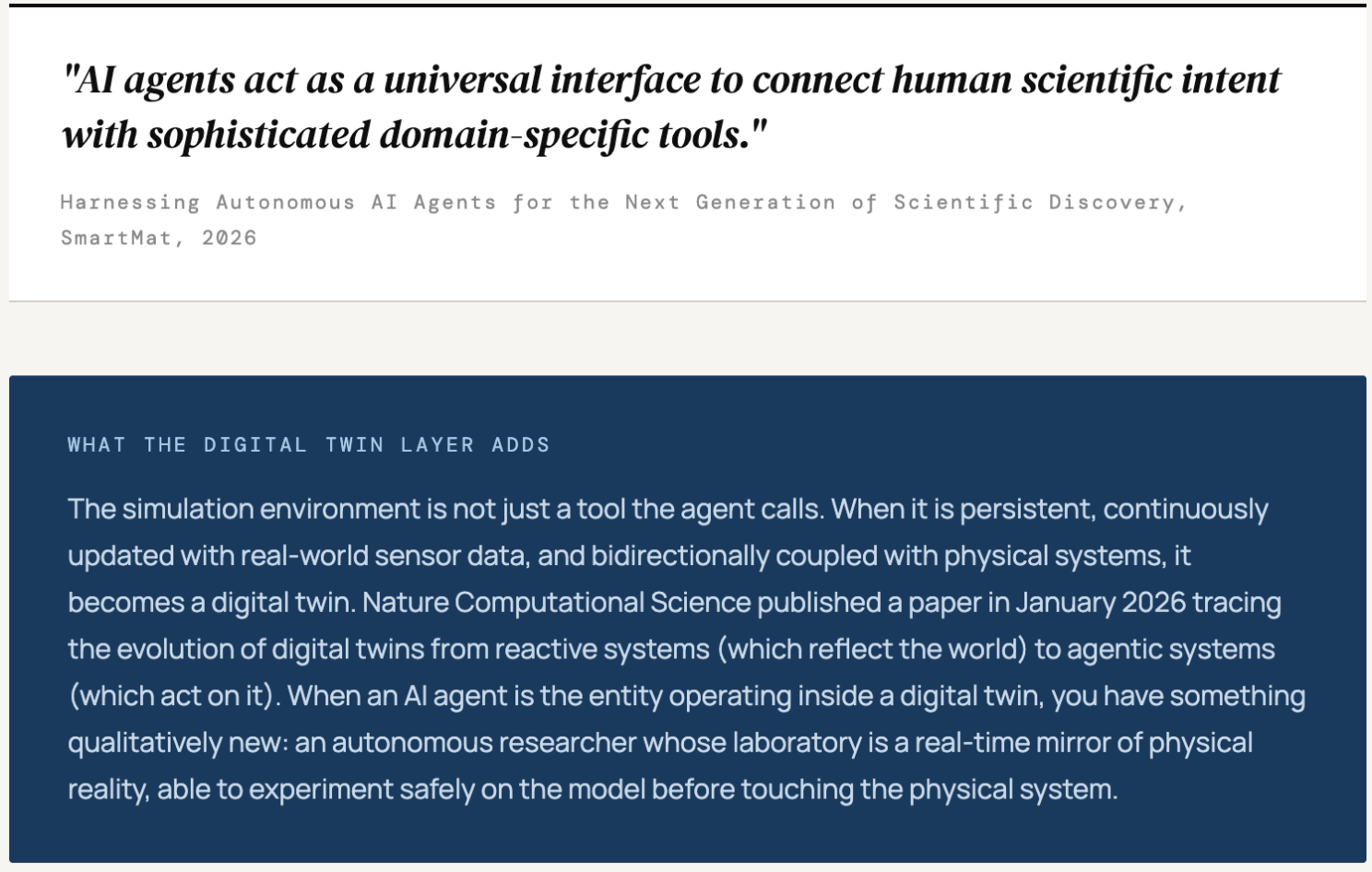
The implications for engineering, drug discovery, climate modeling, structural design, materials science, energy infrastructure, and aerospace are enormous. The traditional research pipeline looks like this: hypothesis formation by humans, experimental design by humans, execution by lab staff and simulation engineers, analysis by postdoctoral researchers, iteration across months. Every one of those steps except the initial framing of the problem is now a candidate for agent automation.
Why This Matters Especially in the Energy and Infrastructure Sectors
My work in site reliability engineering at Pertamina Marine Solution and in AI infrastructure through Infraloka puts me at the intersection of two worlds where simulation has enormous stakes. In energy operations, the cost of a physical experiment is not an afternoon in a lab. It is downtime on a vessel, or a shutdown of a processing unit, or a safety incident. The value of a simulation that can predict failure modes, optimize routing, or test new configurations without touching live infrastructure is not abstract. It is directly measured in avoided costs and lives protected.
Now consider an agent-driven digital twin of a marine vessel operating in real time. The digital twin receives sensor telemetry continuously. The agent monitors it, detects deviations from expected performance models, runs simulation experiments to diagnose the source of deviation, and generates maintenance recommendations before a failure occurs. The traditional pipeline for that process involves human analysts, engineering software operators, and report writers across multiple departments. The agentic pipeline compresses all of that into continuous, automated, documented inference.
The same logic applies to grid management, to supply chain optimization, to pharmaceutical manufacturing, and to structural monitoring of civil infrastructure. Wherever simulation has been the domain of specialized human operators running expensive software on expensive workstations, the agent stack makes that expertise accessible, continuous, and scalable.
Replacement of Software Engineers Was Only the Beginning
The public conversation about AI and jobs has stalled at software engineers. Can AI write code? Yes, increasingly well. Will it replace programmers? The honest answer is: it is already changing what programmers do, and the ones who understand agent orchestration will absorb the work that disappears from those who do not.
But research replacement is the disruption nobody is discussing seriously yet. A research scientist's job, stripped of its human elements, is essentially a loop: read, hypothesize, design experiment, run experiment, analyze results, update hypothesis, repeat. Every node in that loop is executable by a sufficiently capable and well-harnessed agent. The agent does not get tired. It does not resist revising a hypothesis it spent three years defending. It does not have a grant cycle. It does not need a postdoc to run the overnight batch.
What it needs is a well-constructed harness, access to the right simulation tools, grounding in domain-specific context, and a human at the framing level who knows what question is worth asking. The creativity of the initial question, the ethical framing of what experiments are permissible, and the integration of results into institutional knowledge and real-world action: those remain deeply human responsibilities. Everything in between is becoming agentic.
The application layer itself becomes agentic
There is one more dimension worth adding. Simulation software today is built for human users. It has graphical interfaces, menus, documentation written for specialists, and workflows designed around human cognitive bandwidth. When the operator is an agent, none of that architecture is optimal. The agent does not need a menu. It needs an API, a schema, and a specification of what the simulation engine can do.
This means that the simulation application layer itself will be rebuilt for agent consumption. We are already seeing agent-first software design emerge as a category. Tools will expose structured interfaces optimized not for human navigation but for machine instruction. And crucially, the agents themselves will build those interfaces. An OpenClaw-class agent with a well-tuned harness and access to a code execution environment can analyze an existing simulation tool, write wrapper code that abstracts its functionality into a clean API, verify that the wrapper behaves correctly, and document it, all without a human software engineer in the loop.
The simulation software of 2030 will not look like the simulation software of today. It will be thinner, more composable, and designed to be orchestrated by agents. The agents will build parts of it themselves.
The Stack You Need to Build This Today
For engineers and researchers who want to move toward this architecture now, the stack is not theoretical. Its components exist.
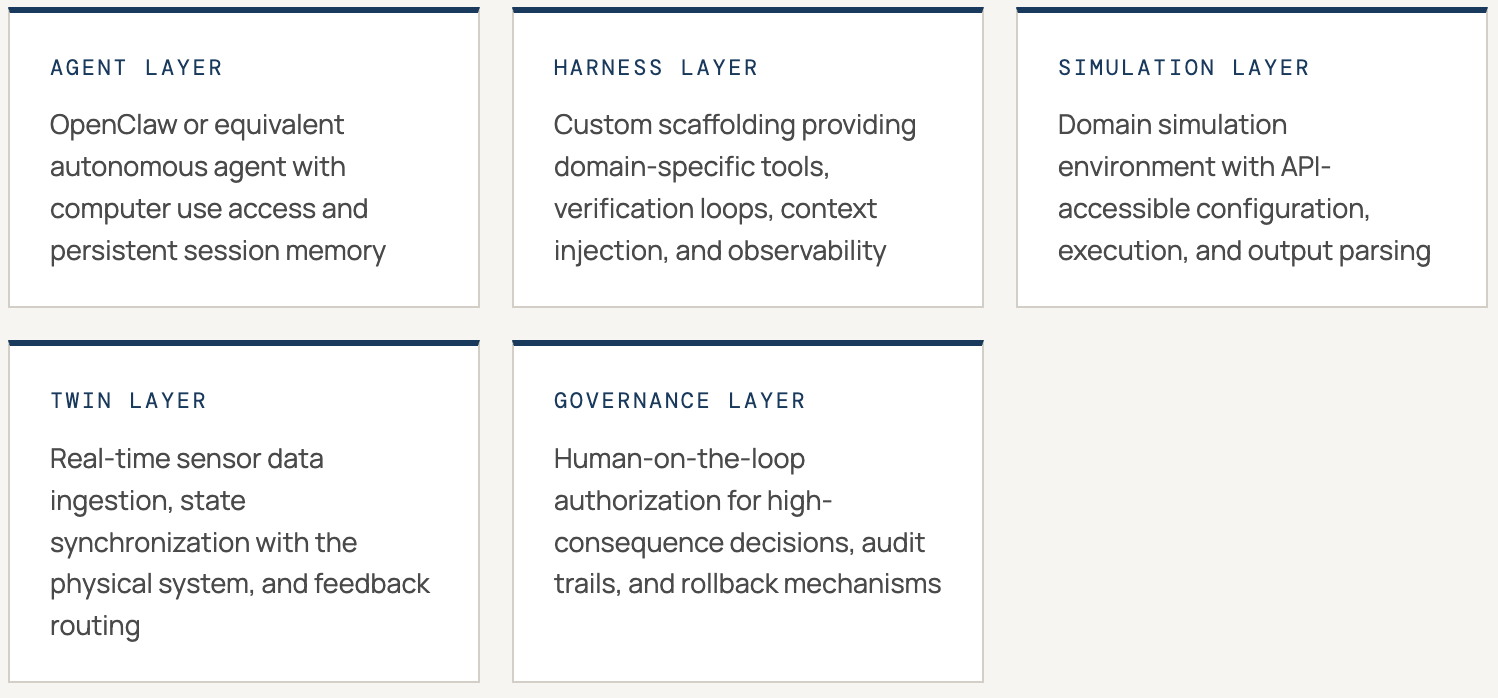
The governance layer is not optional. Research published in 2026 on harness engineering for AI agents consistently emphasizes a pattern called human-on-the-loop rather than human-in-the-loop. The distinction matters. Human-in-the-loop means the human approves every step. Human-on-the-loop means the agent runs autonomously but hard circuit breakers require human authorization before any high-risk action executes. In a simulation context, a high-risk action might be writing results to a shared knowledge base, generating a regulatory submission, or adjusting parameters on a live physical system connected to the twin.
The interoperability standard emerging for multi-agent systems is built around two protocols that one 2026 analysis described as "the USB-C for AI": the Model Context Protocol governing agent-to-tool interactions, and the Agent-to-Agent protocol governing delegation between agents. These standards are maturing rapidly, and building your simulation harness on top of them now means your architecture will compose with the broader agentic ecosystem as it develops.
Tomorrow Is Not Coming Gradually
The trajectory from OpenClaw going viral in January 2026 to agents autonomously running research simulations is not a decade-long journey. The components are available now. The architectural patterns are being documented now. The early adopters in pharmaceutical research, materials science, and energy infrastructure are building this now.
The question for every researcher, engineer, and institution is not whether agent-driven simulation research will arrive. It is whether you will be the one designing the harness and framing the questions, or whether you will be watching someone else's agent publish results in your domain.
The replacement of software engineers was only the start. Research is next. And the timeline is measured not in decades but in months.
References
- Emergent.sh. "What is OpenClaw? Complete Guide to the Open-Source AI Agent." April 2026. emergent.sh/learn/what-is-openclaw
- KDnuggets. "OpenClaw Explained: The Free AI Agent Tool Going Viral in 2026." March 2026. kdnuggets.com
- Transparency Coalition. "TCAI Guide: Understanding the Rise of OpenClaw and Open-Source AI Agents." March 2026. transparencycoalition.ai
- Kanerika Inc. "OpenClaw: How a Self-Hosted AI Agent Changed Automation in 2026." Medium, February 2026.
- Masood, A. "Agent Harness Engineering: The Rise of the AI Control Plane." Medium, April 2026.
- Faros.ai. "Harness Engineering: Making AI Coding Agents Work in 2026." May 2026. faros.ai/blog/harness-engineering
- Preprints.org. "Agent Harness for Large Language Model Agents: A Survey." April 2026. preprints.org
- ResearchGate / SmartMat. "Harnessing Autonomous AI Agents for the Next Generation of Scientific Discovery." 2026.
- San, O. et al. "The Evolution of Digital Twins from Reactive to Agentic Systems." Nature Computational Science 6, 6-10. January 2026. doi.org/10.1038/s43588-025-00944-0
- RT Insights. "Digital Twins Transition to Intelligent, AI-Driven Systems in 2026." January 2026. rtinsights.com
- Taylor and Francis. "Agentic Digital Twins: Bridging Model-Based and AI-Driven Decision-Making." International Journal of Production Research. February 2026. doi.org/10.1080/00207543.2026.2630277
- OpenRouter / a16z. "2025 AI Usage Report." Cited in 36kr.com/en/p/3709890881975048. March 2026.
- Liu, X. and David, I. "AI Simulation by Digital Twins: Systematic Survey, Reference Framework." SoSyM, 2025-2026. arxiv.org/pdf/2506.06580
- Microsoft Research. "Inside the Edge of Discovery: What Will Shape AI in 2026." December 2025. microsoft.com/en-us/research
#ArtificialIntelligence #AIAgents #OpenClaw #HarnessEngineering #DigitalTwin #SimulationResearch #AutonomousResearch #FutureOfWork #ScientificDiscovery #AgenticAI #ComputerUse #MLOps#Innovation #Infraloka #DeepTech #Engineering #ResearchTech #IndustrialAI #EnergyTech #Indonesia