
When Algorithms Play Lawyer : Steven Nataniel Kodyat
The hidden catastrophe of AI-generated legal responses and the lessons from a real Indonesian defamation dispute.
There is a peculiar arrogance that has emerged in the age of large language models: the belief that because an AI can sound like a lawyer, it is one.
This belief is not merely naive. In the context of formal legal proceedings, it is dangerous, and the consequences are playing out in real disputes right now.
This article is not a polemic against artificial intelligence. I build AI-powered infrastructure for a living. I believe deeply in the democratizing potential of intelligent systems. But democratization without discipline is just chaos wearing a press release. Nowhere is this more urgent than in the application of AI to legal matters, specifically to the drafting and delivery of legal notices, counter-responses, and defamation defense strategies.
The Architecture of the Problem
What AI does well and why that is precisely the danger
Large language models are extraordinarily good at producing text that is structurally coherent, rhetorically persuasive, and superficially authoritative. They can cite real statutes, reference real case law, and construct arguments that feel airtight. This is the core of the problem.
Legal proficiency is not about sounding authoritative. It is about identifying the precise legal elements that must be proven in a specific jurisdiction, understanding the procedural posture of a case, knowing what not to say, anticipating how a judge will read every sentence, and managing the interplay between civil liability, criminal liability, and evidentiary burden simultaneously.
AI systems trained on general legal text have no contextual awareness of the specific facts of your case, no accountability for their outputs, and no professional license at stake. They optimize for plausibility, not for legal soundness in your specific jurisdiction.
The Dunning-Kruger amplifier
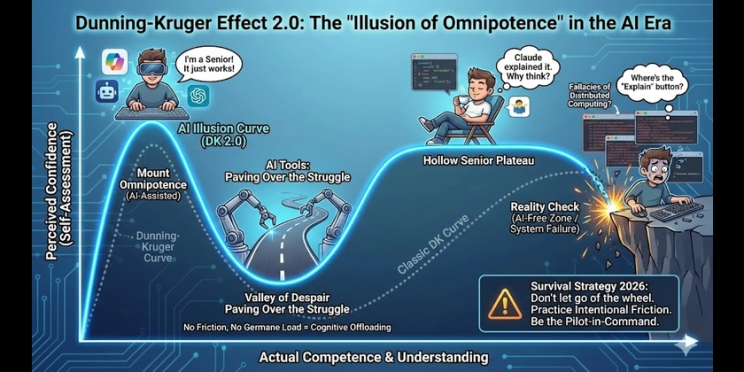
The most dangerous user of AI-generated legal advice is not an uninformed person who knows they are uninformed. It is a moderately sophisticated person who has absorbed enough legal vocabulary to feel confident, and who then uses AI to produce documents that reinforce that false confidence.
"This person will cite Article 28E of the Indonesian Constitution. They will deploy Latin phrases like actori incumbit probatio. And they will do so in ways that are technically accurate in isolation and strategically catastrophic in context."
This is not a hypothetical. This is what I have observed in a formal legal dispute.
The Case Study: Anatomy of an AI-Assisted Legal Failure
In April 2026, I received a formal response to a defamation notice (somasi) I had issued. The responding party -- acting without a licensed attorney -- submitted a document displaying all the hallmarks of AI-assisted legal drafting: extensive statutory citations, peer-reviewed academic references, constitutional arguments, and Latin legal terminology.
The document was, on its surface, impressive. It was also, on forensic examination, a near-complete gift to the opposing party.
All factual claims referenced here are drawn from documents already filed and exchanged in formal proceedings. This analysis is published in the public interest of AI governance education.

Failure Mode 1 : Admitting mens rea while trying to assert a constitutional defense
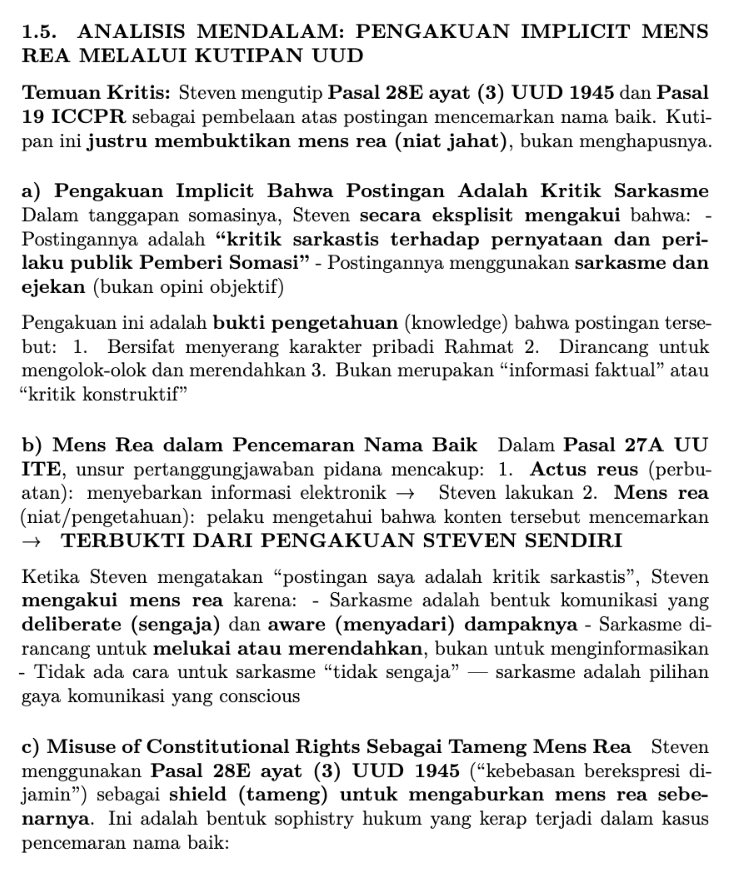
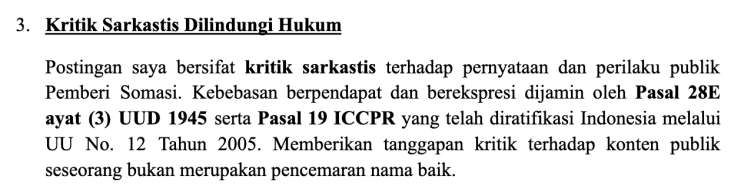
The responding party invoked Article 28E(3) of the 1945 Indonesian Constitution -- the free expression guarantee -- as a shield against defamation liability. This is a legitimate legal argument. The catastrophic error was the accompanying characterization: the response explicitly described the posts as "kritik sarkastis" (sarcastic criticism) -- a deliberate, conscious rhetorical choice designed to ridicule.
In Indonesian defamation law under Article 27A of UU ITE No. 1/2024, the mental element (mens rea) requires that the defendant knew or should have known the content would damage the subject's reputation. Sarcasm, by definition, is a deliberate communicative act. You cannot accidentally be sarcastic. The moment the responding party characterized their posts as intentional sarcasm, they inadvertently admitted the very mental element the plaintiff needed to establish.
A licensed attorney would have spotted this immediately. An AI generating plausible-sounding legal text will not, because it has no strategic awareness of what admissions cost in a specific case.
The lesson
*AI is excellent at constructing arguments in isolation. It cannot evaluate the strategic cost of those arguments when read against the totality of the facts.*Admitting mens rea while trying to assert a constitutional defense
The responding party invoked Article 28E(3) of the 1945 Indonesian Constitution -- the free expression guarantee -- as a shield against defamation liability. This is a legitimate legal argument. The catastrophic error was the accompanying characterization: the response explicitly described the posts as "kritik sarkastis" (sarcastic criticism) -- a deliberate, conscious rhetorical choice designed to ridicule.
In Indonesian defamation law under Article 27A of UU ITE No. 1/2024, the mental element (mens rea) requires that the defendant knew or should have known the content would damage the subject's reputation. Sarcasm, by definition, is a deliberate communicative act. You cannot accidentally be sarcastic. The moment the responding party characterized their posts as intentional sarcasm, they inadvertently admitted the very mental element the plaintiff needed to establish.
A licensed attorney would have spotted this immediately. An AI generating plausible-sounding legal text will not, because it has no strategic awareness of what admissions cost in a specific case.
The lesson
AI is excellent at constructing arguments in isolation. It cannot evaluate the strategic cost of those arguments when read against the totality of the facts.
Failure Mode 2 : Misapplying constitutional doctrine
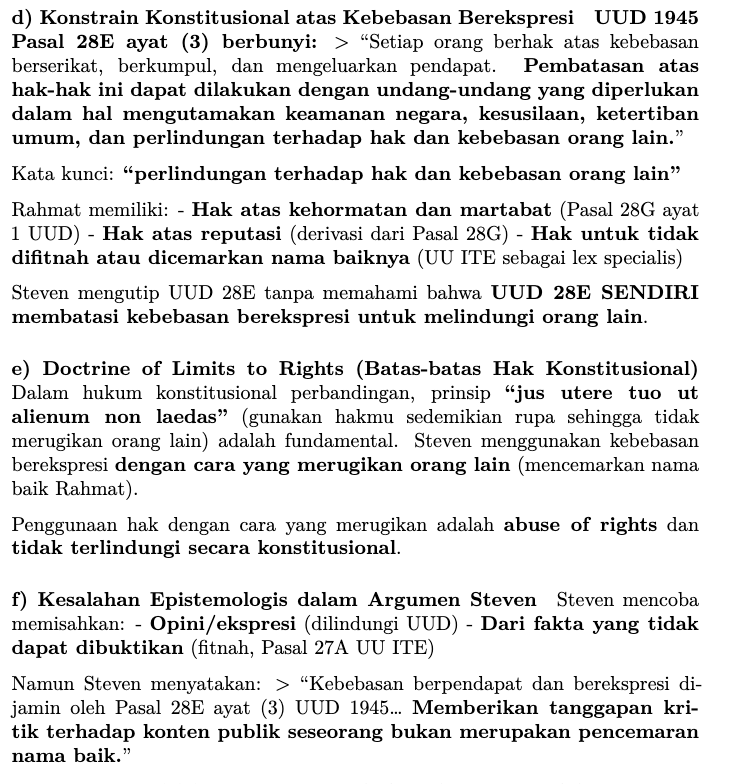
The response cited Article 28E(3) without engaging with Article 28G(1), which guarantees every person the right to protection of personal honor and dignity. Nor did it engage with the internal limiting clause within the free expression guarantee itself, which conditions the right on respect for the rights of others.
In Indonesian constitutional law, these provisions exist in interpretive tension. The Constitutional Court has consistently held that free expression rights do not extinguish defamation liability when content goes beyond opinion into character attacks unsupported by verifiable fact. The response never grappled with this tension -- it simply cited 28E as if it were an absolute shield.
This is a hallmark of AI-generated legal text: it retrieves the relevant provision but does not engage with the body of judicial interpretation that determines how courts actually apply it.
The lesson
Statutory text is only the starting point of legal analysis. The relevant jurisprudence and judicial tendency in your specific jurisdiction is where the real work happens -- and this requires a practitioner with actual courtroom experience.
Failure Mode 3 : The medical science detour that backfired
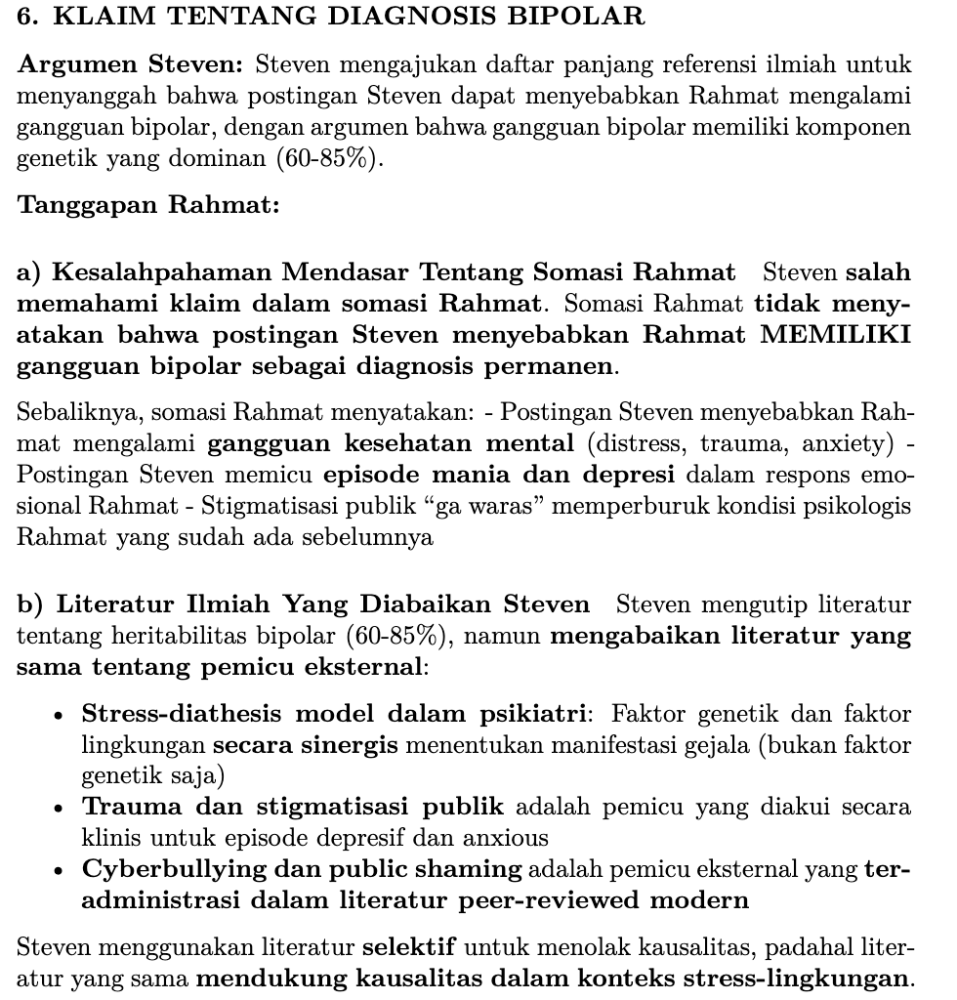
The response cited three peer-reviewed articles on the heritability of bipolar disorder (NIH publications, a Nature journal piece) to argue that social media posts cannot cause bipolar disorder. This was not wrong as a matter of psychiatry. The heritability data cited is accurate.
It was, however, a profound strategic error. The original somasi did not claim that defamatory posts caused bipolar disorder as a primary diagnosis. It claimed the posts triggered episodes and worsened a pre-existing psychological condition -- a claim supported by the stress-diathesis model, which is equally well-established in the same literature the response was citing.
By deploying an impressive scientific apparatus to rebut a claim that was never actually made, the response: (a) wasted argumentative space on a straw man, (b) implicitly acknowledged that psychological harm is cognizable, and (c) failed to engage with the actual legal standard under Article 1365 of the Civil Code, which requires only that the plaintiff demonstrate some causally connected harm.
The lesson
Legal relevance is not the same as factual accuracy. AI can produce accurate information that is strategically irrelevant or actively harmful to your legal position.
Failure Mode 4 : Burden of proof inversion: partially right, fatally incomplete
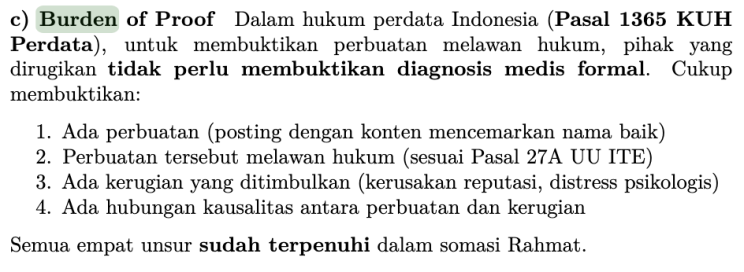
The response correctly noted that in criminal proceedings, the burden of proof rests with the accuser (actori incumbit probatio). This is accurate. However, the response failed to distinguish between the criminal standard and the civil standard, which governs defamation claims under Article 1365 of the Civil Code.
Moreover, the response failed to invoke the defensio vera (truth as a defense) doctrine in any meaningful way. Having raised the burden of proof argument, a competent attorney would have immediately pivoted to affirmatively establishing that the statements made were: (1) true, (2) matters of public interest, or (3) protected opinion. The response did none of this with legal rigor. It raised the procedural shield and then stopped.
The lesson
Legal arguments are not complete when they identify a favorable principle. They are complete when they apply that principle to the specific facts in a procedurally actionable way. AI generates the principle. Only a lawyer can do the application.
Failure Mode 5 : The chronological own-goal
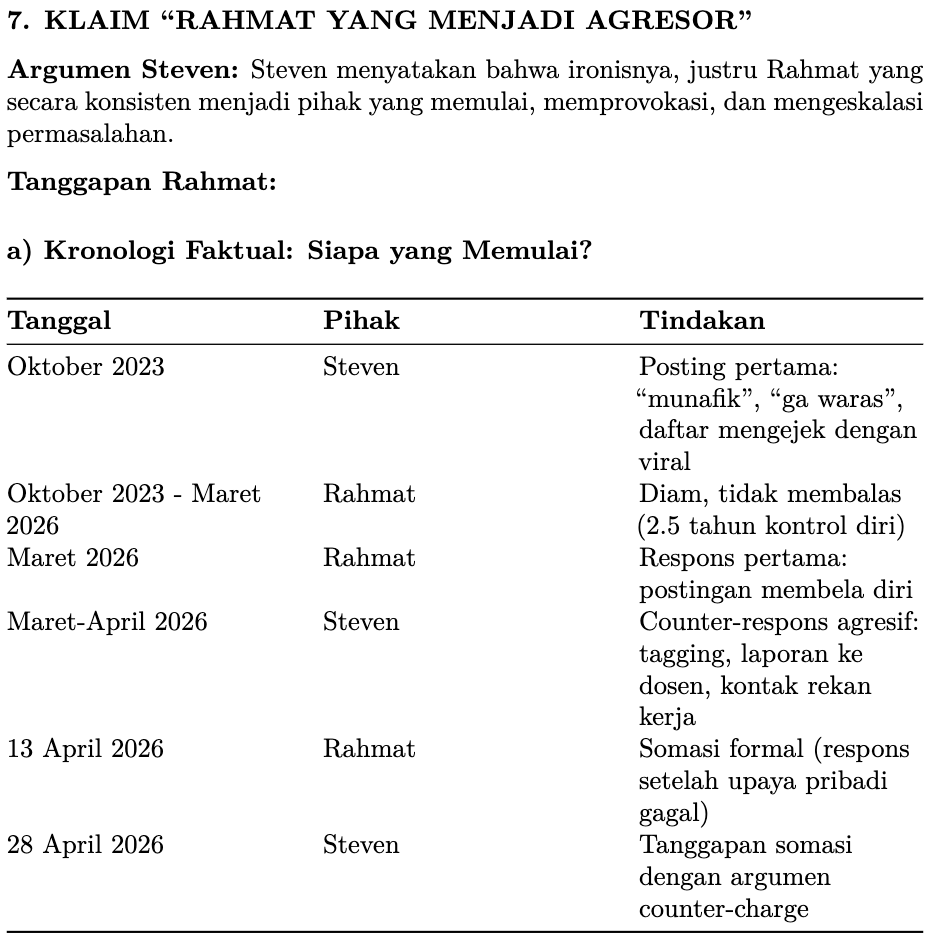
The response included a detailed chronological rebuttal arguing the somasi-issuer was the aggressor -- having allegedly restarted conflict in March 2026. This argument might have been persuasive. But embedded within it was a factual concession that undermined the entire defense: the response acknowledged that posts from 2023 remained publicly accessible and had never been deleted.
Under Indonesian law and general defamation principles, a defamatory post does not "expire" simply because time passes. The harm is continuous as long as the content remains accessible. By confirming the posts remained up while arguing there was no interaction between 2024 and 2026, the response inadvertently confirmed ongoing and continuous publication of the defamatory content throughout that entire period.
The lesson
In legal documents, what you confirm matters as much as what you argue. AI-generated text does not track the strategic implications of factual concessions across a multi-paragraph document.
The Systemic Risk: Why This Is Not an Isolated Case
Accessibility creates exposure
The democratization of legal information through AI tools is genuinely valuable. People who previously had no access to any legal framework now have access to statutes, procedures, and basic rights. This is net positive. The danger emerges at the second-order level: when access to legal information is mistaken for legal competence.
The Indonesian legal context adds complexity
Indonesia's legal system is a hybrid: a Dutch-derived civil law tradition, overlaid with Islamic law influences in personal matters, customary law (adat) recognition, and a rapidly evolving digital law framework through UU ITE and UU PDP. AI systems trained predominantly on English-language legal text from common law jurisdictions are particularly unreliable in this context. The Constitutional Court's jurisprudence, the Mahkamah Agung's circular letters, the Bareskrim's investigative procedures -- these are not well-represented in the training corpora of most available AI models.
The Dunning-Kruger loop in formal proceedings
What makes the AI-assisted legal response particularly risky is that documents become part of the official record. Unlike a casual conversation where a wrong answer can be corrected, a defamation response submitted in a formal process is locked in. The AI-generated document does not know this. It generates text as if every response exists in a vacuum, optimized for local plausibility rather than for strategic coherence across the entire proceeding.
What Responsible AI-Assisted Legal Work Actually Looks Like
I am not arguing that AI has no role in legal work. I am arguing that its role must be precisely calibrated.
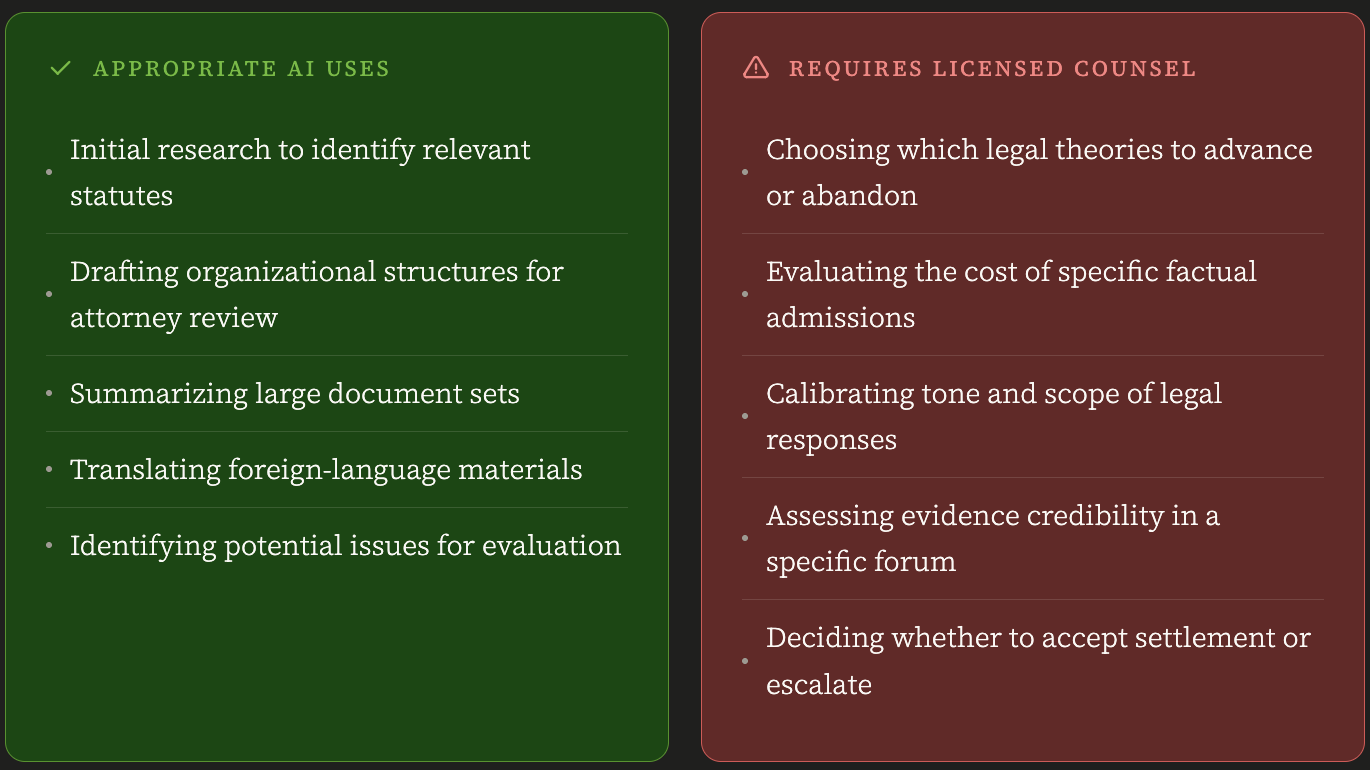
Practical Recommendations
For individuals facing legal disputes
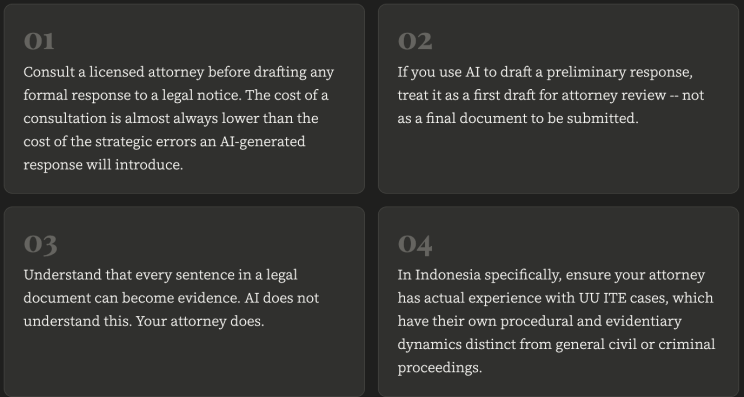
For organizations deploying AI legal tools
Disclosures must be conspicuous. Users must understand that AI-generated legal text is not legal advice. Access controls matter -- tools that generate formal legal documents should require user confirmation that they understand the limitations. And liability frameworks need to be established proactively: when an AI-generated legal response causes measurable harm, questions of product liability are coming.
Intelligence Without Judgment Is Still Just a Machine
Artificial intelligence has genuine transformative potential in the legal sector. Contract analysis, discovery support, regulatory compliance monitoring -- these are areas where AI is already adding real value under proper supervision.
But responding to a defamation notice is not contract analysis. It is a high-stakes, adversarial, jurisdiction-specific, fact-sensitive exercise in strategic communication under legal constraint. Every word matters. Every admission is permanent. Every argument that sounds impressive in isolation may be catastrophic in context.
The case documented here illustrates in granular detail what happens when this distinction is not respected. The errors are not random. They follow a predictable pattern: AI produces text that is locally plausible but globally incoherent; factually accurate but strategically disastrous; rhetorically confident but legally vulnerable.
"The algorithm played lawyer. It should not have."
If you are facing a formal legal proceeding, get a licensed attorney. Use AI to help you understand the landscape. Do not let AI navigate it for you. The stakes are too high for the machine to drive.
#ArtificialIntelligence#LegalTech#AIRisk#IndonesiaLaw#UUITE#Defamation#AIGovernance#LegalAI#DigitalLaw#TechPolicy#AIEthics#LegalCompliance#StartupIndonesia#Infraloka#AIResponsibility#UUPDP