
When Corporations Weaponize Defamation Law: Study Case of Nomni AI (Nomni.AI), Under PT Nomnie Technologies Indonesia
Australia vs. Indonesia: What every employee must know about criminal defamation, corporate standing, and employment rights across two jurisdictions.
There is a moment many employees recognize. You speak truthfully about your workplace experience. You share what happened to you. You name the injustice clearly. And then a legal threat arrives — not because you lied, but because the truth is inconvenient for those with resources to litigate it.
This article is for every professional who has faced that moment, or fears facing it. It is a comparative legal analysis of how corporate defamation law works under the criminal frameworks of Australia and Indonesia, what protections exist for employees who speak out after termination, and why the two systems produce fundamentally different risk profiles for the individual citizen standing against a corporate entity.
I write this not as abstract scholarship but as someone who has lived through employment disputes involving companies operating across both jurisdictions. The intersection of cross-border corporate structures with local legal systems creates asymmetric pressure that ordinary employees are rarely prepared for. That asymmetry deserves clear examination.
The Australian Framework: A System That Largely Shields Citizens from Corporate Defamation Suits
Defamation in Australia Is Civil, Not Criminal
The first and most important distinction to establish: in Australia, defamation is overwhelmingly a civil matter, not a criminal one.
Defamation and anti-defamation laws in Australia are civil matters resolved through the court system without police involvement. A person who is successfully sued for defamation in Australia does not go to prison and has nothing listed on their criminal record. — Gordon Legal
In Australia, a former employer threatening you with "defamation charges" is threatening civil litigation, not criminal prosecution. The consequences, while potentially costly, do not include imprisonment. This is a foundational structural difference from Indonesia.
The Corporate Standing Problem: Large Companies Cannot Sue
Here is where Australian law becomes genuinely protective of the individual.

The implications are sweeping. Lawmakers determined that large corporations possess sufficient resources to absorb reputational damage and can deploy advertising, public relations, and market power to counter false statements. Permitting corporate defamation actions would chill public discourse and allow wealthy entities to silence legitimate criticism through litigation threats.
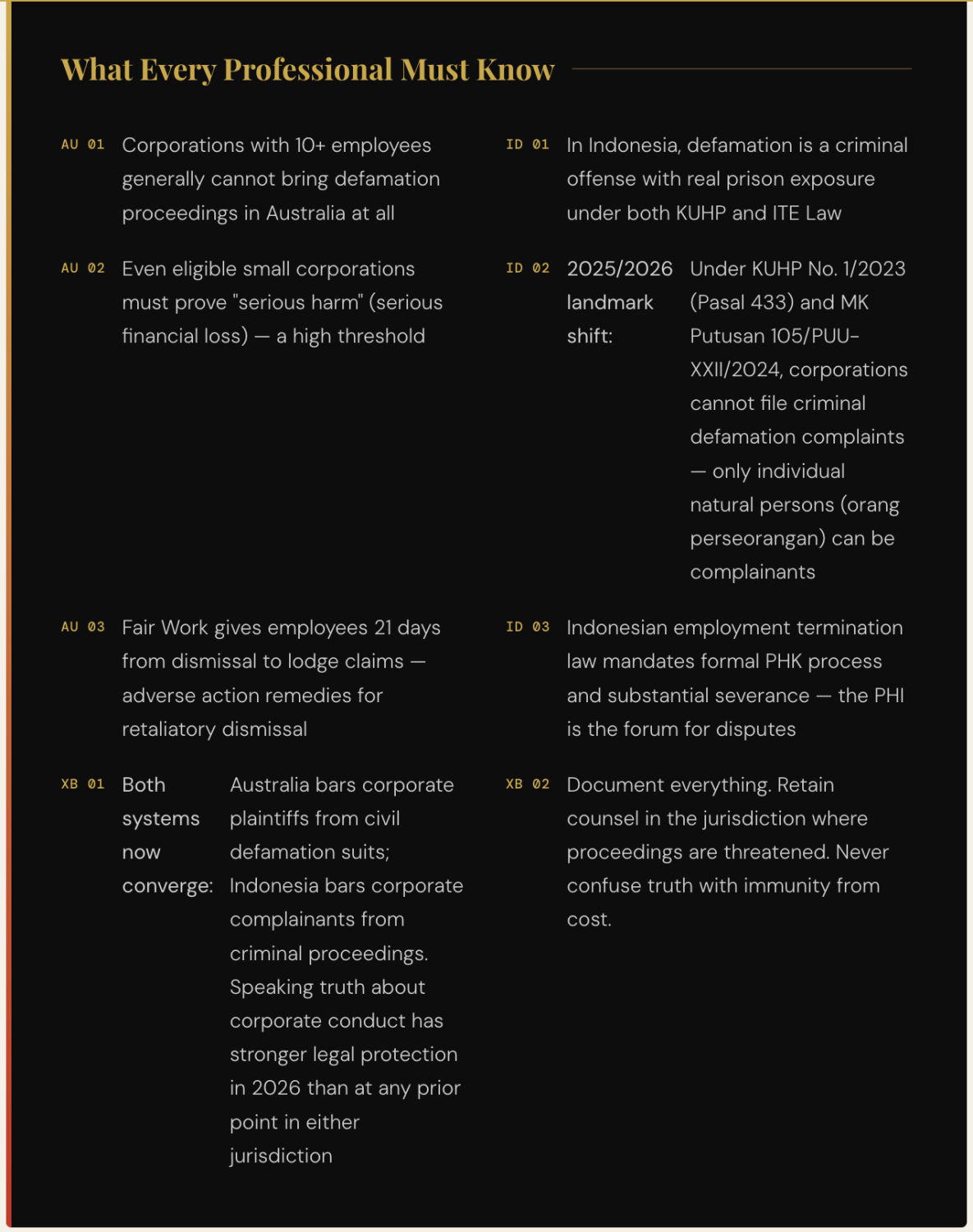
Large companies, multinational corporations, and foreign companies cannot sue for defamation in Australia. Only small Australian businesses with fewer than 10 employees retain the right to bring defamation proceedings, and even then must prove serious financial loss.
For any company with an Australian parent entity employing more than 10 people — including part-time staff counted as fractional full-time equivalents — the door to defamation litigation is effectively closed by statute. The count includes employees of related corporate entities, not just the specific entity nominally involved.
The Serious Harm Threshold
Since the 2021 reforms, even corporations that qualify as excluded corporations must clear a meaningful threshold before any case proceeds.
Plaintiffs suing for defamation must establish that they have suffered serious harm to their reputation. For corporations, this threshold is higher still: serious financial loss must be shown. This acts as an early filter, preventing trivial claims from proceeding. This threshold is not cosmetic — courts have used it consistently to screen cases where reputational impact was claimed but not concretely demonstrated.
Truth as a Complete Defense
The defence of truth (justification) is one of the most straightforward defences available in Australia. A defendant can avoid liability entirely by proving the defamatory material was substantially true.
"The truth is never defamatory."
Additionally, Australia recognizes a public interest defense introduced in the 2021 reforms. A publication concerning an issue of public interest that the publisher reasonably believed was in the public interest carries a complete defense even if the content caused reputational harm.
Reporting to Police Is Absolutely Protected
The 2024 amendments expanded absolute privilege to protect those who report alleged criminal and unlawful conduct and misconduct to police and other complaints-handling bodies. Communications made to law enforcement about workplace misconduct — even if defamatory in content — are absolutely privileged and cannot form the basis of a successful claim.
The Indonesian Framework: Criminal Law as Corporate Shield
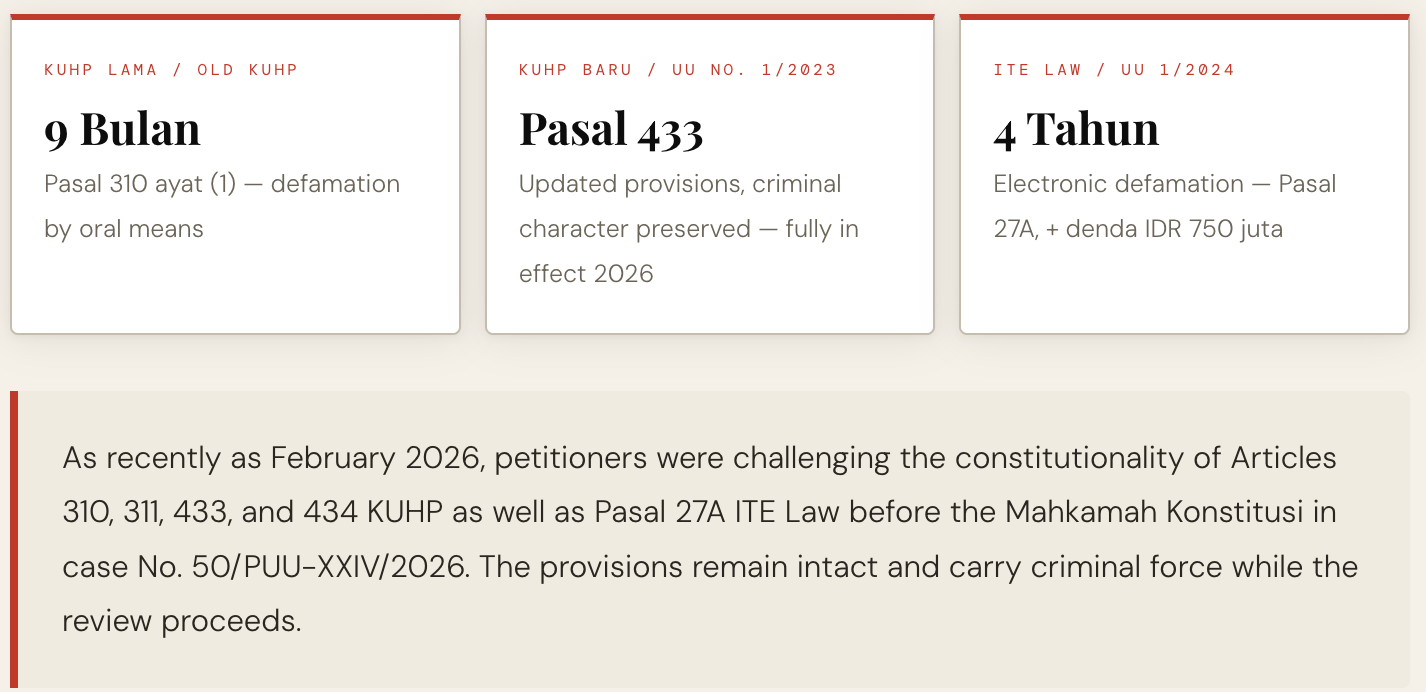
Defamation in Indonesia Carries Criminal Penalties
Indonesia operates under a fundamentally different architecture. Defamation here is not merely a civil wrong. It is a criminal offense. The stakes are categorically different.
The Complaint-Based (Delik Aduan) Nature of Defamation
Under both the KUHP and the revised ITE Law, defamation (pencemaran nama baik) is classified as a delik aduan — a complaint-based offense. The criminal process cannot be initiated without a formal complaint from the aggrieved party.
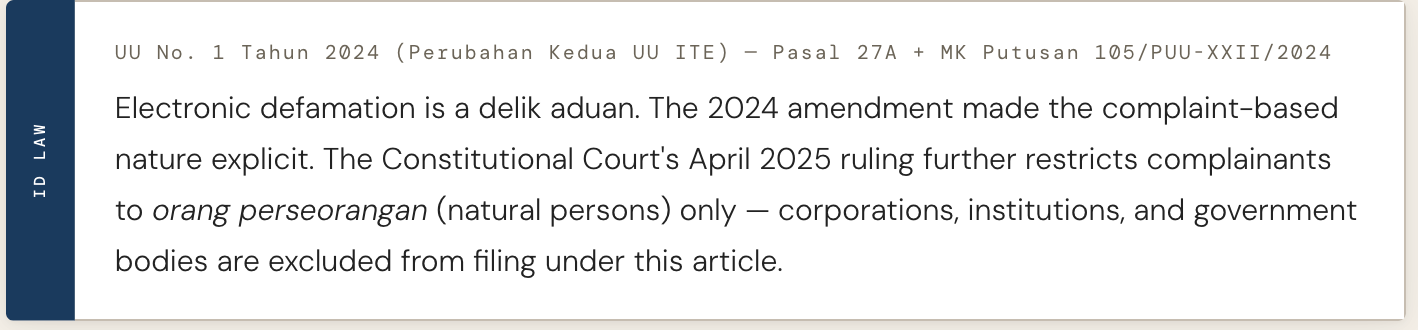
In practice, complainants in Indonesia are significantly more inclined to resolve defamation disputes through criminal proceedings than through civil litigation. Analysis of Supreme Court decision databases shows criminal cases — under the general KUHP and the ITE Law — substantially outnumber civil defamation cases. The strategic reality: criminal process creates leverage through the threat of investigation, interrogation, and potential prosecution, even before any finding of guilt.
Corporations Cannot Be Complainants: A Landmark Shift
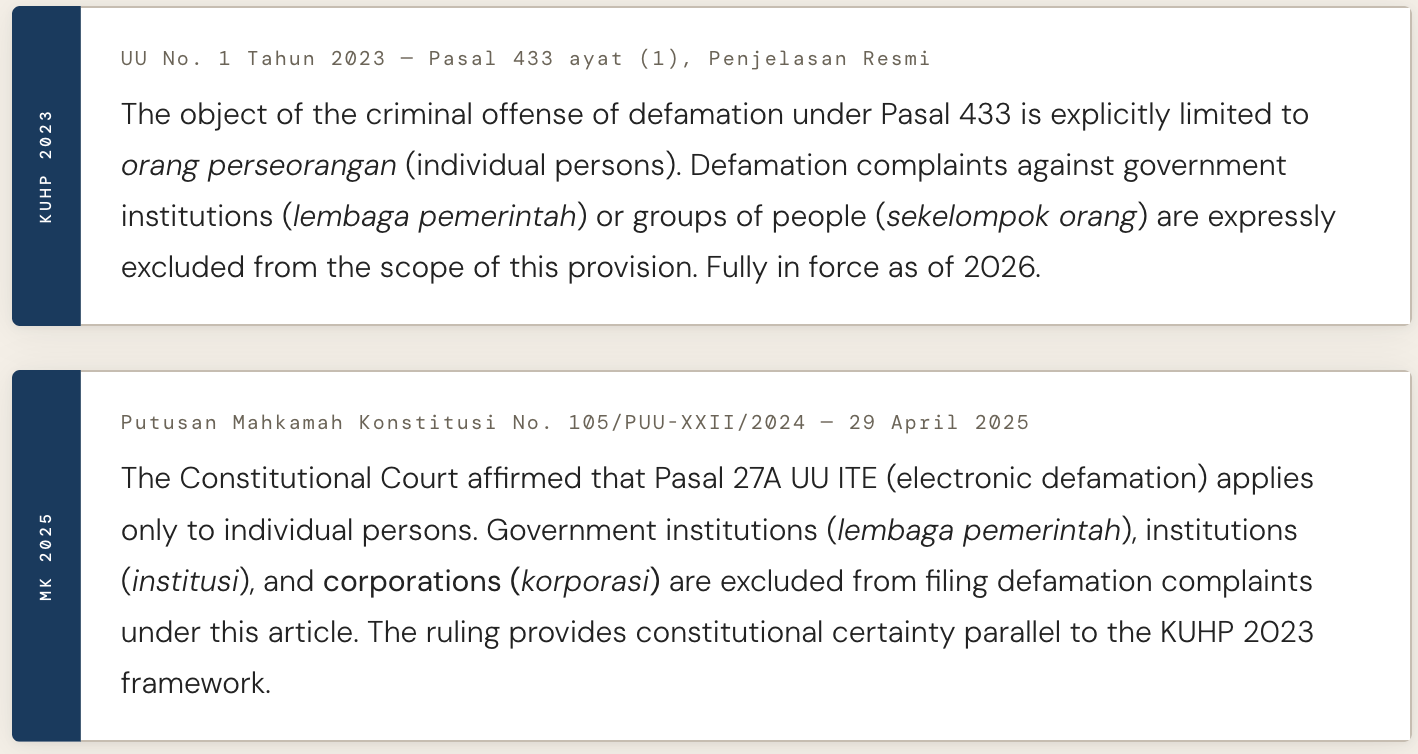
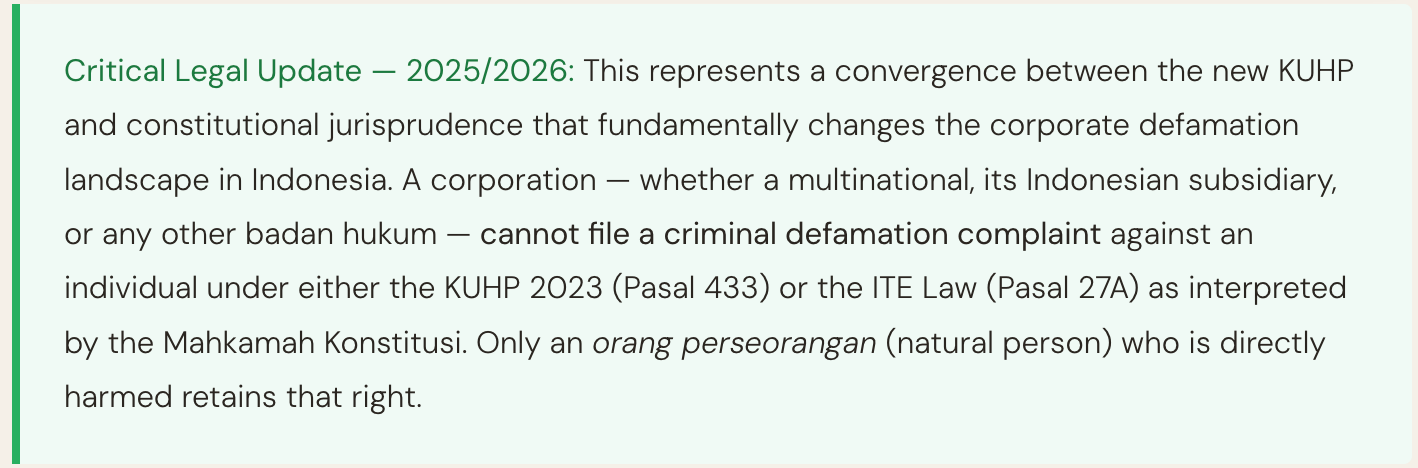
Researcher Nur Ansar of the Institute for Criminal Justice Reform (ICJR) noted that the MK ruling reinforces the guarantee of freedom of expression and creates a need to revisit related provisions on defamation of state officials in the KUHP 2023. The convergence of Pasal 433's explicit limitation to individual victims and the MK's constitutional ruling on the ITE Law creates a robust shield for individuals speaking truthfully about corporate conduct.
Corporations whose officers are individually named in public statements retain the option of those officers filing personal complaints in their own names. This residual pathway, while narrower, remains legally available and should not be discounted when evaluating litigation risk. However, it places the burden of demonstrating personal, individual harm on a named natural person — not on the corporate entity as such.
Employment Termination: Comparing the Frameworks
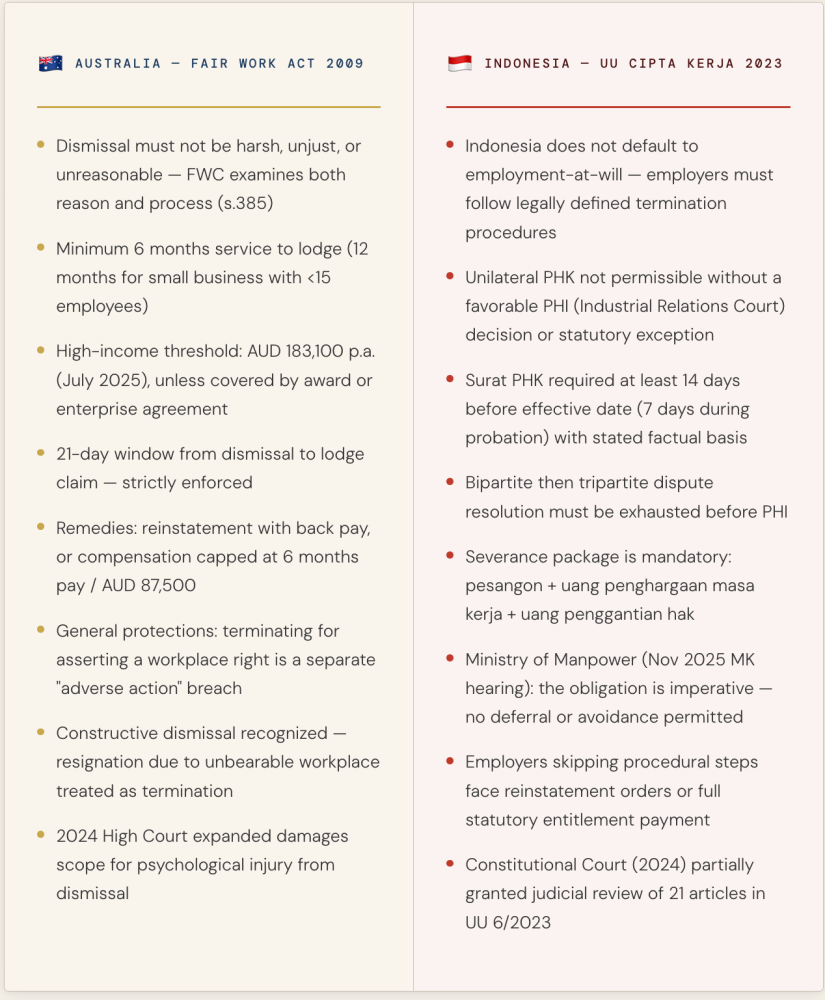
The question of speaking out after termination cannot be separated from how that termination was conducted. Both Australian and Indonesian law establish substantive employee rights, and violations of those rights are legally relevant context for any subsequent defamation claim.
The Cross-Border Corporate Strategy — And Its Limits
When a company with an Australian parent and Indonesian operations threatens defamation action against a former Indonesian employee for statements made in Indonesia, several dynamics emerge simultaneously.
First: The Australian Parent Likely Cannot Sue
Large companies, multinational corporations, and foreign companies cannot sue for defamation in Australia. An Australian-incorporated company with more than 10 employees is legally barred from bringing defamation proceedings in Australian courts — regardless of how damaging the allegedly false statements are.
Second: The Indonesian Subsidiary Cannot File as a Corporation Either
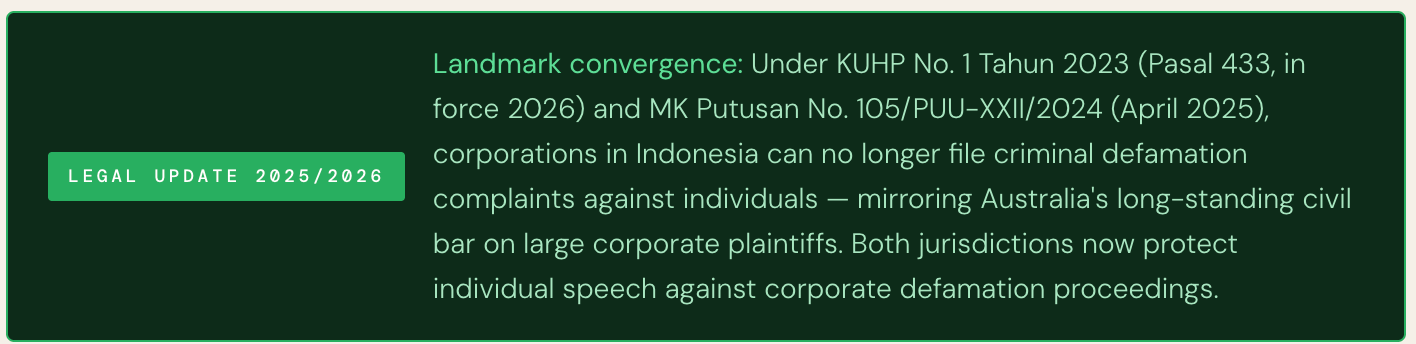
This is where the legal landscape has shifted dramatically. Under Pasal 433 KUHP No. 1 Tahun 2023 (fully in force 2026) and the Mahkamah Konstitusi's Putusan No. 105/PUU-XXII/2024 (April 2025), a corporation, institutional body, or government agency cannot file a criminal defamation complaint against an individual in Indonesia. The defamation provisions apply only when the victim is an orang perseorangan — a natural person. A multinational's Indonesian subsidiary, as a badan hukum (legal entity), is expressly excluded from the complainant role.
The convergence is now complete: Both Australia and Indonesia bar corporations from using defamation law directly against individuals. Australia bars corporate plaintiffs from civil suits. Indonesia bars corporate complainants from criminal proceedings. In both jurisdictions, the mechanism for speaking truth about corporate conduct is now significantly more protected than it was even two years ago.
The residual risk remains if individual corporate officers file complaints in their own names as natural persons who claim to be personally defamed. This is a narrower, harder-to-sustain avenue but it is not closed. It requires the named officer to demonstrate direct, individual reputational harm — distinct from harm to the corporate entity.
Third: Truth Remains the Most Powerful Shield in Both
The substantive truth of the statements made remains the most powerful protective factor in both jurisdictions. In Australia, truth is a complete civil defense. In Indonesian criminal proceedings, it is highly relevant, though the process of proving it while defending a criminal investigation carries its own costs and burdens. Document everything from the beginning.
Fourth: Statements to Law Enforcement Carry Enhanced Protection
Statements made to Indonesian Bareskrim or Polda, or to Australian regulatory bodies, carry heightened protection in both systems. Australia's absolute privilege for reporting to police and complaints bodies is explicit since the 2024 amendments. In Indonesia, delik aduan offenses require the complainant to be the aggrieved party, and statements made in the context of formal law enforcement reports are analyzed differently from public social media posts.

#CorporateLaw #DefamationLaw #IndonesiaLaw #AustraliaLaw #EmploymentLaw #WorkerRights #UUITE #KUHP #FairWork #LaborLaw #LegalLiteracy #PHK #CrossBorderLaw #WorkplaceJustice #HRCompliance #LinkedInIndonesia #HukumKetenagakerjaan #HukumPidana #Infraloka