
When Demanding Money Becomes Blackmail — and When It's Your Legal Right, Study Case of Rahmat Wibowo Allegation By Machi Achmad And Partners's Lawyer
Understanding the Critical Line Between Criminal Extortion and Civil Compensation Under Indonesian Law
There is a conversation that needs to happen in Indonesia's digital public sphere — one that most people avoid because the law feels complicated, distant, or intimidating.
But here is the truth: not all demands for money are blackmail. And not all blackmail accusations are valid.
Understanding the difference between pemerasan (criminal extortion/blackmail) and gugatan ganti rugi perdata (civil compensation claims) is not just academic. It can determine whether you are the one holding a legal right — or the one facing criminal prosecution.
Part I: What Is Blackmail (Pemerasan)?
Blackmail — known in Indonesian criminal law as pemerasan — is a crime, not a civil dispute.
Defined under Pasal 368 KUHP, pemerasan occurs when someone uses violence or the threat of violence to force another party to hand over money, goods, or the cancellation of a debt — for the purpose of unlawfully enriching themselves or another person. In Black's Law Dictionary, blackmail is described as a threatening demand made without justification, synonymous with extortion: obtaining something through unlawful pressure or coercion.
The key elements of pemerasan under Indonesian law are:
- Intent to unjustly enrich oneself or another party
- Coercion through violence or threats — including threats to expose secrets, physical threats, or digital intimidation
- A transfer of money, goods, or rights as a direct result of that coercion
The criminal penalty is severe: up to 9 years imprisonment under Pasal 368 KUHP.
In the digital era, this extends to online platforms. Under UU ITE No. 1 Tahun 2024, Pasal 27B ayat (2) specifically criminalizes using electronic media to threaten exposure of information in order to force someone to give money or property — carrying a maximum sentence of 6 years imprisonment and/or a fine of up to Rp 1 billion.
The defining characteristic of blackmail: the demand is made through force, threat, or coercion — not through legitimate legal process.
Part II: What Is Civil Compensation (Gugatan Ganti Rugi Perdata)?
Civil compensation is a fundamentally different mechanism. It is a legal right — not a crime.
Under Pasal 1365 KUH Perdata (the foundational provision on unlawful acts in Indonesian civil law), any act that violates the law and causes harm to another party obligates the wrongdoer to compensate for that harm. This is the doctrine of Perbuatan Melawan Hukum (PMH) — tortious liability.
To succeed in a PMH civil claim, a plaintiff must prove four elements:
- An unlawful act — including acts that violate written law, the perpetrator's legal duties, social norms, or standards of reasonableness and decency
- Fault — whether intentional or through negligence
- Actual harm — both material (measurable financial loss) and immaterial (harm to dignity, reputation, psychological wellbeing, or future earning capacity)
- Causation — a direct causal link between the unlawful act and the harm suffered
Crucially, the right to claim compensation under PMH does not require a prior criminal conviction. A victim may file a civil suit independently of — or in parallel with — any criminal proceeding.
Forms of compensation that courts may award include:
- Materiil (Material): Actual quantifiable losses — legal fees, lost income, costs of remediation
- Immateriil (Immaterial): Non-quantifiable harm — emotional distress, damage to reputation, loss of enjoyment of life, psychological trauma
Additionally, under Pasal 1372–1380 KUH Perdata, victims of insult or defamation have a specific civil right to demand both compensation and the restoration of their honor and name — including public apologies, retraction of statements, or a combination of remedies.
The defining characteristic of a civil claim: it is filed through the court system, based on documented harm, supported by evidence, and decided by a judge — not demanded privately under threat.
Part III: The Critical Distinction
The line between blackmail and legitimate civil action is often misunderstood — sometimes deliberately.
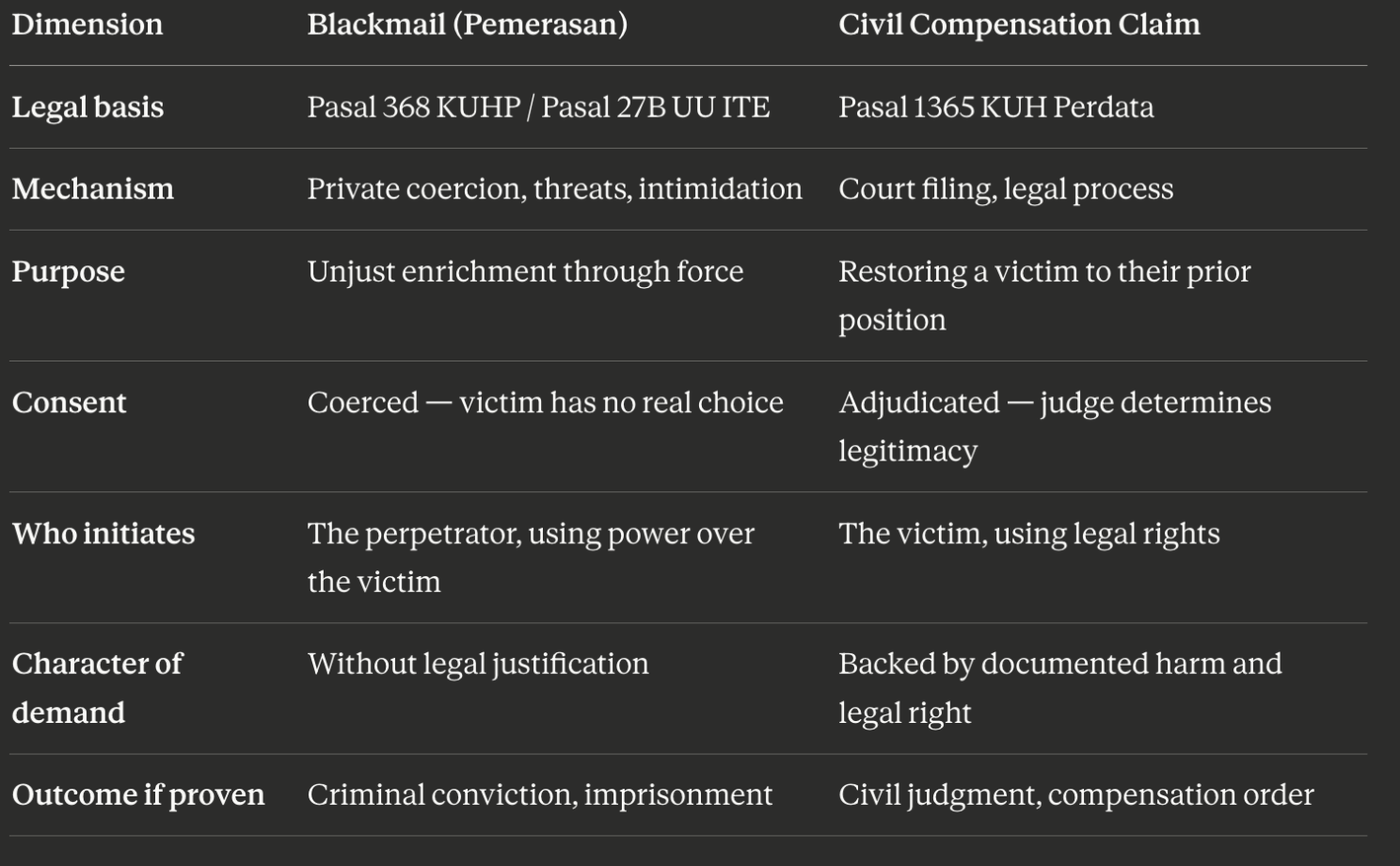
The legal principle is clear: a victim demanding compensation through proper legal channels is exercising a right. A perpetrator demanding money through threats is committing a crime.
However, there is a grey zone that demands care: in Indonesian legal culture, some actors attempt to reframe a victim's legitimate legal notice (somasi) as harassment or extortion — an abuse of process designed to silence the rightful claimant. Understanding this distinction protects victims from having their legal rights weaponized against them.
Part IV: The Legal Notice (Somasi) — A Victim's First Step
In Indonesian civil practice, the somasi (legal notice or letter of demand) is the formal instrument through which a victim initiates the compensation process outside of court — or signals their intent to bring the matter before a judge.
A somasi is not a threat. It is a documented, transparent, legally recognized communication — typically sent through an advocate or legal representative — that:
- Describes the unlawful act committed
- Documents the harm suffered (material and immaterial)
- States the compensation demanded
- Sets a response deadline
- Signals the intent to escalate to litigation if unresolved
Importantly, claiming compensation through a somasi does not require prior criminal proceedings. Under Pasal 1365 KUH Perdata, the right to civil action arises from the unlawful act itself. The victim may proceed directly.
Part V: Legal Notice in UU ITE Cases — When the Victim Seeks Compensation
In UU ITE-related cases — particularly those involving online defamation, harassment, or the unlawful spread of damaging digital content — a victim may pursue multiple legal tracks simultaneously or in sequence:
Track 1: Criminal Report (Laporan Pidana)
Under UU ITE No. 1 Tahun 2024:
- Pasal 27A — criminalizes intentional attacks on another person's honor or reputation through electronic systems. Penalty: up to 2 years imprisonment and/or Rp 400 million fine.
- Pasal 27B ayat (2) — criminalizes digital extortion using threats of exposure. Penalty: up to 6 years and/or Rp 1 billion fine.
- Both are delik aduan absolut — they can only be prosecuted upon the victim's complaint. The perpetrator cannot be charged without the victim's explicit report.
The current approach in Indonesian cyber law enforcement increasingly emphasizes restorative justice — bringing parties together for resolution before escalating to prosecution. This makes the somasi even more strategically significant.
Track 2: Civil Gugatan (Lawsuit for Compensation)
The victim may file a civil lawsuit under Pasal 1365 KUH Perdata and/or Pasal 1372 KUH Perdata, demanding:
- Material compensation — quantified losses including lost professional opportunities, legal fees, remediation costs
- Immaterial compensation — for psychological harm, damaged reputation, and loss of life quality
- Restoration of honor — public apology, removal of defamatory content, formal retraction
Victims may also apply through LPSK (Lembaga Perlindungan Saksi dan Korban) for restitution in criminal cases, which may include recovery for medical/psychological costs, transportation, and attorney fees.
Track 3: Administrative Report (Kominfo)
For violations involving unlawful distribution of personal data or harmful digital content, a report to Kementerian Komunikasi dan Digital (Komdigi) may trigger administrative sanctions against the platform or operator — independent of criminal or civil proceedings.
Part VI: A Legal Notice with Compensation — How It Works in Practice
When a victim of UU ITE violations issues a formal legal notice demanding compensation, the document should be structured to:
1. Establish the factual basis Document each incident with timestamps, screenshots, platform URLs, and witness information. Digital evidence must be preserved immediately — courts accept electronic evidence under UU ITE and UU PDP frameworks.
2. Identify the applicable legal violations Specify which provisions of UU ITE (Pasal 27A, 27B, 28), KUHP (Pasal 310, 311, 368), and KUH Perdata (Pasal 1365, 1372) apply to the documented conduct.
3. Articulate the harm in both categories
- Materiil: lost contracts, income, legal costs (with supporting evidence)
- Immateriil: psychological impact, professional reputation damage, disruption to livelihood
4. State the specific demands Including the total compensation figure, a deadline for response, and the demand for removal of offending content and/or a public apology.
5. State the escalation consequence Clearly note that failure to respond within the stated period will result in criminal reporting to Bareskrim/Polda and/or filing of a civil lawsuit at the Pengadilan Negeri.
6. Issue through legal representation A somasi carries significantly more weight — and legal protection — when issued through a licensed advocate (advokat), who can also protect the victim from counter-accusations of harassment.
Part VII: The Public Interest Exception — Speaking Truth Is Not Defamation
One critical protection in the revised UU ITE (No. 1 Tahun 2024) that victims and advocates must know:
Pasal 45 ayat (7) expressly provides that conduct under Pasal 27A cannot be criminalized if it is carried out:
- For the public interest (kepentingan umum), or
- As a forced act of self-defense (pembelaan diri yang terpaksa)
This means: a victim who documents and publicly discloses the harassment they have suffered — for the purpose of their own legal defense or to protect the broader public — is protected from retaliatory criminal accusations under this provision.
The law recognizes that truth-telling in defense of one's dignity is not the same as defamation.
Closing: Know Your Rights Before You Act
The difference between blackmail and a civil demand for compensation is not just technical — it is moral. One is an act of power exercised through threat. The other is an act of dignity exercised through law.
If you have been harmed — through harassment, defamation, or unlawful conduct in digital spaces — the Indonesian legal system provides you with real instruments:
- The right to issue a formal legal notice demanding compensation
- The right to file criminal reports under UU ITE
- The right to civil action under Pasal 1365 KUH Perdata
- The right to restoration of your honor and name under Pasal 1372 KUH Perdata
Exercise these rights clearly, documentedly, and through proper legal counsel.
And if someone attempts to weaponize your legitimate legal action against you by calling it extortion — that too is a violation of law.
This article is written for educational and awareness purposes. It does not constitute formal legal advice. For specific legal situations, consult a licensed Indonesian advocate (advokat) or legal aid organization (LBH).
#HukumIndonesia #UUIndonesia #UUITE #HakKorban #LegalAwareness #DigitalLaw #CivilLaw #HukumPerdata #Infraloka #DigitalRights #OnlineHarassment #LegalNotice #Somasi #Indonesia