
When My Brain Becomes Prabu Siliwangi's Tiger, and When It Becomes the Macan Cisewu By Rahmat Wibowo From Infraloka
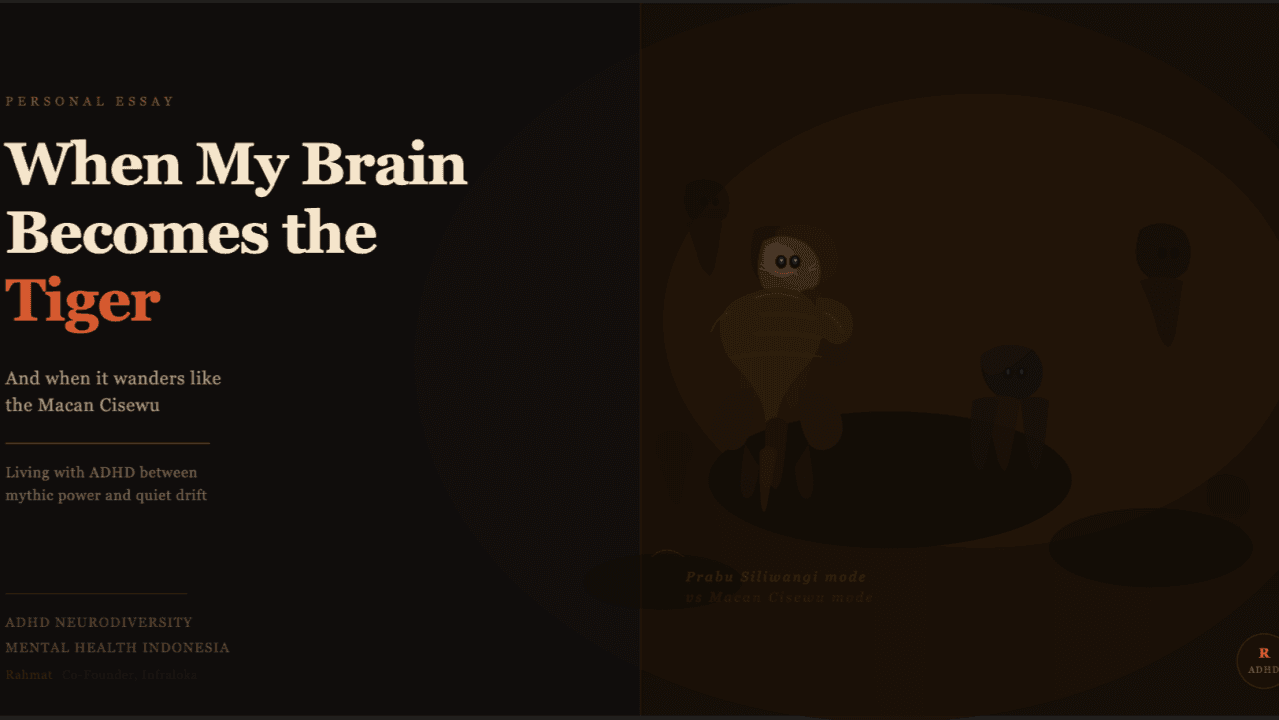
Living with ADHD is not a spectrum between focus and distraction. It is a rupture. A before and after. And nothing in Sundanese mythology captures that rupture more honestly than the difference between the maung of Prabu Siliwangi and the legend of Macan Cisewu.
Let me be honest about something most productivity content refuses to admit: not all focus is created equal. There is the kind of focus that is built slowly, deliberately, through habit and willpower. And then there is the kind that descends on you like something supernatural. Uninvited. Unstoppable. Otherworldly in its intensity.
That second kind is hyperfocus. And if you have ADHD, you know exactly what I am talking about.
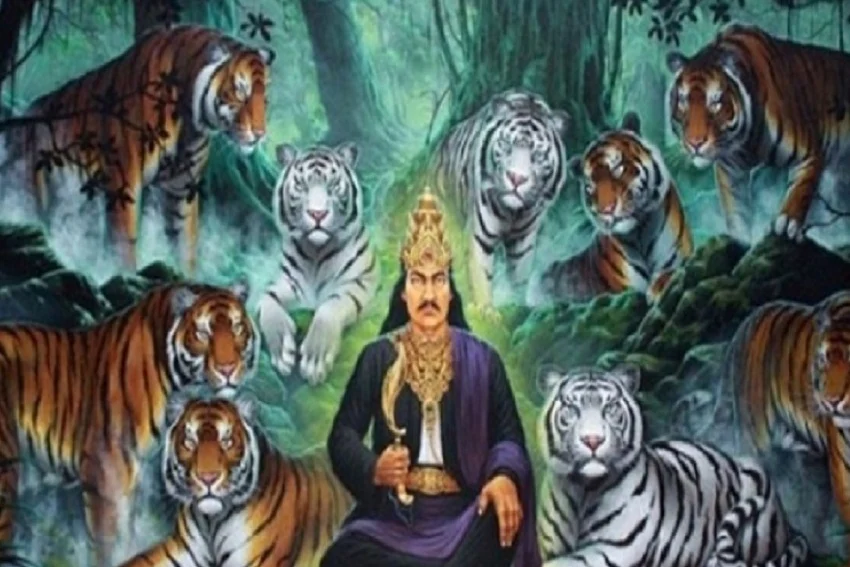
I have been thinking about the right way to describe this experience to people who have never felt it. And the image that keeps coming back to me is the legendary illustration of Prabu Siliwangi, the great king of Sunda, seated calmly at the center of a circle of tigers. Not fleeing them. Not commanding them with force. Simply existing in perfect harmony with something wild and immensely powerful.
"Hyperfocus does not feel like discipline. It feels like being chosen by something you cannot explain."
The hyperfocus state: Prabu Siliwangi and his tigers
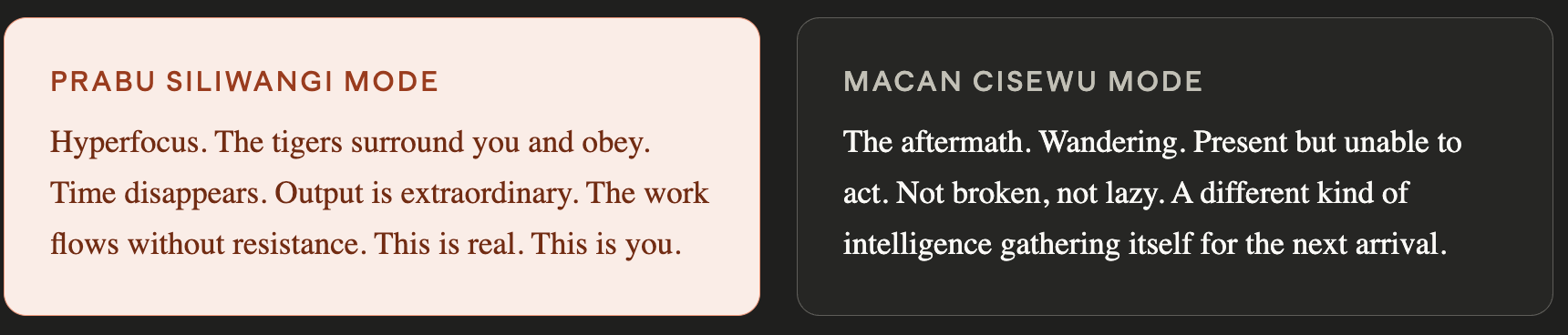
When hyperfocus arrives, the world does not get louder. It gets quieter. Everything that usually competes for your attention, the notifications, the ambient noise, the hundred half-formed thoughts, dissolves. What remains is the work. Only the work.
You do not check the time. You do not feel hunger. You move through material at a speed that surprises even you. You see connections across domains. You write or build or solve with a fluency that feels borrowed from somewhere beyond your ordinary self. Hours pass and you genuinely cannot account for them, not because you were distracted, but because you were so completely present that clock-time became irrelevant.
This is the ADHD brain in its full, mythological form. Majestic. Uncomfortably powerful. Capable of doing in three hours what would take others three days. Prabu Siliwangi did not tame his tigers. He coexisted with them because he understood their nature. That is the only relationship you can have with hyperfocus. You do not summon it. You do not schedule it. But when it appears, you learn to move with it and not against it.
In those moments, I have written entire frameworks in one sitting. I have mapped out strategies, read half a book, drafted content, and solved a problem that had been sitting unsolved for weeks. There is no crash yet. There is no awareness of the cost. There is only the extraordinary sensation of a mind operating at the ceiling of its capacity.
The aftermath: when the tiger becomes Macan Cisewu

And then it ends.
If you know Sundanese folklore, you know the Macan Cisewu. The tiger of Cisewu is not celebrated the same way as Prabu Siliwangi's maung. It exists in a different register. Quieter. Less glorious. Wandering. Unseen. Associated with the kind of presence that lingers in a landscape without being able to act on it.
That is the ADHD brain after hyperfocus disappears.
The first thing you notice is that the screen, which felt magnetic twenty minutes ago, now seems to push you away. You open the same document and feel nothing. The words do not connect. The logic that was obvious is now opaque. You are not tired in the way that sleep fixes. You are depleted in a way that has no easy name in productivity vocabulary.
"You are the same person. You are sitting in the same chair. But the tiger has left the room, and it did not tell you when it is coming back."
This is where ADHD gets misread as laziness, as inconsistency, as lack of discipline. People see the output of the hyperfocus phase and assume it reflects a standard you can maintain with effort. They do not see the Macan Cisewu phase, the afternoon where you cannot complete a three-sentence email, where basic administrative tasks feel like moving furniture through wet concrete.
And the cruelest part is that you know what you are capable of. You just lived it. The contrast makes the emptiness feel worse, not better.
You do not manage the tiger. You study the pattern.
I spent years trying to replicate hyperfocus on demand. Trying to manufacture the conditions. Trying to force the tiger to return on a schedule. It does not work like that. What I have learned instead is to study the terrain around it.
I have learned the early signals that hyperfocus is approaching, the particular kind of restlessness, the sudden magnetism toward a specific problem. I have learned to clear my calendar when I feel it arriving and not waste it on low-leverage tasks. I have learned that the Macan Cisewu phase is not failure. It is recovery. It is the system doing what it needs to do. Trying to override it with caffeine and guilt makes the next hyperfocus weaker, not stronger.
I have also learned that ADHD does not make you unreliable. It makes you different from the industrial model of human productivity, which assumes a flat, consistent, controllable output. But the world was not only built by consistent people. It was also built by people who disappeared into a problem for seventy-two hours and emerged with something no one else had thought of.
Prabu Siliwangi is remembered not because his tigers were domesticated. He is remembered because he understood their nature deeply enough to coexist with them at full power. That is the goal. Not to suppress the ADHD brain. Not to apologize for its cycles. But to understand it well enough to show up with the whole thing, tigers and all.
If you are someone with ADHD who has felt the whiplash between these two states, I see you. If you manage someone who has ADHD, the variance in their output is not inconsistency. It is a very human signal worth learning to read.
#ADHD #Neurodiversity #MentalHealth #WorkplaceInclusion #PersonalBranding #Leadership #SundaneseCulture #Indonesia #Infraloka #Productivity #GrowthMindset #Authenticity #PrabuSiliwangi #KnowYourself