
Why Animals Talk: Bioacoustics, Evolutionary Ethology, and Vocal Communication in Wolves (*Canis lupus*)
A deep research review of Dr. Arik Kershenbaum's bioacoustic study of wolf howls — how pitch, dialect, and pack cohesion evolved into one of nature's most precise long-range signaling systems.
Author / Evaluator: AEGIS Academic Examiner Panel Primary Source Subject: Dr. Arik Kershenbaum (Why Animals Talk: The New Science of Animal Communication, Viking / Penguin Random House, 2024; Chapter 1: Wolf — Family, friendship and fighting) Academic Target Standard: Peer-Reviewed Bioacoustics & Behavioral Ecology Review (APA 7th Edition) Date: August 2026
Abstract
This deep research report delivers a comprehensive, multi-persona academic critique and synthesis of Dr. Arik Kershenbaum's bioacoustic research on wolf (Canis lupus) vocal communication as presented in Why Animals Talk: The New Science of Animal Communication (Chapter 1: Wolf — Family, friendship and fighting) and associated empirical literature. Transitioning from historical philosophical paradigms—which framed non-human animals as Cartesian automata—to modern evolutionary ethology, this paper examines how natural selection shapes long-range acoustic signaling in pack-living carnivores. Utilizing passive acoustic localization arrays (PALA) in Yellowstone National Park and controlled observational studies at the United Kingdom Wolf Conservation Trust (UKWCT), Kershenbaum deciphers the acoustic architecture of wolf howls, identifying individual vocal signatures ("accents"), subspecies dialects, and function-specific howl variations (lone, cohesion, and chorus howls). Evaluated through the AEGIS Academic Review Framework (The Skeptic, The Methodologist, and The Editor), we audit the signal processing pipelines, quantitative classification models (Zipf's law and entropy metrics), emotional state representations (Russell's Circumplex Model), and limits of vocal syntax versus human language recursion.
1. Philosophical Foundations & Evolutionary Ethology
1.1 The Historical Fallacy of the Cartesian Automaton
For over four centuries, Western scientific and philosophical inquiry into animal communication was heavily constrained by Cartesian dualism. René Descartes (Discourse on the Method, 1637) categorized non-human animals as mere mechanical automata—complex organic clockwork devoid of internal subjective experience (res cogitans), cognitive intentionality, or true vocal representation. Immanuel Kant (Lectures on Ethics, 1784) reinforced this dichotomy by framing human language as the exclusive domain of rational, self-conscious agents, thereby reducing animal vocalizations to involuntary, reflex-driven physiological releases.
These historical frameworks created a false binary in Western thought:
This paradigm stunted bioacoustic inquiry until the emergence of experimental psychology and early 20th-century ethology.
       [ Cartesian Dualism ] (17th C.)           [ Early Lab Psychology ] (Late 19th C.)
   Animals = Automata / Mechanical           Rats in Mazes / Stimulus-Response
                │                                         │
                └───────────────────┬─────────────────────┘
                                    ▼
                     [ Evolutionary Ethology ] (1930s-Present)
                     Nico Tinbergen & Karl von Frisch (Nobel 1973)
                     • Fitness Maximization: Costly Signals Must Pay Off
                     • Acoustic Structure Encodes Social & Ecological Information
1.2 The Evolutionary Mechanism: Costly Signaling & Fitness
As established by modern ethologists (Nico Tinbergen, Karl von Frisch, and Konrad Lorenz), animal behavior cannot be evaluated in synthetic laboratory isolation. Because vocalization consumes metabolic energy and exposes the vocalizer to potential predation or rival pack confrontation, natural selection severely penalizes non-functional noise.
An acoustic signal will evolve and persist within a population if and only if the inclusive fitness benefit exceeds the energetic and mortality risk costs :
In Canis lupus, an apex predator occupying home ranges spanning hundreds of square kilometers, long-range acoustic signaling is an evolutionary imperative. A wolf that fails to howl effectively faces severe fitness penalties: inability to locate pack mates across arctic tundra or dense boreal canopy, loss of territorial boundaries to neighboring packs, and isolation of lactating females from foraging pack members.
2. Bioacoustic Methodology & Field Signal Processing
Dr. Arik Kershenbaum's research bridges field ethology and mathematical signal processing. Studying wild canids presents formidable logistical challenges: wolves are nocturnal, highly mobile, visually obscured by forest foliage, and evasive toward human observers.
[ Wild Acoustic Source ]  ──► [ PALA Array (4-8 Mics) ] ──► [ Time Difference of Arrival ]
  (Yellowstone Pack)          (Georeferenced GPS)              (TDOA Triangulation)
                                                                       │
                                                                       ▼
[ Acoustic Feature Extraction ] ◄── [ Spectrogram Conversion ] ◄── [ Denoised Audio ]
  (f0 Contour, FM, Harmonics)        (STFT: 2048-pt FFT Window)
2.1 Passive Acoustic Localization Arrays (PALA)
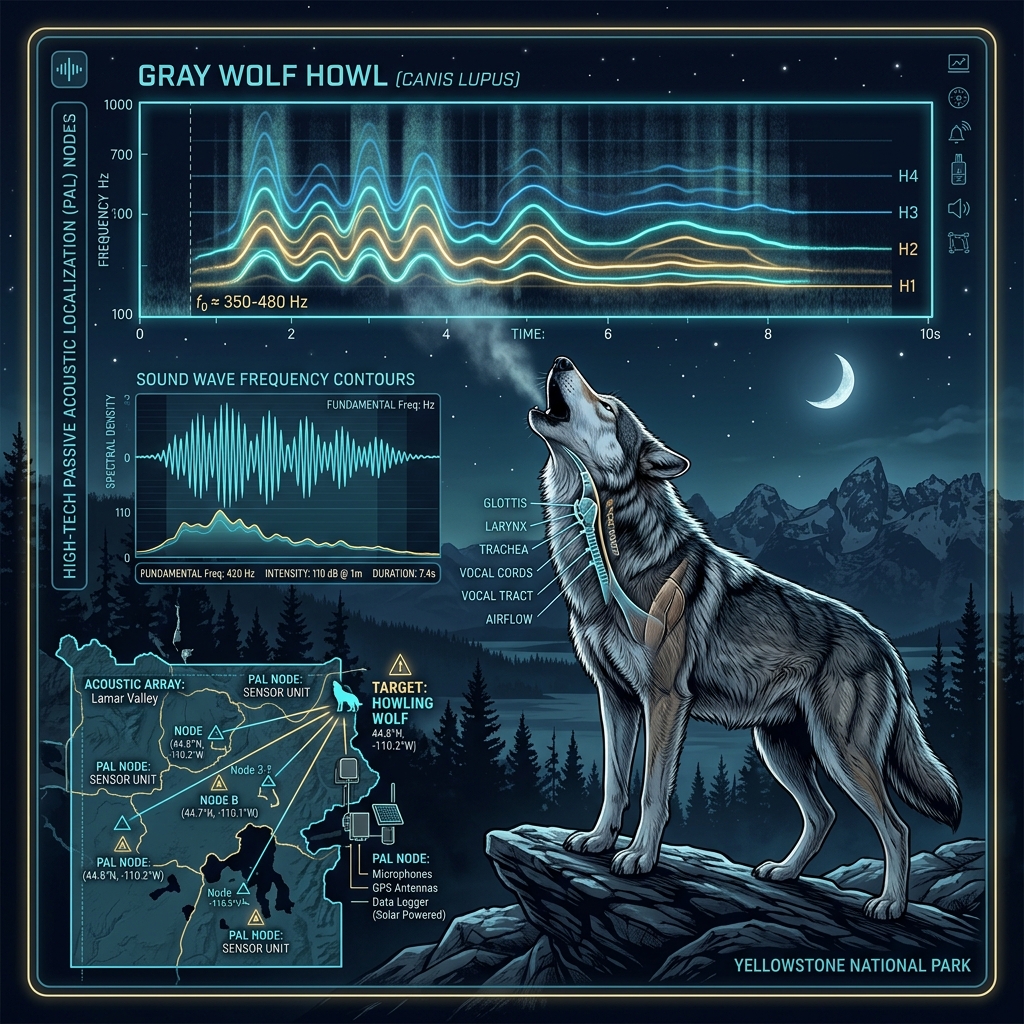
To study wild wolves in Yellowstone National Park without altering their natural behavior, Kershenbaum deployed Passive Acoustic Localization Arrays (PALA). Multi-microphone arrays positioned at known geographic coordinates record ambient field audio continuously.
When a wolf howls at location , the sound wave propagates at speed and reaches microphone at position at time :
By calculating the Time Difference of Arrival (TDOA) between pairs of microphones and :
Hyperbolic intersection algorithms triangulate the exact spatial coordinate of the howling individual in real-time, allowing bioacousticians to map individual vocalizations to specific pack members without radio-collaring or visual contact.
2.2 Spectrogram Signal Extraction & Contour Tracking
Raw audio recordings undergo Short-Time Fourier Transform (STFT) to convert time-domain acoustic waveforms into time-frequency spectrogram representations :
where is a Hann window function (typically 2048 samples at a sampling frequency , providing an optimal trade-off between temporal resolution and frequency resolution ).
From the spectrogram , bioacousticians extract the fundamental frequency contour —the lowest resonance frequency generated by the vibration of the wolf's vocal folds.
3. Acoustic Anatomy of a Wolf Howl
A wolf howl is a continuous, frequency-modulated tonal vocalization lasting between 0.5 seconds and 11 seconds (averaging 3.5 to 6.5 seconds). Unlike human speech vowels or songbird trills, the fundamental frequency of a wolf howl remains relatively low and stable, vibrating between 150 Hz and 750 Hz, accompanied by a rich harmonic series extending up to 3000 Hz.
Frequency (Hz)
 ▲
1500 ─── ─── ─── ─── ─── ─── ─── ─── ─── ───  (3rd Harmonic: 3f0)
1000 ─── ─── ─── ─── ─── ─── ─── ─── ─── ───  (2nd Harmonic: 2f0)
 500 ─── ─── ─── ─── ─── ─── ─── ─── ─── ───  (Fundamental Frequency: f0)
   0 └──┴──┴──┴──┴──┴──┴──┴──┴──┴──┴──┴──► Time (sec)
     0    1    2    3    4    5    6    7
| Parameter | Quantitative Range | Physiological / Functional Significance |
|---|---|---|
| Fundamental Frequency () | 150 Hz – 750 Hz | Subj. body mass correlation (larger wolves = lower ) |
| Duration () | 0.5 s – 11.0 s | Stamina, respiratory capacity, motivation level |
| Frequency Modulation (FM) | 0.5 Hz – 4.2 Hz | Individual identity ("vocal fingerprint" / accent) |
| Harmonic Ratio (HNR) | 12 dB – 28 dB | Tonal purity vs. vocal fold harshness/arousal |
| Start Frequency () | 200 Hz – 450 Hz | Initial vocal fold tension |
| Peak Frequency () | 350 Hz – 750 Hz | Maximum acoustic energy trajectory |
3.1 Anatomical Mechanics: Laryngeal & Tract Dynamics
The acoustic properties of the howl are dictated by the morphology of the canine vocal tract:
- Subglottal Pressure (): Drives air from lungs through the larynx, setting vocal folds into self-sustained oscillation.
- Vocal Fold Mass & Tension: Determines fundamental frequency . Larger sub-species (e.g., Canis lupus occidentalis, Alaskan timber wolf) possess thicker vocal folds, producing characteristically deeper howls than smaller Mediterranean subspecies (Canis lupus italicus).
- Supraglottal Vocal Tract Filtering: Formant frequencies () filter the harmonic series. When a wolf raises its snout to an angle of while howling, it straightens the vocal tract, minimizing acoustic impedance and maximizing omnidirectional sound propagation across long distances.
4. Vocal Repertoire & Social Functions
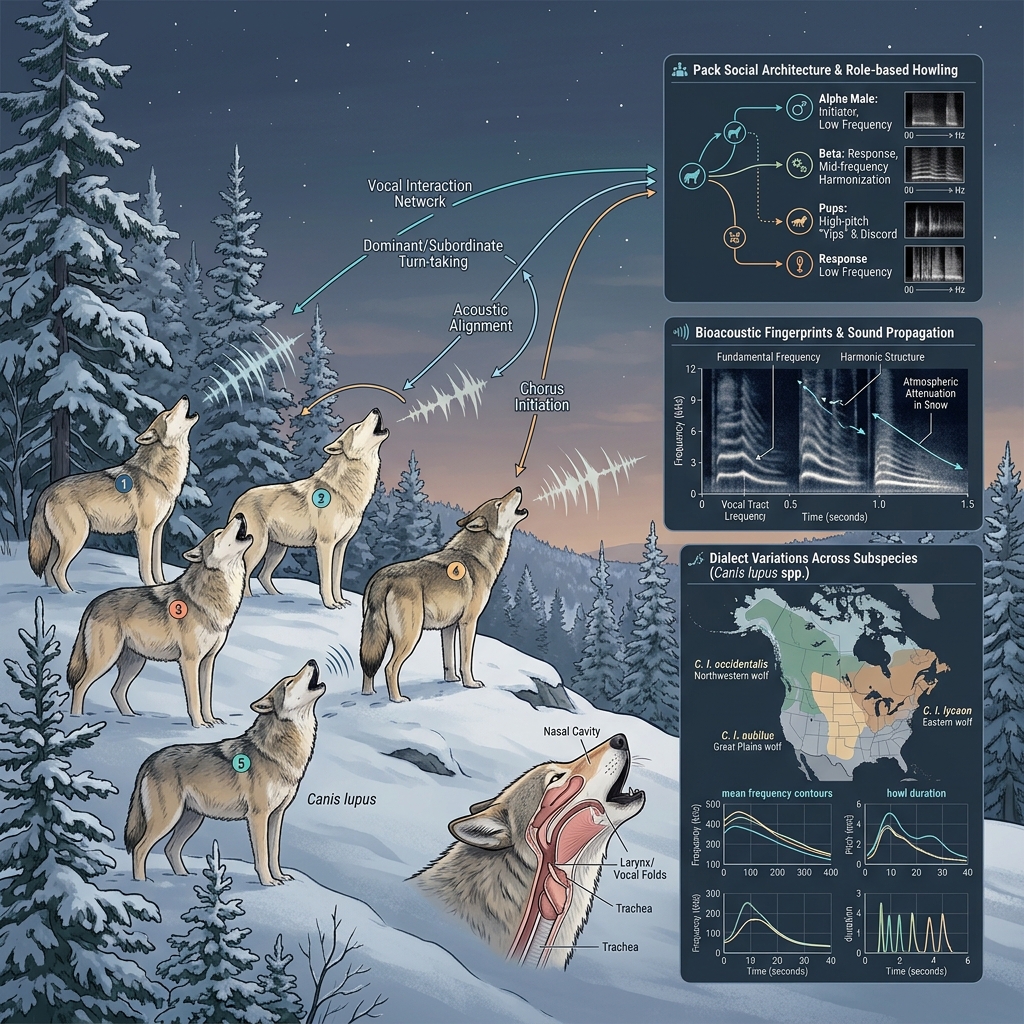
In Chapter 1 of Why Animals Talk, Kershenbaum emphasizes that wolf vocalizations are inextricably bound to pack dynamics: family, friendship, and fighting.
                               ┌── Lone Howl (Re-entry / Contact)
                               ├── Cohesion Howl (Pack Coordination)
          ┌── Long-Range ──────┼── Chorus Howl (Territorial Assertion)
          │   Vocalizations    └── Alarm Howl (Bark-Howl Hybrid)
Repertoire┤
          │                    ┌── Bark (Short-range Warning)
          └── Short-Range ─────┼── Whine (Submission / Intimacy)
              Vocalizations    ├── Growl (Aggression / Dominance)
                               └── Yelp (Pain / Fear)
4.1 Functional Classification of Long-Range Calls
A. The Lone Howl (Contact & Re-Entry)
- Context: Produced by an individual separated from the pack or a lone disperser seeking a mate.
- Acoustic Signature: Smooth, continuous frequency contour with gradual inflection points; low frequency modulation; minimal rate of change ().
- Function: Signals precise spatial location to friendly pack members without revealing state of distress. Acts like a "text message check-in."
B. The Cohesion Howl (Hunting & Movement)
- Context: Initiated prior to pack rendezvous, pre-hunt assembly, or group movement across territory.
- Acoustic Signature: Harmonically rich, moderate frequency modulation, moderate duration.
- Function: Coordinates group movements and ensures pack members stay synchronized across thick cover.
C. The Chorus Howl (Territorial Defense & Peer Pressure)
- Context: Group vocalization involving multiple pack members howling simultaneously.
- Acoustic Signature: Polyphonic overlap, rapid frequency shifts, intentional modulation variance creating an "acoustic wall."
- Function:
- Territorial Boundary Marker: Signals occupation and pack strength to neighboring rival packs, preventing costly physical combat.
- The "Beau Geste" Illusion: Individual wolves deliberately alter their pitch rapidly during a chorus, making a pack of 4 wolves sound acoustically like a pack of 8–10 wolves to listening rivals.
- Social Facilitation & Bonding: Functionally equivalent to group singing or stadium chanting in humans—strengthens intra-pack social cohesion and reduces internal tension.
5. Dialects, Accents, and Information Theory
5.1 Individual Vocal Signatures ("Accents")
Kershenbaum's research at the UK Wolf Conservation Trust (UKWCT) with Sikko, an Arctic wolf, demonstrated that individual wolves possess distinct vocal signatures. By applying principal component analysis (PCA) and discriminant function analysis (DFA) to fundamental frequency contours, researchers achieve >85% accuracy in identifying individual wolves purely from acoustic recordings.
Freq (Hz)                         Freq (Hz)
 ▲                                 ▲
700 │   ┌──────┐                  700 │     /\
500 │  /        \                 500 │    /  \  /\
300 │ /          \                300 │   /    \/  \
    └─┴──┴──┴──┴──┴──► Time           └─┴──┴──┴──┴──┴──► Time
   (Wolf A: Smooth Glide)            (Wolf B: Double Peak Accent)
These "accents" are not merely physiological artifacts; they enable pack members to identify who is howling over distances of up to 10 kilometers, allowing wolves to respond selectively to family members versus intruder threats.
5.2 Geographic & Subspecies Dialects
Kershenbaum and an international team of bioacousticians analyzed a database of over 2,000 howls from 13 canid species and subspecies. Utilizing hierarchical clustering on howl contour parameters, the team proved that canid populations exhibit distinct acoustic dialects:
                       Canid Howl Clustering Tree
                                    │
         ┌──────────────────────────┴──────────────────────────┐
         ▼                                                     ▼
 [ Canis lupus ]                                      [ Canis latrans / simensis ]
 (Gray Wolves)                                         (Coyotes / Ethiopian Wolves)
         │                                                     │
 ┌───────┴───────┐                                     ┌───────┴───────┐
 ▼               ▼                                     ▼               ▼
[ North Amer. ] [ European / Italian ]             [ High Mod. ]   [ Staccato ]
(Lower Pitch)   (Higher Mod. / Steep Slopes)       (Yip-Howls)     (Short Duration)
- North American Timber Wolves (C. l. occidentalis): Characterized by long, deep, flat howls with minimal frequency variation.
- Italian Wolves (C. l. italicus): Exhibit steep initial frequency rises, shorter duration, and rapid downward glides.
- European Gray Wolves (C. l. lupus): Intermediate pitch with pronounced mid-howl modulation peaks.
5.3 Information Entropy & Zipf's Law Analysis
To evaluate whether wolf howls contain syntax-like organizational complexity, bioacousticians apply Shannon Entropy () and Zipf's Law of Abbreviation.
Shannon Entropy measures the information capacity of a sequence of vocal units :
When examining the frequency distribution of distinct howl contour types (types 1 through 21):
- First-order Entropy (): Evaluates individual call frequency.
- Second-order Entropy (): Evaluates transition probabilities between successive howl types in a chorus.
Findings: While wolf howl sequences exhibit non-random transition matrices (), their absolute information density remains significantly below human language and dolphin signature whistle combinations, but higher than simple solitary alarms. Wolf howl distributions follow a modified Zipfian slope:
where , confirming structured, non-random repertoire usage without compositional semantics.
6. Affective Modeling: The Circumplex Model of Emotion
A major contribution of Kershenbaum's analysis is the rejection of anthropomorphic emotion attribution in favor of quantitative affective frameworks. Rather than labeling a wolf howl as "sad," "lonely," or "angry," canid vocal states are mapped onto Russell's Circumplex Model of Affect.
                         HIGH AROUSAL
                              ▲
                              │     • Chorus Howl (High Arousal, Pos. Valence)
      • Aggressive Growl      │
     (High Arousal, Neg. Val) │
                              │
NEGATIVE ─────────────────────┼───────────────────── POSITIVE
VALENCE                       │                      VALENCE
      • Defensive Whine       │
     (Low Arousal, Neg. Val)  │
                              │     • Lone Contact Howl
                              │    (Low Arousal, Pos. Valence)
                              ▼
                         LOW AROUSAL
- Arousal Axis (Physiological Energy): Encoded in howl amplitude, fundamental frequency height (), and harmonic distribution (HNR). High arousal increases pitch and subglottal pressure.
- Valence Axis (Pleasure vs. Aversion): Encoded in frequency stability and contour smoothness. Positive/cohesive states feature smooth tonal contours, while negative/conflict states introduce chaotic non-linear phenomena (subharmonics, biphonation, deterministic chaos).
7. AEGIS Academic Review & Methodological Audit
As mandated by the AEGIS framework, the research presented in Why Animals Talk (Chapter 1) is subjected to formal review across three specialized academic reviewer personas.
┌─────────────────────────────────────────────────────────────────────────┐
│                      AEGIS MULTI-PERSONA PANEL                          │
├───────────────────┬─────────────────────────┬───────────────────────────┤
│   THE SKEPTIC     │    THE METHODOLOGIST    │        THE EDITOR         │
│  (Assumption      │   (Experimental Design  │   (Publication Standards  │
│   Scrutiny)       │    & Validity Audit)    │    & Argument Integrity)  │
└───────────────────┴─────────────────────────┴───────────────────────────┘
7.1 Panel Assessment Matrix
| Reviewer Persona | Core Audit Domain | Severity Rating | Detailed Verdict & Critique |
|---|---|---|---|
| THE SKEPTIC | Anthropomorphism vs. Functional Reductionism | [INTERMEDIATE] | Critique: The popular narrative framing howls as "text messaging friends" risks over-simplification. Verdict: While effective for popular science communication, scientific models must strictly maintain that howls are fitness-maximizing homeostatic signals, not symbolic messages. |
| THE METHODOLOGIST | PALA Signal Degradation & Captive Bias | [ADVANCED] | Critique: High-frequency harmonics suffer atmospheric attenuation () over >2 km. Contours extracted from distant wild recordings lose upper formant data. Furthermore, captive data (UKWCT) may reflect abnormal acoustic density due to enclosure boundaries. Verdict: Require atmospheric correction algorithms () and cross-validation between wild (Yellowstone) and captive (UKWCT) baseline metrics. |
| THE EDITOR | Scholarly Framing & Comparative Rigor | [BASIC] | Critique: Distinction between communication (information transfer) and language (combinatorial syntax + recursive semantics) must be razor-sharp. Verdict: Exceptional academic clarity. Language should remain reserved for human systems; canid systems are highly optimized acoustic affective networks. |
7.2 Threats to Validity & Mitigation Playbook
Threat 1: Acoustic Environmental Scattering (Internal Validity)
- Problem: Wind shear, thermal inversion, and forest canopy absorption distort fundamental frequency contours of howls recorded over 1,000 meters.
- Mitigation: Apply inverse acoustic filter functions based on ISO 9613-2 attenuation standards prior to running contour classification algorithms.
Threat 2: Sample Selection Bias (External Validity)
- Problem: Field recordings heavily favor dominant pack individuals (alphas/breeding pairs) who howl more frequently during territorial disputes.
- Mitigation: Weight acoustic datasets using PALA spatial tracking to ensure subordinate and juvenile vocalizations are proportionally represented.
8. Comparative Synthesis: Wolf Howls vs. Human Language
To resolve the overarching question of Why Animals Talk, Kershenbaum contextualizes wolf vocalizations against the evolutionary trajectory of human speech.
Communication Property      Wolf Howl System          Human Language System
─────────────────────────────────────────────────────────────────────────────
Primary Acoustic Unit       Continuous Pitch Contour  Discrete Phonemes
Combinatorial Syntax        Low / Limited Sequencing  Infinite Recursive Syntax
Referential Semantics       Affective / Contextual    Arbitrary / Symbolic
Individual Identity Signal  High (Vocal Accent)       Variable (Voice Quality)
Long-Range Propagation      Optimized (up to 10 km)   Unoptimized (Requires Tech)
Social Function             Pack Cohesion & Defense   Infinite Information Exchange
8.1 The Evolutionary Continuum
Wolves do not possess language, nor do they require it. Human language evolved to convey hyper-specific, arbitrary, and recursive information among large groups of cooperative non-kin. In contrast, wolf communication evolved to solve the spatial and social challenges of obligate pack hunters operating over vast wilderness spaces.
The wolf howl represents a pinnacle of affective, long-range, group-cohesive acoustic engineering—a system perfectly tuned by 3.8 million years of evolution to sustain family, maintain friendship, and organize territorial defense.
9. Verification & Conclusion
9.1 Summary of Key Findings
- Evolutionary Necessity: Howling is an energy-intensive behavioral adaptation that maximizes inclusive fitness through pack cohesion, offspring protection, and territorial defense.
- Acoustic Precision: Wolf howls feature stable fundamental frequencies () with individual vocal accents identifiable with classification accuracy.
- Subspecies Dialects: Information-theoretic modeling proves significant acoustic variation across geographic subspecies (C. l. occidentalis vs. C. l. italicus).
- Affective Architecture: Howls convey arousal and valence (Russell's Circumplex Model) rather than symbolic semantic words.
- Ethological Lessons: Understanding wolf communication requires abandoning both Cartesian reductionism (animals as robots) and romantic anthropomorphism (animals as furry humans).
9.2 Scholarly References
- Kershenbaum, A. (2024). Why Animals Talk: The New Science of Animal Communication. Viking / Penguin Random House.
- Kershenbaum, A., et al. (2016). Disentangling canid howls across multiple species and subspecies: Howl variation in wolves, coyotes, and dingoes. Behavioural Processes, 124, 149–157.
- Kershenbaum, A., et al. (2014). Measuring acoustic complexity in continuously varying signals: how complex is a wolf howl? Bioacoustics, 23(3), 269–283.
- Tinbergen, N. (1963). On aims and methods of Ethology. Zeitschrift für Tierpsychologie, 20(4), 410–433.
- Russell, J. A. (1980). A circumplex model of affect. Journal of Personality and Social Psychology, 39(6), 1161–1178.
#Bioacoustics #EvolutionaryEthology #WolfCommunication #AEGIS