
Why Indonesian companies cannot jail you for a bad Google Maps review anymore Study Case of Nomni , Nomni.AI, Under PT Nomnie Technologies Indonesia
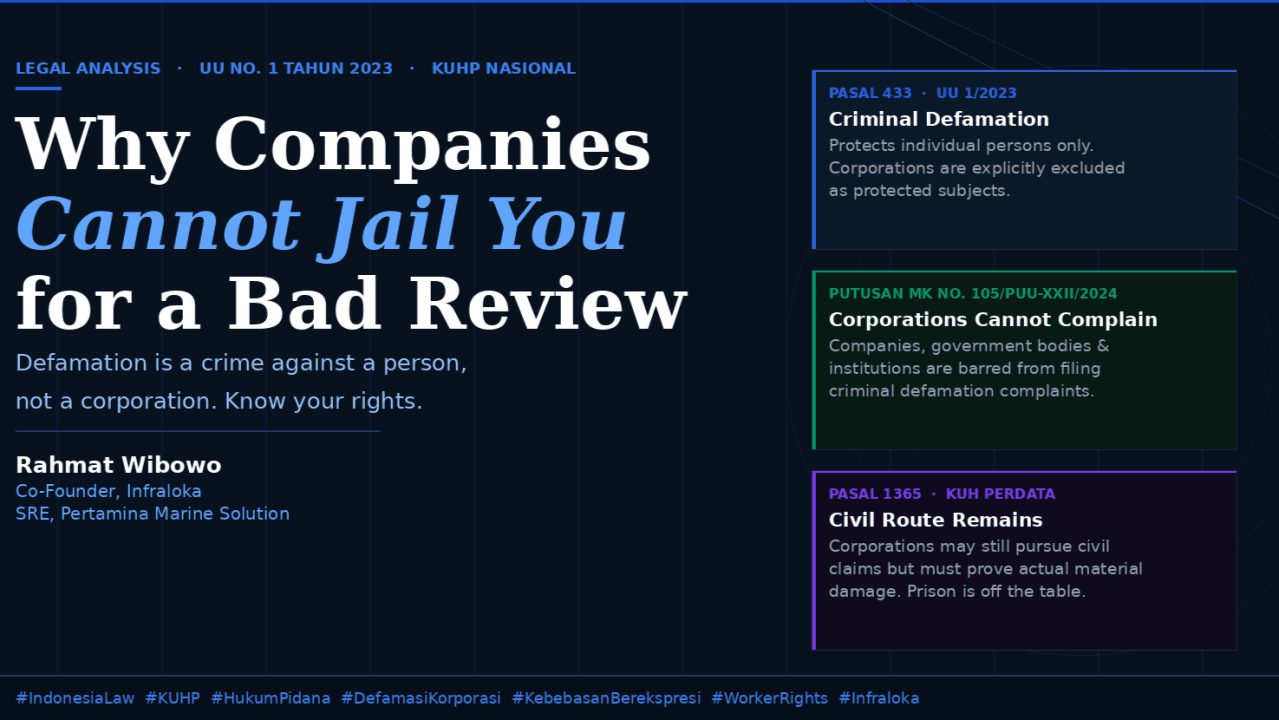
Under KUHP Nasional, defamation is a crime against a person, not a corporation. Here is what that means for every Indonesian worker, consumer, and professional.
The old fear was real
For years, a single negative online review in Indonesia could end someone's freedom.
A consumer posting about spoiled food at a restaurant. A patient sharing a poor hospital experience. An employee describing toxic work conditions. All of them were potential criminal defendants under the old UU ITE and the colonial-era Wetboek van Strafrecht (KUHP lama).
Companies and institutions used pencemaran nama baik (defamation) provisions aggressively. The threat alone, regardless of whether the claim was true, was often enough to silence critics. Pay up or face prison. Take down the post or face prosecution.
That era is legally over.
What KUHP Nasional actually says
UU No. 1 Tahun 2023, Indonesia's new Criminal Code that came into force in 2026, draws a clear and deliberate line in Pasal 433.
Pasal 433 ayat (1) defines defamation as an act by which a person verbally attacks the honor or good name of another individual (orang lain) by making accusations, with the clear intent for that accusation to become publicly known. The critical phrase is "orang lain" -- another person, an individual.
Penjelasan Pasal 433 ayat (1) UU 1/2023"Objek tindak pidana menurut ketentuan dalam pasal ini adalah orang perseorangan. Sedangkan, penistaan terhadap lembaga pemerintah atau sekelompok orang tidak termasuk ketentuan pasal ini."The object of the criminal offense under this provision is a natural person. Defamation against government institutions or groups of people is explicitly excluded.
This is not an ambiguity. It is a design choice. The legislature deliberately limited criminal defamation protection to individual human beings.
The Constitutional Court removed any remaining doubt
Before the new KUHP even came into force, Indonesia's Constitutional Court (Mahkamah Konstitusi) delivered a landmark ruling under Putusan Nomor 105/PUU-XXII/2024 that reshaped how Pasal 27A of UU ITE could be applied.
The Court ruled that criminal defamation complaints under UU ITE could only be filed by the person who had been directly defamed. Corporations, government bodies, professional groups, and institutions with specific identities were barred from being complainants.
The case was brought by environmental activist Daniel Frits Maurits Tangkilisan, who had faced prosecution after criticizing a shrimp pond operation. The court did not revoke the defamation article entirely, but drew a sharp boundary: only a human being whose name is directly attacked can activate the criminal complaint mechanism. This ruling aligned Indonesian law with the direction already established in KUHP Nasional's Pasal 433, making the legal position consistent across both frameworks.
The assumption: what if corporate defamation had stayed criminal?
Let us run the hypothetical that Pasal 433 had been drafted differently, extending criminal defamation protection to corporations and institutions alongside individuals. In that scenario, the following would arguably be criminal acts:
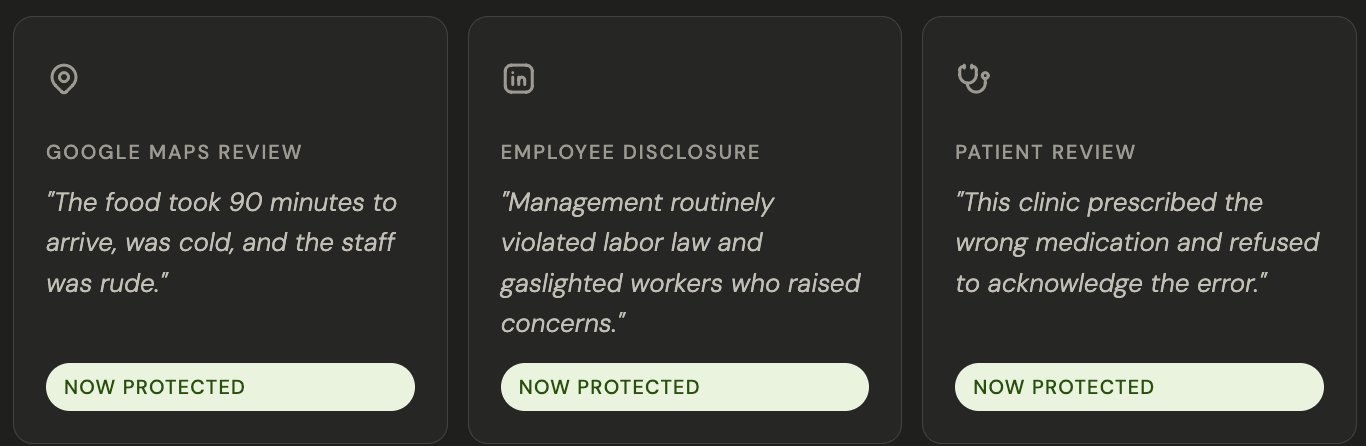
Under the old framework, all three of these were genuinely risky. Cases were filed. Arrests happened. People who told the truth went to prison or paid settlements to avoid it. The hypothetical collapses. A company cannot file a criminal defamation complaint against someone for leaving a bad Google Maps review. The provision simply does not apply to non-human entities.
Why this matters for freedom of expression
The structural problem with criminalizing corporate defamation is the power imbalance. When a large company, with its legal team, resources, and institutional credibility, can file a criminal complaint against an individual consumer or employee, the cost of truth-telling becomes prohibitive.
Even if the case ultimately fails, the process itself is the punishment.
International human rights organizations including Human Rights Watch have noted that Indonesia's defamation laws have historically been weaponized not just by the government, but by corporations seeking to suppress criticism. The MK ruling of 2025 was characterized as a positive step, though observers noted that powerful individuals can still pursue cases against vulnerable critics, meaning the reform is partial rather than complete.
What the penalties look like under the new KUHP
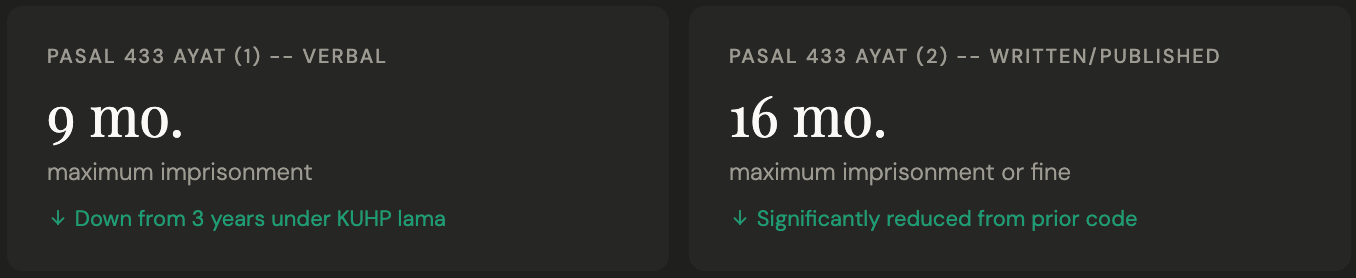
Critically, under Pasal 433, prosecution requires a complaint from the victim. This is a klachdelict: no complaint, no criminal case. There is no public prosecution for defamation. Only the person whose name is attacked can trigger the mechanism, not their employer's, their institution's, or their company's.
Civil liability: the channel that remains
Removing criminal standing does not mean corporations have zero recourse. A corporation that believes false statements have materially damaged its reputation retains the right to pursue civil litigation under Pasal 1365 KUH Perdata (perbuatan melawan hukum).
The burden shifts: the corporation must prove actual damage, not merely assert harm. The defendant faces financial risk, not imprisonment. And truth is a complete defense -- a review that accurately describes an experience is generally not actionable in tort. For ordinary consumers and workers sharing genuine experiences, the civil route is far less threatening. The evidentiary burden falls where it belongs: on the party claiming harm.
Practical implications for professionals and consumers
For employees who have experienced labor violations and want to speak publicly, a factual account directed at the company as an institution, absent malicious fabrication, falls outside the scope of Pasal 433.
For consumers who want to leave honest reviews on Google Maps, Tokopedia, or any platform, an accurate description of your experience is not criminal defamation. The business cannot file a criminal complaint.
The caveat that consistently applies: if a post contains fabrications specifically designed to destroy a named individual's reputation, Pasal 433 is alive and available to that individual. The protection of honest expression does not extend to deliberate lies about a specific person.
The broader context: Indonesia is moving in the right direction
This is not a complete reform. Legal scholars and human rights advocates have consistently argued that defamation should be decriminalized entirely, treated as a civil matter in line with international norms. But the direction of travel is visible. KUHP Nasional reduces the maximum penalty. It limits criminal defamation to individual victims. It requires the victim's own complaint to activate prosecution. The Constitutional Court reinforced that corporations and institutions cannot weaponize the criminal complaint system against critics. That is a meaningful body of reform, even if the work is not finished.
Personal account / First-person opinion
When the blacklist becomes the defamation
I am sharing this not just as legal analysis, but as someone who has lived this directly.
I am a former employee of Liven, a technology company operating in Indonesia. I was terminated during my probation period under circumstances that I consider unlawful under Indonesian labor law. That alone is a dispute I am addressing through the appropriate legal channels.
What concerns me beyond the termination itself is what followed: a blacklist status attached to my name within professional circles. A former employer, through its institutional weight, signaling to the market that I am not to be hired, not to be trusted, not to be engaged with professionally.
I am raising this within the scope of criminal law analysis for a specific reason: the law has something to say about this scenario, and it runs in a direction that many employees do not realize.
The legal inversion
Under Pasal 433 UU No. 1 Tahun 2023, the protected subject is an individual person. I am an individual person. A company cannot be criminally defamed under the current framework. But I can. If a company circulates false characterizations about my professional conduct or fabricates grounds for a blacklist that do not reflect reality, the question that arises is this: who is the defamation victim here?
A blacklist, when communicated to third parties based on false or misleading characterizations of a former employee, may constitute pencemaran nama baik against that employee. The individual whose career, reputation, and economic opportunities are damaged by false professional labeling has standing under Pasal 433 that the company itself does not.
Historically, companies used defamation law as a sword against employees who spoke publicly. The new legal framework shifts that posture. An employee who is falsely labeled, blacklisted without legitimate basis, or subjected to coordinated reputational attacks through professional networks now has criminal law on their side in a way that their former employer does not.
I am warning other professionals: if you were terminated during probation, if you have been labeled as blacklisted by a former employer, and if that characterization does not reflect the factual record of your conduct, you are not powerless under Indonesian law.
Speak your truth. Know the law behind it.
Summary
Under Pasal 433 UU No. 1 Tahun 2023, criminal defamation protects individual human beings only. Corporations, government bodies, institutions, and professional groups are explicitly excluded.
Putusan MK No. 105/PUU-XXII/2024 reinforced this by barring non-individual entities from filing criminal defamation complaints under UU ITE.
A company cannot pursue criminal defamation charges against a consumer who leaves a bad Google Maps review, an employee who describes a workplace violation, or a journalist who critically covers corporate conduct.
Civil recourse for demonstrably false and damaging statements remains available. But the power to put a critic in jail has been structurally removed for institutional complainants.
A blacklisted former employee who is falsely labeled has stronger criminal law standing than the company that labeled them.
The analysis in this article is for informational and educational purposes only. It does not constitute legal advice. For specific situations, consult a qualified Indonesian legal practitioner (Advokat terdaftar di PERADI).
#IndonesiaLaw #KUHP #HukumPidana #DefamasiKorporasi #UUNo1Tahun2023 #PencemaranNamaBaik #KebebasanBerekspresi #HukumIndonesia #LegalInsight #CorporateLaw #Infraloka #RahmataLilAlamin #DigitalRights #ConsumerRights #WorkerRights #HukumKetenagakerjaan