
Why UAVs Trust 433 MHz: Physics, Open Spectrum & Private Networks By Rahmat Wibowo From Infraloka
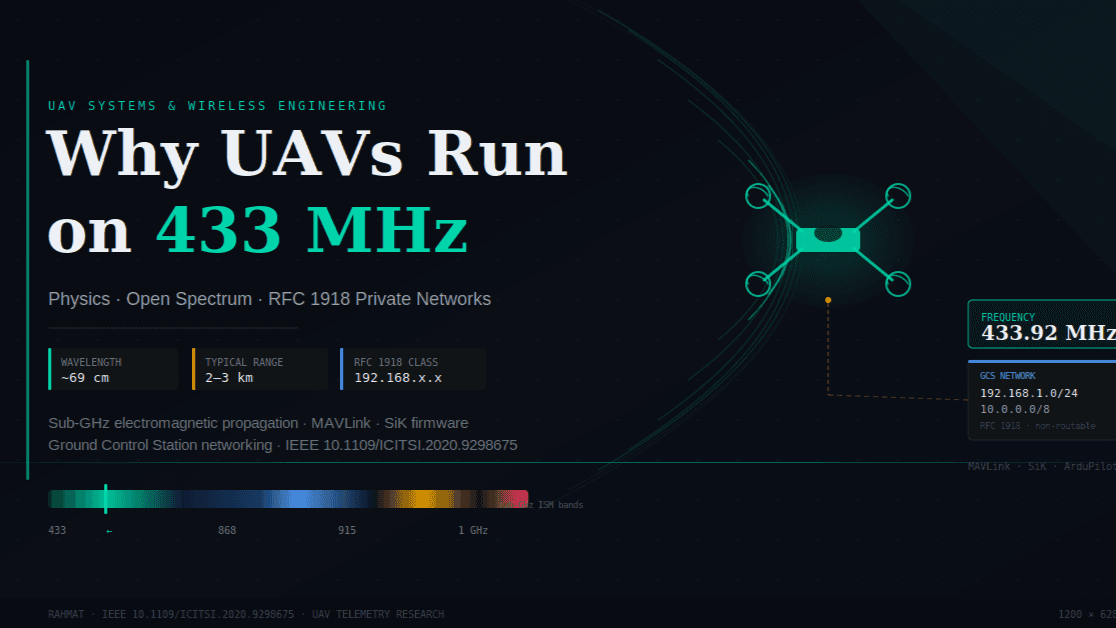
From sub-GHz propagation physics to RFC 1918 IP addressing — a systems-level look at how UAV telemetry works end-to-end, and why the frequency choices you make on the radio link cascade into your network architecture.
When you watch a UAV hold its position 1.5 km away and relay GPS, battery, airspeed, and attitude data back to your laptop in real time, you're witnessing the convergence of radio physics, open-spectrum policy, and internet protocol engineering — all compressed into a module the size of a thumb drive.
At the heart of most open-source UAV setups — ArduPilot, PX4, Pixhawk — sits a 433 MHz or 915 MHz telemetry radio running the MAVLink protocol. This article unpacks why 433 MHz became the dominant frequency for UAV telemetry in much of the world, what the open sub-GHz spectrum landscape looks like, what electromagnetic physics drives the choice, and how RFC 1918 private addressing ties the radio link to your ground station network.
This discussion is grounded in the research context of UAV ground control station (GCS) architectures explored in my IEEE-published work on UAV monitoring systems.
Open Sub-GHz Spectrum: A Global Patchwork
Sub-GHz frequencies — broadly defined as frequencies below 1 GHz — occupy a unique regulatory and physical sweet spot for wireless systems. They are old enough to be well-understood, long-wavelength enough to propagate far, and increasingly regulated under license-exempt ISM (Industrial, Scientific, and Medical) band frameworks.
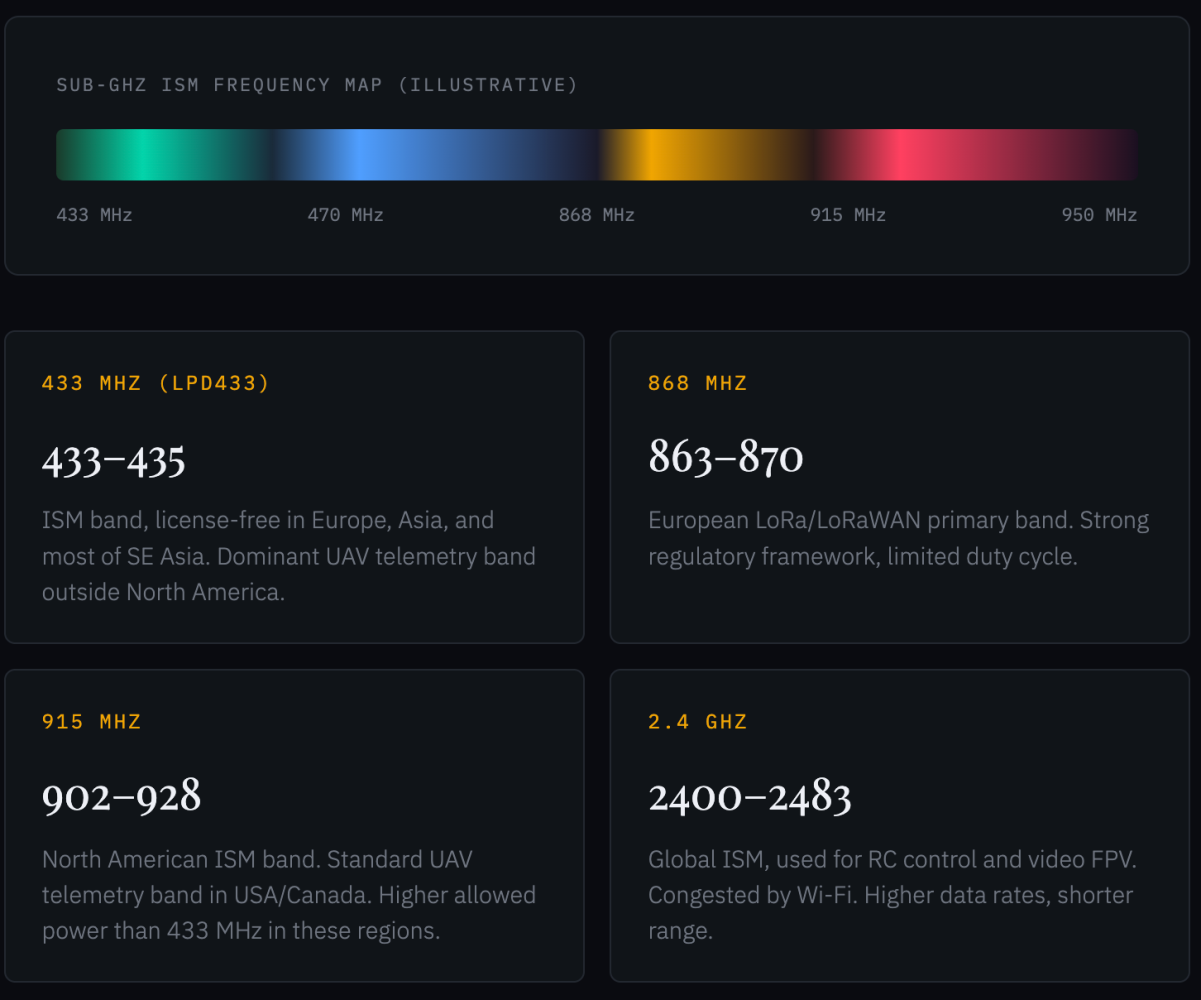
The 433.050–434.775 MHz LPD433 band — centered at the famous 433.92 MHz — is license-free across most of Europe, Asia, Africa, and Southeast Asia including Indonesia. This makes it the natural default for UAV builders operating under those regulatory frameworks. In Indonesia, SDPPI (Direktorat Jenderal Sumber Daya dan Perangkat Pos dan Informatika) regulates these ISM bands, generally permitting low-power 433 MHz devices within ITU Region 3 allocations.
Regulatory note: In Europe, 433 MHz telemetry is limited to ~10 mW ERP under the R&TTE/RED directive, yielding multi-kilometer range in open terrain. Amateur radio licensing can remove this power cap. In North America, 915 MHz is the equivalent open band — 433 MHz is not license-free there. Always verify with your local spectrum regulator before field deployment.
Why 433 MHz Is Exceptional for UAV Telemetry
The choice of frequency is not arbitrary — it is dictated by electromagnetic wave physics. Lower frequencies have longer wavelengths (roughly 69 cm at 433 MHz vs. 12.5 cm at 2.4 GHz), and this single physical fact cascades into multiple operational advantages.
📡 Lower Free-Space Path Loss. Path loss scales with the square of frequency. A signal at 433 MHz experiences significantly less free-space attenuation over the same distance than at 2.4 GHz, translating directly into longer range for the same transmit power.
🌳 Superior Obstacle Penetration and Diffraction. Longer wavelengths diffract more readily around buildings, trees, and terrain features. This is critical for UAVs flying at altitudes of 15–50 m, where Non-Line-of-Sight (NLoS) propagation is common, especially in suburban or forested environments.
🔋 Power Efficiency. Achieving a given link margin requires less transmit power at 433 MHz than at higher frequencies. This matters enormously on small UAVs where every milliwatt drawn from the battery competes with motors, sensors, and flight computers.
📶 Less Atmospheric Absorption. Frequencies above 1 GHz begin to experience measurable absorption from water vapor and rain. At 433 MHz, atmospheric effects are negligible at the range scales relevant to UAV operations.
🚫 Separation from Wi-Fi Congestion. The 2.4 GHz band is saturated with Wi-Fi traffic in urban environments. Research has shown that 433 MHz UAV control links achieve 6× longer distances than 2.4 GHz links in interference-heavy environments, and fail-safe events are dramatically reduced.
At 433 MHz, the antenna wavelength is long enough to bend around the world you're trying to observe — rather than bouncing off it.
Antenna geometry also follows: a quarter-wave whip at 433 MHz is approximately 17 cm — manageable on both airframe and ground station. The same antenna at 2.4 GHz is just 3.1 cm but is far more sensitive to ground plane geometry and polarization mismatch. Studies comparing antenna types at 433 MHz show Nagoya-style antennas outperforming standard rubber ducks by approximately 9 dB — a meaningful link budget improvement at range.
03 — The Protocol Layer
MAVLink Over 433 MHz: The SiK Radio Standard
The physical 433 MHz link is almost universally paired with the SiK firmware stack (open-source, named after its co-author Simon "SiK" Thoete) running on Si1000-family radio chips. SiK radios implement adaptive frequency hopping spread spectrum (FHSS), configurable air data rates (1–250 kbps), and transparent serial bridging — making them effectively a wireless UART cable for the MAVLink protocol above.
MAVLink (Micro Air Vehicle Link) is a lightweight, header-only binary protocol transmitting structured messages — attitude, GPS, battery, mode changes, waypoints — at 1–10 Hz update rates. Version 2 adds packet signing and a 24-bit message ID space. Each packet is just 8–280 bytes. The combination of MAVLink's compactness and 433 MHz's range profile makes this stack standard in open-source flight stacks including ArduPilot and PX4.
Typical link budget at 433 MHz (SiK, 100 mW): Transmit power: +20 dBm | Antenna gain (Nagoya): +2 dBi | Path loss at 1 km: ~85 dB | Receiver sensitivity: −117 dBm | Link margin: ~54 dB — sufficient for 2–3 km in open terrain with significant fade margin.
RFC 1918 and the UAV Ground Control Network
The 433 MHz radio link delivers MAVLink bytes to the ground. But those bytes need to reach software — Mission Planner, QGroundControl, a custom GCS — running on a laptop, tablet, or a multi-operator network. This is where TCP/IP and RFC 1918 enter the picture.
RFC 1918, published by the IETF in February 1996, defines three blocks of IPv4 address space reserved for private, non-routable use within organizational intranets:
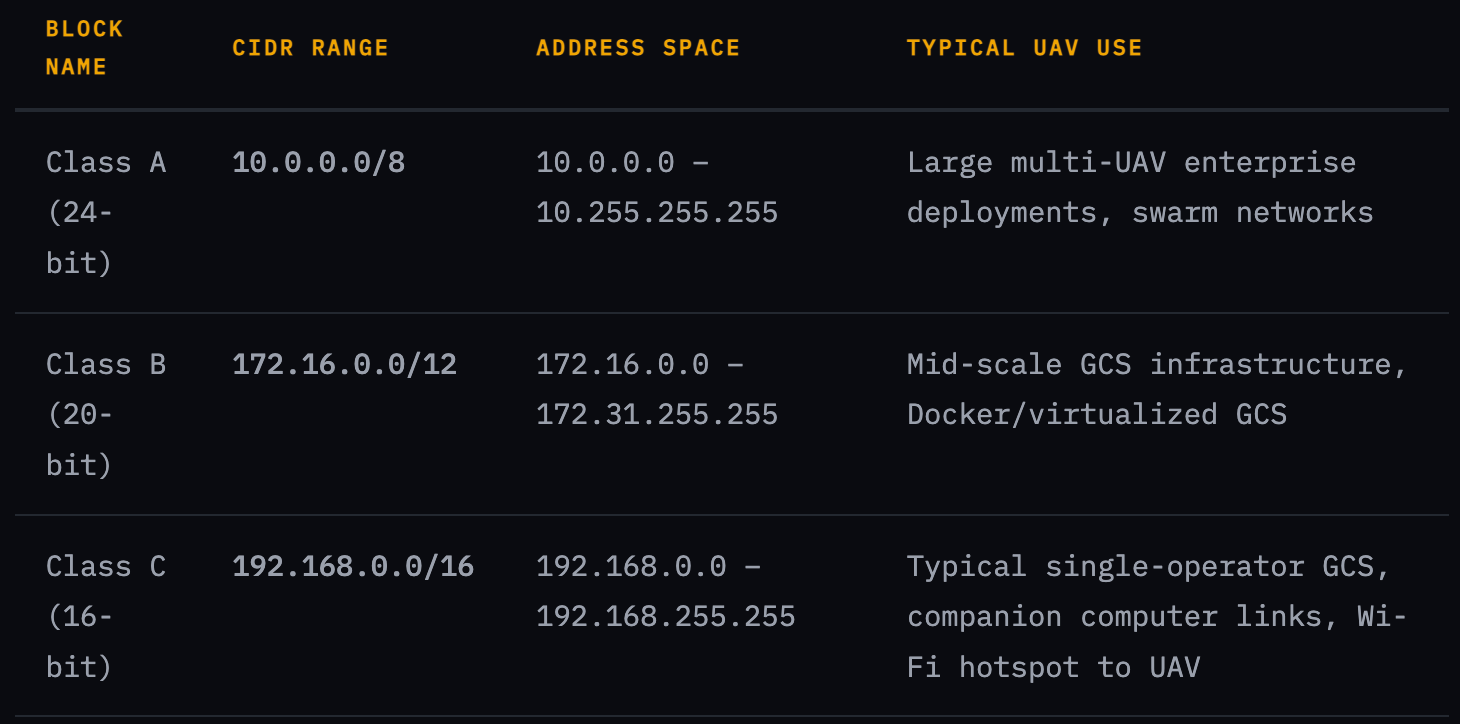
These addresses are non-routable on the public internet — a packet sourced from 192.168.x.x will be dropped by any properly configured border router. This is by design: it creates a contained, isolated network space for the UAV system's internal communications without consuming publicly registered IP addresses.
In a typical UAV deployment, the architecture looks like this: the 433 MHz telemetry radio connects via USB to a companion computer or GCS laptop, which exposes a serial-to-UDP or serial-to-TCP bridge. MAVLink traffic flows over this bridge on the local LAN — typically 192.168.1.x or 10.0.0.x. Multiple operators can then subscribe to MAVLink streams simultaneously, and mission planning software connects to the GCS server via standard socket addresses within the RFC 1918 space.
Why RFC 1918 matters for UAV security: Because these addresses never appear on the public internet, they inherently reduce the UAV system's external attack surface. However, within the private LAN, MAVLink v1 sends no authentication headers — an attacker on the same subnet can inject commands. This motivates either MAVLink v2 signing, or IP-layer isolation (VLANs, firewall rules) within the RFC 1918 space. Network segmentation is architecture, not an afterthought.
The Full Stack, From Hertz to Host
The complete picture, then, is a coherent vertical stack:
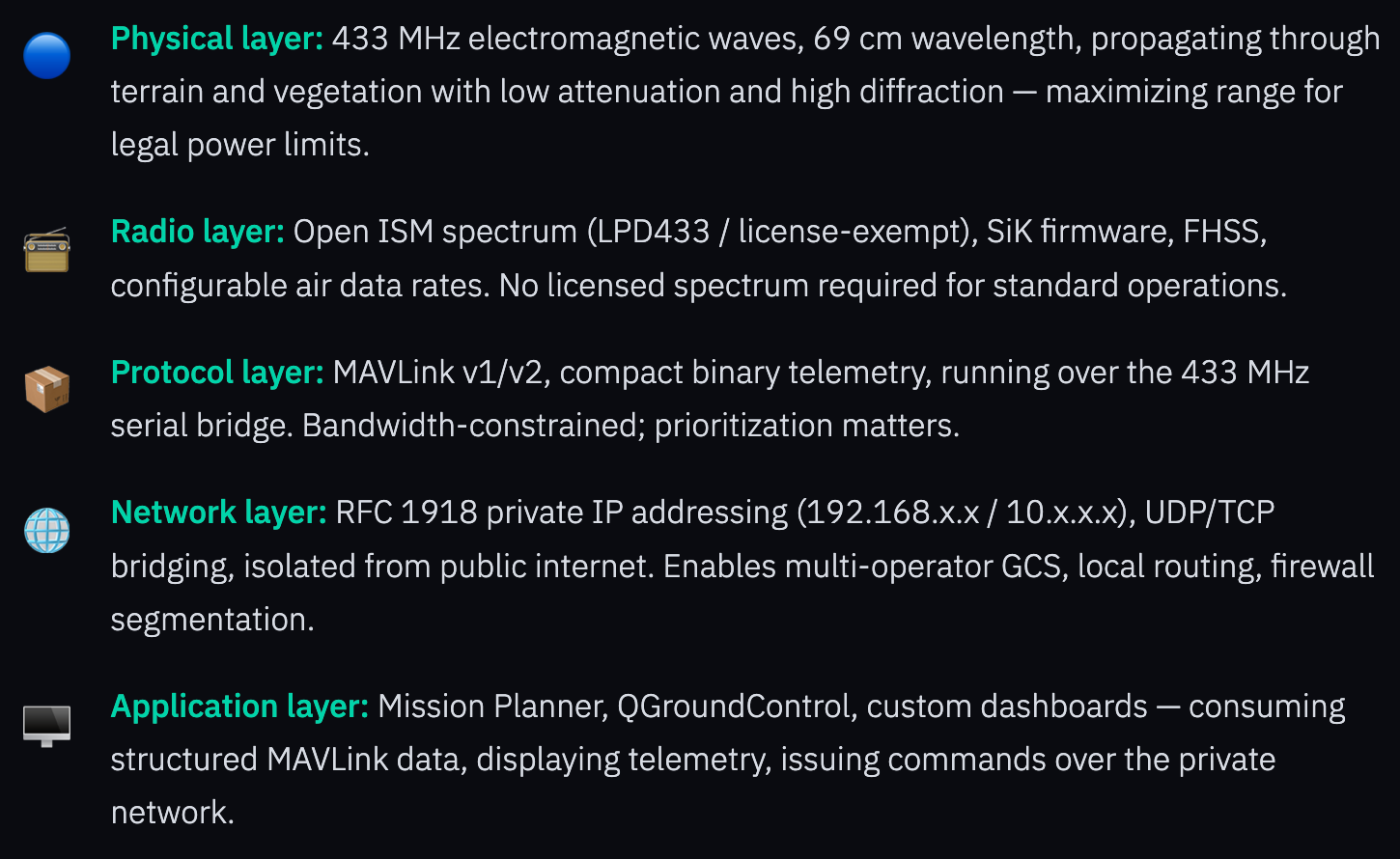
The choice of 433 MHz is not nostalgia or convenience — it is the result of optimizing across this entire stack simultaneously. For the bandwidth, range, power, and regulatory requirements of most UAV telemetry applications in Regions 2 and 3, it remains the most efficient solution available in open, unlicensed spectrum today.
As UAV operations scale — toward swarms, BVLOS, urban air mobility — the pressure on this stack will grow. But the foundational physics of sub-GHz propagation, the discipline of private network addressing from RFC 1918, and the open ecosystem around MAVLink will remain the baseline from which next-generation architectures are built.
#UAV#Telemetry#433MHz#SubGHz#MAVLink#RFC1918#DroneEngineering#WirelessCommunications#ISMBand#GroundControlStation#BVLOS