
Arif Kautsar Nibras Senna: When a Public Legal Debate Became Personal
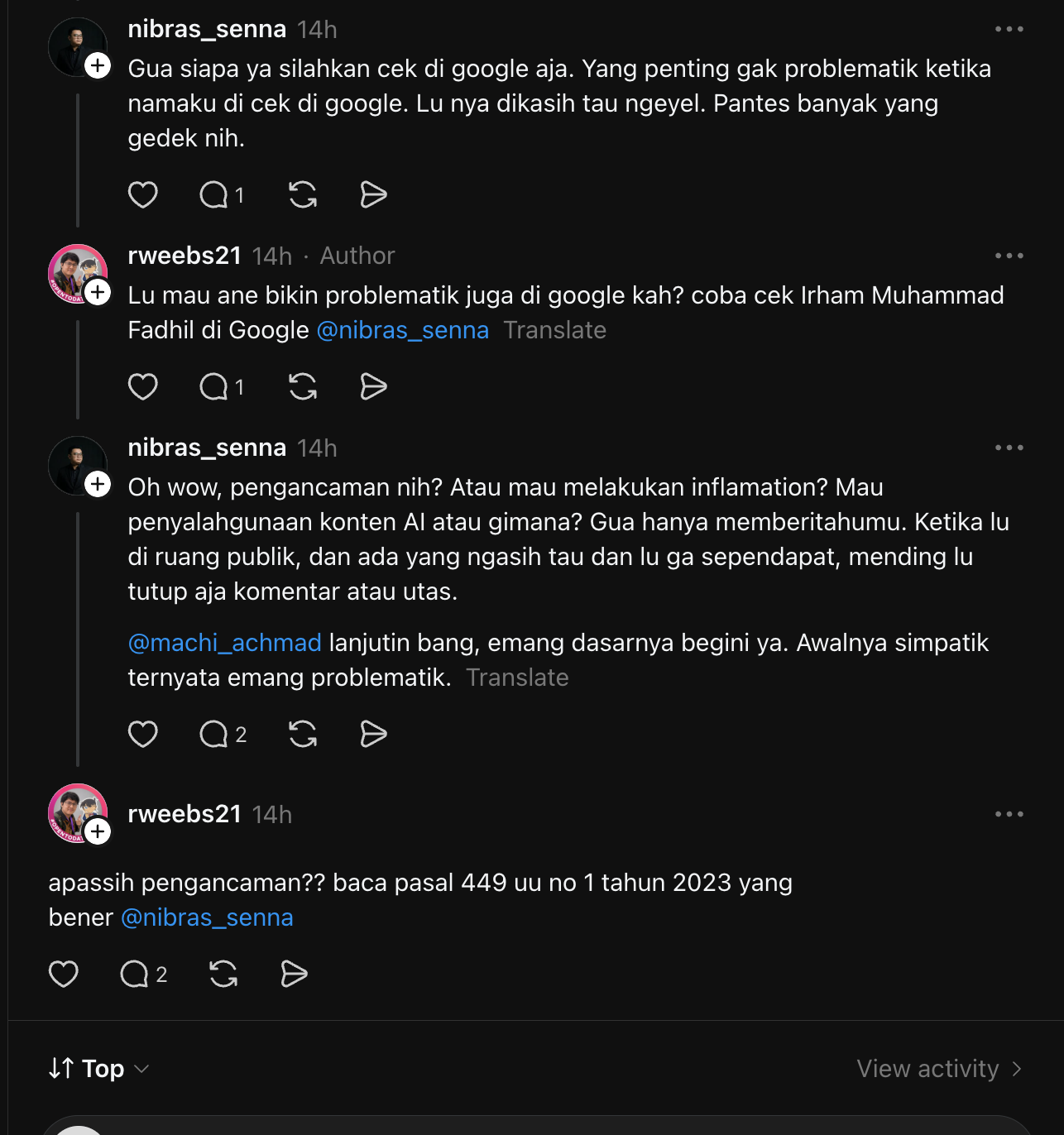
Evidence-based account of my Threads exchange with Arif Kautsar Nibras Senna: what he argued, where I escalated, and why professional trust matters.
I began the thread by questioning the conduct of a lawyer involved in a separate dispute. Arif Kautsar Nibras Senna was not the original subject. He entered the public conversation, said that I appeared “problematic,” and challenged how I responded to people who disagreed with me.
The discussion then stopped being about professional ethics and became a fight over intent, language, credentials, and character. Arif interpreted one of my replies as a possible threat. I rejected that interpretation. He consulted Meta AI. I mocked him for doing so. Later, I published insulting and speculative statements about him that went beyond the evidence in the exchange.
That full sequence matters. A professional record should not omit the conduct of its author.
Scope and identity note
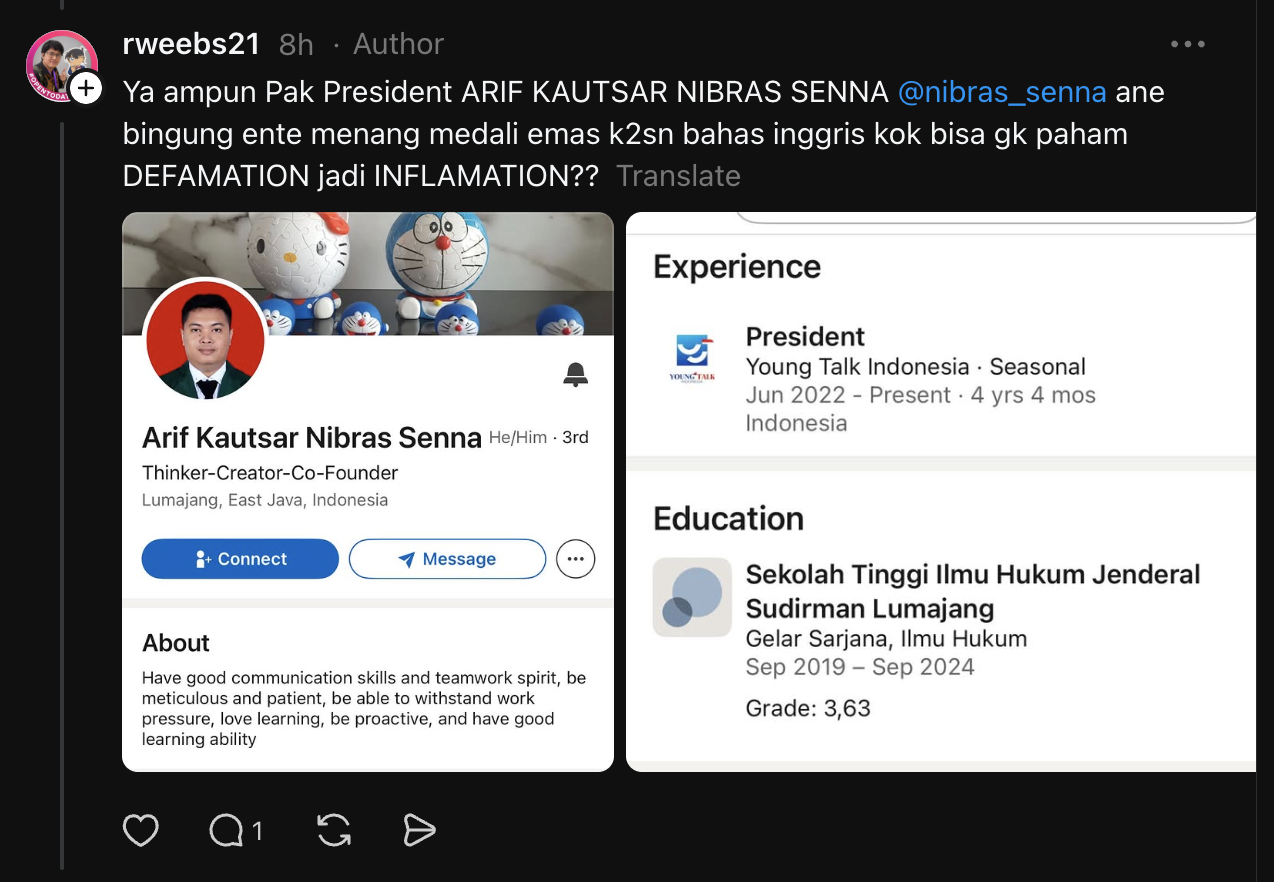
This article is based on 16 screenshots supplied from a public Threads discussion and public-profile pages in the folder temp/advocat aneh. The screenshots associate the Threads handle @nibras_senna with the displayed name Arif Kautsar Nibras Senna. A separate screenshot shows a LinkedIn profile under the same name. I have not independently authenticated account ownership, the complete platform export, or the unshown context beyond these captures.
For that reason, this article describes what the screenshots show. It does not declare that either person committed a crime, and it does not present a court finding, disciplinary ruling, or independent legal opinion.
How the exchange began
My original thread asked whether the conduct of lawyer Machrio Achmad Nurhatta was consistent with the ethical obligations of an advocate. I document that underlying dispute separately in When a Licensed Lawyer Becomes the Threat. Other participants argued about whether private conversations could lawfully be published and whether my interpretation of the law was correct.
Arif then wrote, in Indonesian:
“Emang problematik kalo ini mah. Dikasih tau yang bener malah ngeyel sendiri. Merasa dirimu yang paling paham?”
A fair English rendering is:
“This is indeed problematic. You were told what was right but kept insisting otherwise. Do you think you understand it better than everyone else?”
This was blunt and personal, but it was still criticism made inside an already contentious public discussion. It did not, by itself, prove harassment, defamation, or professional misconduct.
The sentence Arif read as a threat
Arif said that anyone could search his name online and that, unlike mine, it would not appear problematic. I replied:
“Lu mau ane bikin problematik juga di Google kah?”
The closest natural translation is:
“Do you want me to make you look problematic on Google too?”
Arif asked whether this was a threat, defamation, or misuse of AI-generated content. He also tagged Machrio and encouraged him to continue.
My intent was to say that public conduct can itself become part of a searchable record. But intent is not the only thing that controls how words are received. Read literally and without that explanation, my sentence could reasonably sound like a warning that I would damage his online reputation. I should have written the point directly instead of using confrontational wording.
This is an important distinction: a statement can be poorly judged or intimidating in tone without automatically satisfying the legal elements of a criminal threat. The screenshots alone are not enough to decide that legal question.
The Meta AI detour
When I asked Arif to identify the legal basis for his interpretation, he asked Meta AI to explain my sentence. The AI characterized it as a conditional threat and offered a legal-sounding explanation.
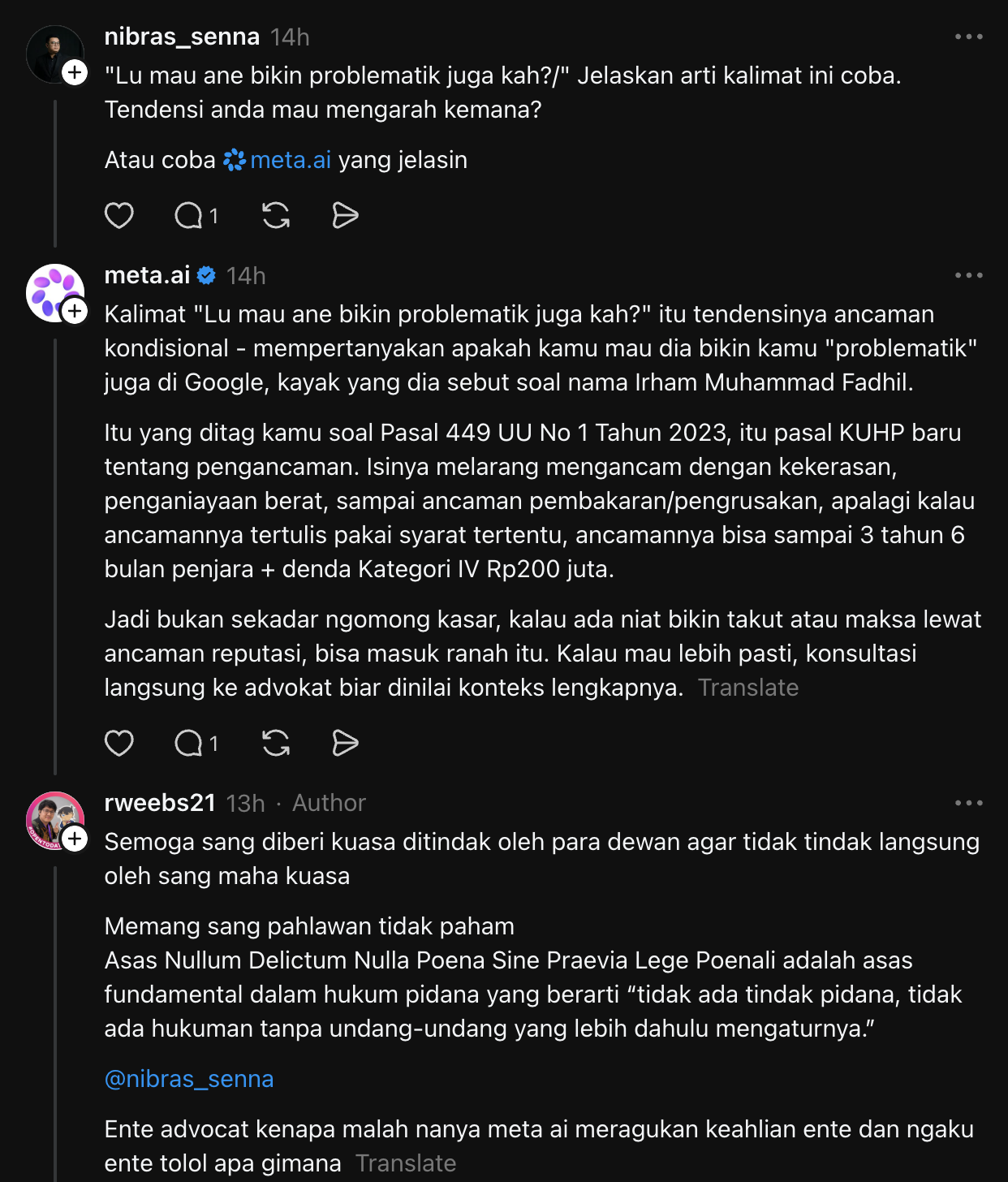
I criticized Arif for using an AI response in a legal disagreement. The underlying criticism had merit: an AI answer is not legal authority, and a generated summary cannot replace the statutory text, complete factual context, or advice from a qualified lawyer.
My delivery did not have merit. I turned the point into a personal insult and assumed that Arif was an advocate. That assumption was wrong.
Arif corrected it plainly:
“Emang nya saya advokat? Dengan begini memang menunjukkan semua ucapan, semua tindakan mu itu murni berdasarkan asumsi.”
In English:
“Am I an advocate? This shows that your words and actions are based entirely on assumptions.”
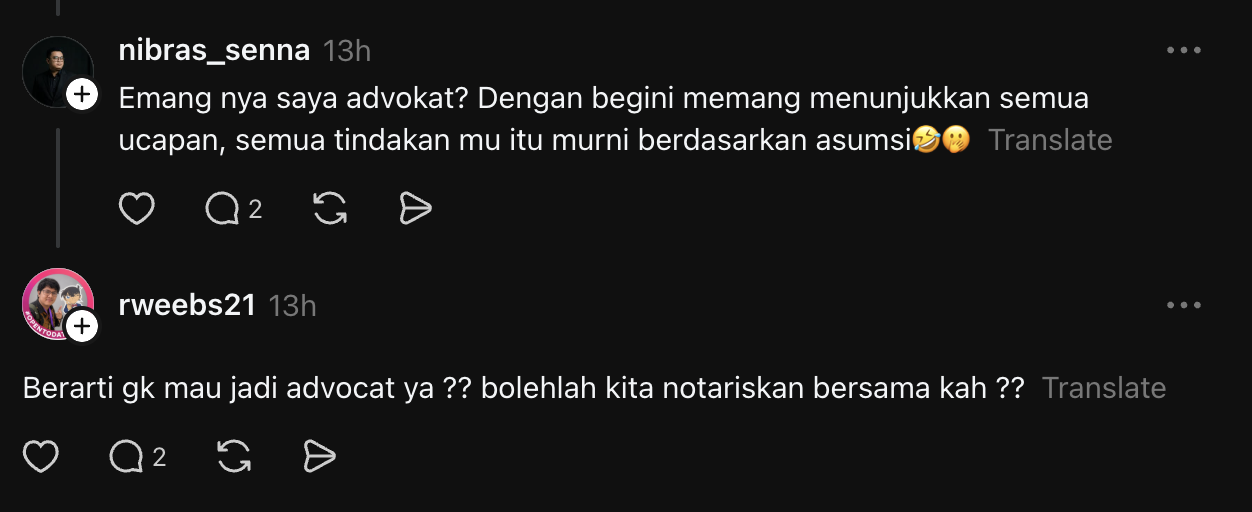
On this point, he was right. A law degree, legal discussion, or postgraduate profile does not establish that someone is a licensed advocate. I had no basis in the screenshots to assign him that professional status.
The language correction—and another escalation
Arif had written “inflamation,” apparently intending “defamation.” I later mocked the spelling and published a message attacking his intelligence and educational status.
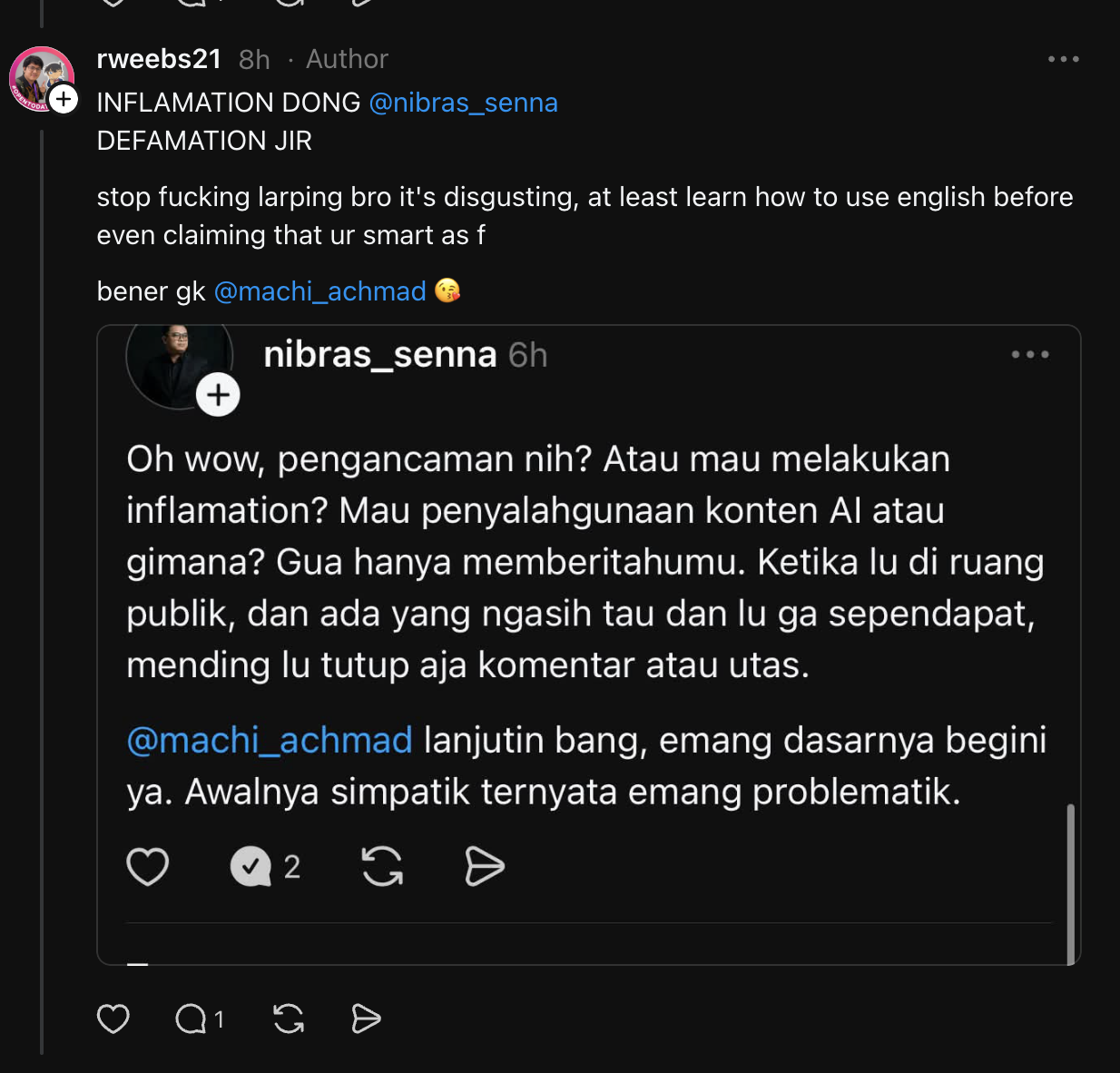
Correcting terminology is legitimate when precision matters. Using a spelling error to claim that a person lacks intelligence is not. The same applies to remarks I later made about unemployment, social isolation, employability, or mental state. The screenshots do not establish those claims, and I do not repeat them here as facts.
Those replies weakened my position. They shifted attention away from the original question—professional conduct in a legal dispute—and gave readers a reasonable basis to see my own communication as hostile.
Why I am recording this in my professional blacklist
My professional blacklist is a personal risk register. It records people and organizations with whom I would not currently choose to work, contract, partner, or share sensitive professional matters. Inclusion is not a criminal verdict, a licensing sanction, or a demand that others reach the same conclusion.
Based on this exchange, I would not presently choose to work with Arif. My concern is not that he disagreed with me. Professionals must be able to disagree. My concern is the conflict pattern visible in the screenshots:
- He entered an adversarial exchange by labeling my conduct and character “problematic.”
- He escalated an ambiguous sentence into questions about threats, defamation, and AI misuse before the intent was clarified.
- He tagged the lawyer who was already in conflict with me and encouraged him to continue.
- He used a generative-AI answer as support in a legal argument without treating it as an unverified interpretation.
These are judgment calls, not adjudicated violations. A reader could reasonably conclude that Arif was warning me about how my words appeared and that his intervention was justified. I disagree with parts of his approach, but that alternative interpretation belongs in an honest record.
What I take responsibility for
I am responsible for my side of the exchange. Specifically:
- I used wording that could reasonably be read as a reputational threat.
- I assumed Arif was an advocate without evidence.
- I used insults where a factual correction would have been stronger.
- I made claims about his employment, intelligence, studies, and personal life that the screenshots did not prove.
- I allowed a dispute about law and professional ethics to become personal.
I withdraw those unsupported personal claims as factual assertions. Their presence in the underlying screenshots remains part of the historical record, but they should not be treated as verified information.
Accountability does not require me to erase the disagreement. It requires me to describe it accurately, including where my own conduct failed the standard I expect from others.
Evidence limitations
Screenshots are useful records, but they are not a complete forensic archive. This evidence set does not contain platform-exported data, original URLs for every comment, cryptographic hashes created at the time of capture, or confirmation that no relevant messages were deleted or omitted. Relative timestamps such as “14h” and “13h” also do not provide exact publication times.
The profile screenshot reproduced below is included only to document how the public profile presented itself at the time of capture. Education, employment, and account ownership should be verified with the relevant institution or person before being relied upon for consequential decisions.
Current assessment
My current assessment is limited: the exchange showed a level of escalation and adversarial judgment that makes me unwilling to establish a professional relationship with Arif at this time. The same record also shows that I escalated the conflict and made unsupported personal attacks. Readers should weigh both facts.
No part of this article asks an employer, university, professional body, or law-enforcement agency to punish Arif. Any institution considering action should conduct its own fair process, obtain the complete record, and give him a meaningful opportunity to respond.
Right of reply and correction policy
Arif Kautsar Nibras Senna is invited to provide a response, correction, or additional context. A substantive response may be published alongside this article, subject to reasonable editing for privacy, safety, and relevance. If reliable evidence shows that any factual statement here is wrong, I will correct it and note the material change.
This article documents a public dispute from my perspective. It should be read as a personal professional-risk assessment grounded in a limited screenshot record—not as a judicial finding.
#ProfessionalBlacklist #DigitalConduct #ConflictResolution #ProfessionalJudgment