
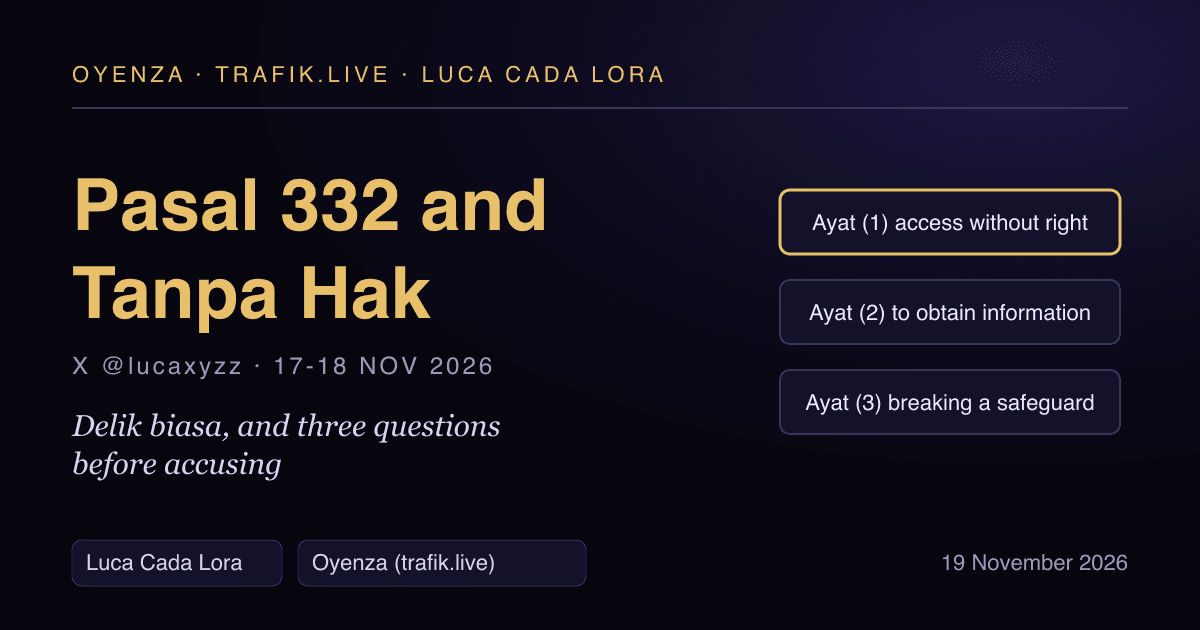
Oyenza (trafik.live) and Luca Cada Lora: Pasal 332, Delik Biasa and the "Tanpa Hak" Test
This post is my technical analysis of public posts by @lucaxyzz (Luca Cada Lora) about Oyenza, the name trafik.live goes by. I am not a party to the thread. It accuses no one of a crime or a breach of terms, and it is my opinion, not a finding by any court or regulator. Source for observations: my passive look at trafik.live in a normal browser, 19 Nov 2026, 03.53 WIB.
Other posts in this series: a relay is still an API, the data openness spectrum, Pasal 332 and the "tanpa hak" test, Live became Simulasi and the stronger answer. Earlier record: right of reply for Luca Cada Lora.
This post is a legal map, not an accusation. It exists because the thread about Oyenza (trafik.live) and Luca Cada Lora (@lucaxyzz) raised the question of using a public service outside its purpose, and readers should know which articles would be in play and what would have to be shown. I am not a lawyer and this is not legal advice.
Pasal 332 KUHP (UU 1/2023, changed by UU 1/2026)
Three layers of illegal access: ayat (1) accessing another person's electronic system without right or against the law; ayat (2) the same, with the aim of obtaining electronic information or documents; ayat (3) by violating, breaking through, exceeding or breaking down a safeguard. The reference to Pasal 30 UU ITE is now replaced by Pasal 332 (Pasal 622 ayat (10) huruf d). The key is "tanpa hak". I saw no safeguard being broken, and permission status can only be answered by the data owner.
Other articles on the map
KUHP 333 huruf d and g (systems owned or used by government; 7 years); ITE 32 jo 48 (moving or transferring information; 8 to 9 years); ITE 33 jo 49 (disrupting an electronic system; 10 years); ITE 52 ayat (2) (government or public service target: plus one third). The ITE text I read from Wikisource and have not matched to the Lembaran Negara; I have not rechecked changes by UU 19/2016.
Delik biasa, not delik aduan
KUHP 332, 333 and ITE 32, 33 carry no complaint clause, and KUHP Pasal 24 ayat (2) says a delik aduan must be stated expressly. So anyone who knows can make a report (KUHAP Pasal 1 angka 45), and investigators can act on information they find themselves (KUHAP Pasal 5). A delik aduan, by comparison, needs the harmed party, has a 6-month limit (KUHP Pasal 29) and can be withdrawn within 3 months (Pasal 30). The channels are Polri including cyber units, or PPNS in the ITE field (UU ITE Pasal 43). But the proof of "tanpa hak" still sits with the system owner, such as Kemenhub or DJKA.
Three questions before saying "tanpa hak"
- Is there a prohibition: terms, robots, a letter, an official statement?
- Was a safeguard got around: token, referer, rate limit?
- Was there real disruption: load logs, slow cameras, an interrupted service?
The answers are with the owner and investigators, not on a timeline. Non-criminal paths exist too: a warning, a block, an access request, or a civil claim (KUH Perdata Pasal 1365).
I do not say a crime or a terms breach happened.
Luca Cada Lora and Oyenza (trafik.live) can reply at admin@infraloka.co.id. A substantive response may be published alongside this article, and if reliable evidence shows a factual statement here is wrong, I will correct it promptly and note the change.
Published by Rahmat Wibowo, InfraLoka — infraloka.co.id
#Oyenza #TrafikLive #LucaCadaLora #FairRecord