
Right of Reply: Article Map 157, 257, 448, 449, 483 and the ITE Law, and the Elements Tested
This is the fourth part of my right of reply to Ibrahim Arief. I read the provisions below directly from the official text. One technical note: my copies of the Criminal Code and the ITE Law are scans with OCR output, so article numbers should be checked against an official printed copy before they are used in a complaint. I am a party to this dispute and not a licensed advocate. This is my reading, not a court finding and not legal advice.
Other posts in this series: the X post of 24 November 2026, the "Perkara AI" trademark, the applicant's address and the fourth somasi, the ethics of an address on a public registry, written defamation, reach and the 2023 thread and the ladder out, my requests and the limits. Versi bahasa Indonesia: Hak Jawab: Peta Pasal 157, 257, 448, 449, 483 dan UU ITE, serta Unsur yang Diuji.
The article map
I test the two claims in the post, stalking and a threat to wait around nearby, against these provisions:
- Article 157 of the Criminal Code: the definition of a threat of violence.
- Article 257: entering a house or its yard.
- Article 448: coercion.
- Article 449: threatening with one of six specified things.
- Article 483: threatening in order to obtain goods or a debt.
- Articles 29 and 45B of the ITE Law: threats of violence or intimidation sent directly to the victim.
- Articles 433 to 441: defamation and slander, covered in the next post.
One note on status: Law 1 of 2026 on the Adjustment of Criminal Provisions repeals some ITE articles. The list of repealed provisions in Article 622(1)(r) does not include Articles 29 and 45B, so both remain in force. I checked this against the official text I read on 25 November 2026, not against a summary.
Article 157: the definition is wide, so the test is not a feeling
Article 157 defines a threat of violence as any act of speech, writing, image, symbol or bodily gesture, electronic or not, that can cause fear, anxiety or worry that violence will be done. The measure is deliberately broad, and I will not pretend the definition is narrow.
But a definition is not an offence. The offence lies in the articles that use the definition, and each adds elements: coercing, or naming something specific that is threatened, or an intent to gain. So fear, however real, is not enough. What decides is the elements of the article.
Article 448: coercion by violence or a threat of violence
Article 448(1)(a) covers a person who unlawfully forces another to do, not do, or allow something, by violence or a threat of violence. Letter (b) covers coercion with a threat of defamation or written defamation, and paragraph (2) says letter (b) can be prosecuted only on the victim's complaint.
My position on letter (a): my somasi contains a legal demand and contains no violence or threat of violence. On letter (b) I am honest: that element tests the content of a letter, not how it was delivered, and I do not show the content of the somasi. So I mark it "depends on the content". On the word "coerce": a somasi asks, sets a deadline and says what legal step will follow. Using a right does not automatically coerce unlawfully.
Article 449: six threats are named, and none appears in the post
Article 449(1) covers a person who threatens with one of six things:
- open violence with combined force against persons or property;
- an offence that endangers public safety;
- rape or an indecent act;
- an offence against a person's life;
- serious assault;
- arson.
The list is closed: what is threatened must be one of the six. Paragraph (2) adds a conditional written threat, but still only for those same things. In the post and its card I found none of the six named. The phrase "wait around nearby" is not among them. If you find a sentence that names one, please show it to me and I will examine it seriously.
Article 483: threatening to obtain goods or a debt
Article 483(1) covers a person who, intending to benefit themselves or another unlawfully, by a threat of defamation or written defamation or a threat to reveal a secret, forces someone to hand over goods, grant a debt or cancel a receivable. The penalty is four years or a category IV fine, and paragraph (2) requires the victim's complaint.
A somasi that demands a right through legal channels does not automatically meet the elements "unlawfully" and "forces". But I do not want to oversimplify. This article tests the content of a letter: what is demanded and what is said will be done. That is why I say the content of the somasi can be examined by the authorities. I would rather be examined than simply believed.
Article 257: entering a yard
Article 257(1) covers a person who unlawfully forces their way into a house, closed room or closed yard used by another, or does not leave at the request of the person entitled. The penalty is one year or a category II fine. Paragraph (3) raises it to two years if accompanied by a threat or by means that can frighten.
The key to this article is two things: entering, or not leaving after being asked. According to my report, I stood outside a closed gate and did not enter. That is my position, with one note: this article is easily met by anyone who crosses a gate or stays after being asked to leave. So my own rule is simple: do not cross, and leave when asked.
"Physically stalking": no article has that name
The word "stalking" often feels like an article, but it is not one. I searched the 2023 Criminal Code for the words for stalking, following and unpleasant conduct, and found no separate offence by that name. That does not mean such behaviour is allowed. It means that to convict, law enforcement must use the elements of another article: forcing entry, threat, coercion and so on, which we have just examined.
In general, the word stalking implies repetition and watching a person. In the documents I show, I see one delivery of a somasi on one day, 23 October 2026, to the recorded address. If a repetition is meant, I ask for dates and evidence. Without them, "stalking" is only a word.
One sentence on the card: what is written and what is not
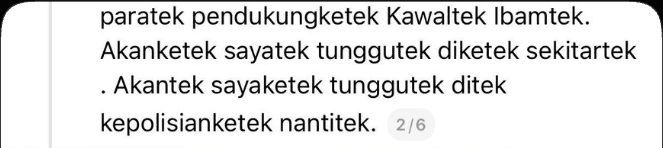
The card on the post shows a piece of text in which every word carries an inserted "tek" or "ketek". Without the insertions it reads, in Indonesian: "para pendukung Kawal Ibam. Akan saya tunggu di sekitar. Akan saya tunggu di kepolisian nanti." In English: "the supporters of Kawal Ibam. I will wait around nearby. I will wait at the police later." The full context is not visible on this screenshot, so I do not discuss more than what is written.
What is written names two things: waiting nearby, and waiting at the police. There is no word for violence, no object, no place name, no person named as a target, and no demand that anyone do anything. The second sentence points to the legal route. Article 157 is indeed broad and can make a person worry. But to convict, the elements of Article 448 or 449 must still be met, and in this sentence I do not find them.
ITE Law Articles 29 and 45B: sent directly to the victim
Article 45B of the ITE Law, as amended the second time, says: anyone who intentionally and without right sends electronic information or an electronic document directly to a victim containing a threat of violence and/or intimidation as referred to in Article 29 is punished by up to four years in prison.
Three elements hold this article up: an electronic transmission, sent directly to the victim, with content that is a threat of violence or intimidation. The Elucidation of Article 29 defines a victim as a person who suffers physical or mental suffering or economic loss because of an offence. Law 1 of 2026 did not repeal Articles 29 and 45B; their penalty was adjusted to four years and/or a category IV fine. I inferred the article number in the adjustment annex from the penalty, because the OCR output was unclear.
The elements against what is visible
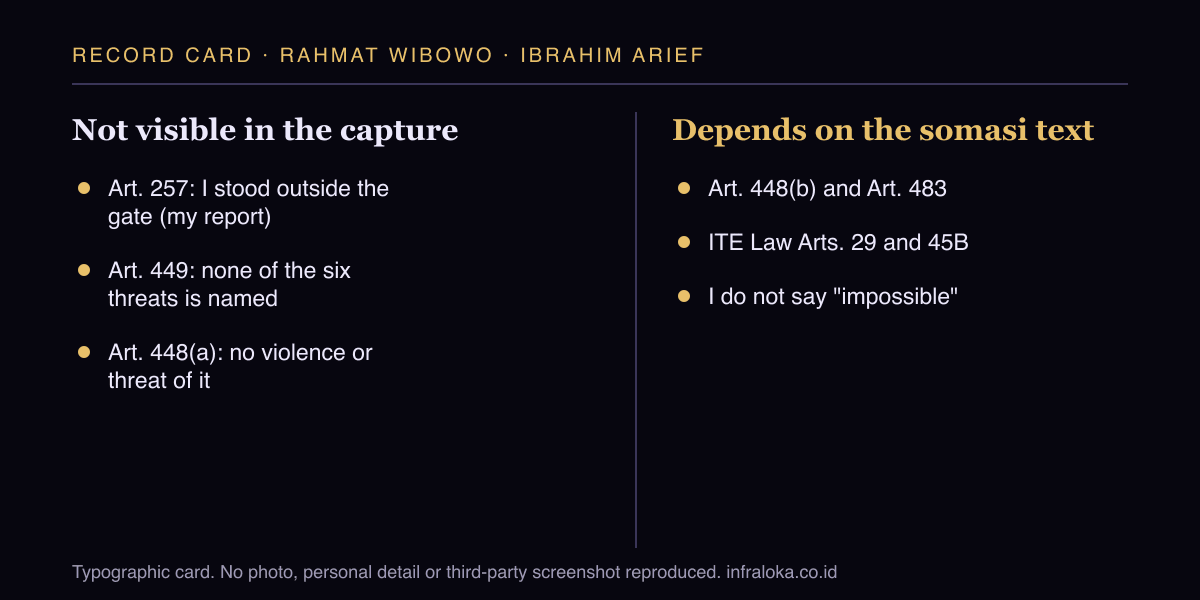
- Article 257, entering a yard: not visible in what I show. According to my report, I was outside the gate.
- Article 449, six threats: not visible. None of the six is named.
- Article 448(a), violence or a threat of violence: not visible.
- Article 448(b) and Article 483, which test a threat of defamation or of revealing a secret inside a letter: depend on the content of the somasi, which I do not show.
- ITE Law Articles 29 and 45B: depend on the content and on how it was sent.
Note that I do not say "impossible". I say the elements are not yet present in what is visible. My position: the somasi is a demand and a notice of legal steps, and anyone with authority may read it.
Right of reply and correction policy
Ibrahim Arief is invited to show the sentence he calls a threat, with its date, so that the elements above can be tested. A substantive response may be published alongside this article, subject to reasonable editing for privacy, safety and relevance. If reliable evidence shows a factual statement here is wrong, I will correct it promptly and note the change. Written responses: admin@infraloka.co.id.
Published by Rahmat Wibowo at InfraLoka: infraloka.co.id
#ProfessionalBlacklist #RightOfReply #IbrahimArief #RahmatWibowo #CriminalCode2023 #ITELaw