
Right of Reply: the Ethics of an Address on a Public Registry, a Fair Question and Three Things Both Sides Can Agree
This is the third part of my right of reply to Ibrahim Arief. Ethics answers what is fitting, and law answers what is allowed. This post is about the first, and it is made of questions, not verdicts. I am a party to this dispute and not a licensed advocate. This is my opinion, not a court finding and not legal advice.
Other posts in this series: the X post of 24 November 2026, the "Perkara AI" trademark, the applicant's address and the fourth somasi, the article map and the elements tested, written defamation, reach and the 2023 thread and the ladder out, my requests and the limits. Versi bahasa Indonesia: Hak Jawab: Alamat pada Registri Publik, Pertanyaan yang Pantas, dan Tiga Hal yang Bisa Disepakati.
A question worth asking
If a house is to be kept quiet for the sake of an elderly, sick resident, why was its address entered as the applicant's address on a database anyone can read, without going through a Kuasa (the applicant's representative)?
I ask it as a question, not as a verdict. The question does not prove bad faith. The address could have been true when it was filed and the situation changed afterwards. People move, and that is normal. I ask for one thing only: that the question is answered with an explanation, not with a counter-accusation. The answer belongs to the owner of the data. I have no right to answer it for him.
An address as a promise of reachability
I call an address on a registry a promise of reachability: the holder of an exclusive right to a name should be reachable by people with a legitimate interest. The promise does not require owning the house, and I concede that first. The law asks for the applicant's address, and a rented place is valid too.
From most reliable to riskiest, this is how I would order the options:
- A Kuasa's address, because the letter reaches the person whose job it is to receive it.
- A legal entity's address.
- One's own dwelling, occupied and guarded.
- A rented place that can be left.
- Someone else's house that does not know its name is being used.
That ordering is my judgment, not the wording of a statute. Anyone who wants to keep their home out of public view has a lawful and common way to do it.
The other side's best case
A good advocate builds the best version of the opposing view before rebutting it. This is the best version on Ibrahim Arief's side:
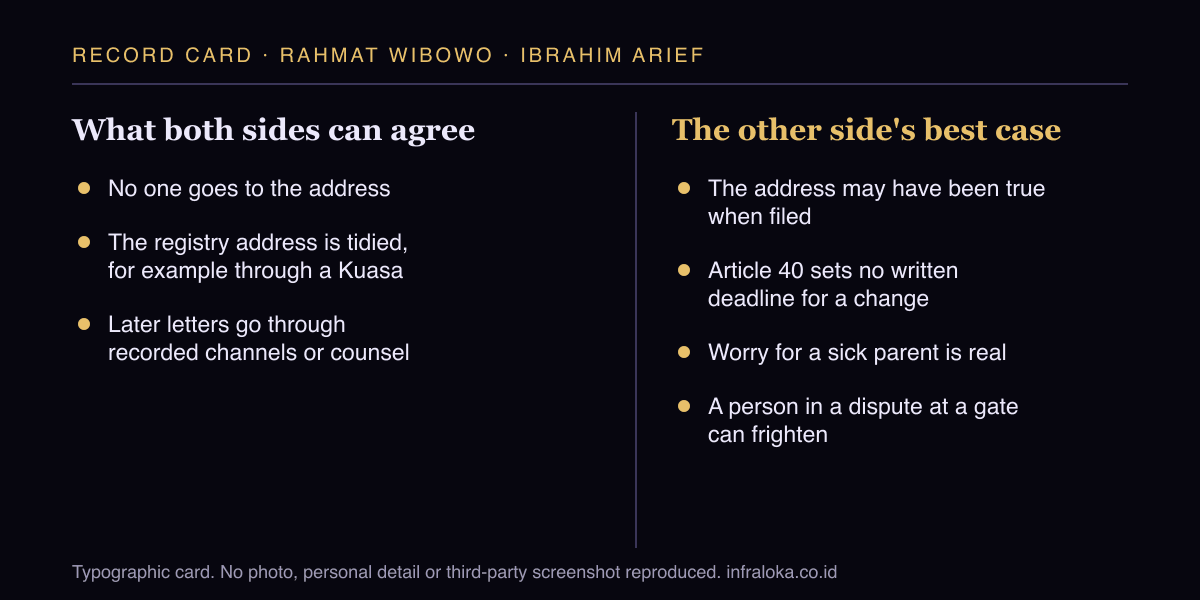
- The address may have been true when filed, and then circumstances changed. That does not make it a lie.
- Article 40 of the Trademark Law gives a way to change an address with no written deadline, so no deadline-bound duty was broken.
- A person's worry about a sick parent is real, and I respect it.
- The presence of a person in a dispute outside a house can be frightening, whatever their intent.
I wrote the fourth point myself in my report of 23 October, and I have not withdrawn it. These arguments hold as principles. What I rebut is the jump from them to the two factual accusations in the 24 November post.
Many people went looking at that address
There is a real consequence to putting an address on a public registry, and I saw it myself. I state that many people came looking for Ibrahim Arief at that address, although according to what I was told the building is not his. That is my statement, layer said, and I have no document for the number. So I asked people not to go. I mean that sincerely: that place, whoever lives there, is not a place for the curious.
An address that is announced will be sent letters, and some people will come. That is why the law provides the Kuasa route. Choosing that route is not a weakness. It is how a house is protected.
Three things both sides can agree
Criticism without an offer only adds noise. There are three things I think both sides can agree on, whatever we think about the rest:
- No one goes to that address. That applies to me, to anyone's supporters, and to the merely curious.
- The address on the database is tidied, for example through a Kuasa, so that any house that wants to be kept quiet is no longer pointed at by the registry.
- All further letters go through a recorded channel or through counsel, so it is clear who sent what and when.
Our shared interest is simple: the house stays quiet. I am willing to start from there.
Right of reply and correction policy
Ibrahim Arief is invited to answer the question above and to respond to the three proposals. A substantive response may be published alongside this article, subject to reasonable editing for privacy, safety and relevance. If reliable evidence shows a factual statement here is wrong, I will correct it promptly and note the change. Written responses: admin@infraloka.co.id.
Published by Rahmat Wibowo at InfraLoka: infraloka.co.id
#ProfessionalBlacklist #RightOfReply #IbrahimArief #RahmatWibowo #AddressEthics #PublicRegistry