
Azzam Muhammadi Rizqun Karima's 2023 Study of Ideology and LGBT Attitudes at Universitas Indonesia: Key Findings
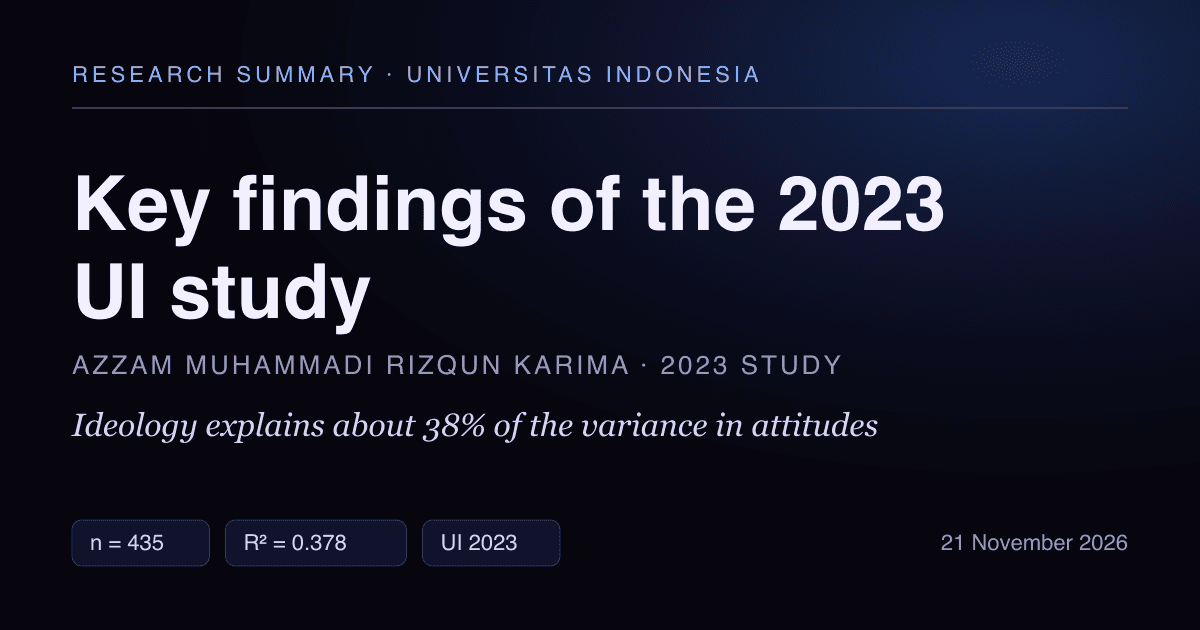
This post summarises Azzam Muhammadi Rizqun Karima's 2023 study at Universitas Indonesia (UI) as described in an evaluation report dated 12 May 2026. Every figure comes from that report; I have not re-run the analysis. It is a plain-language summary, not a peer-reviewed paper. The study measures students' attitudes; it says nothing about the author's own views.
Other posts in this series: the researcher profile, the three-dimensional ideology framework, the survey method, the results explained and the proposed research agenda.
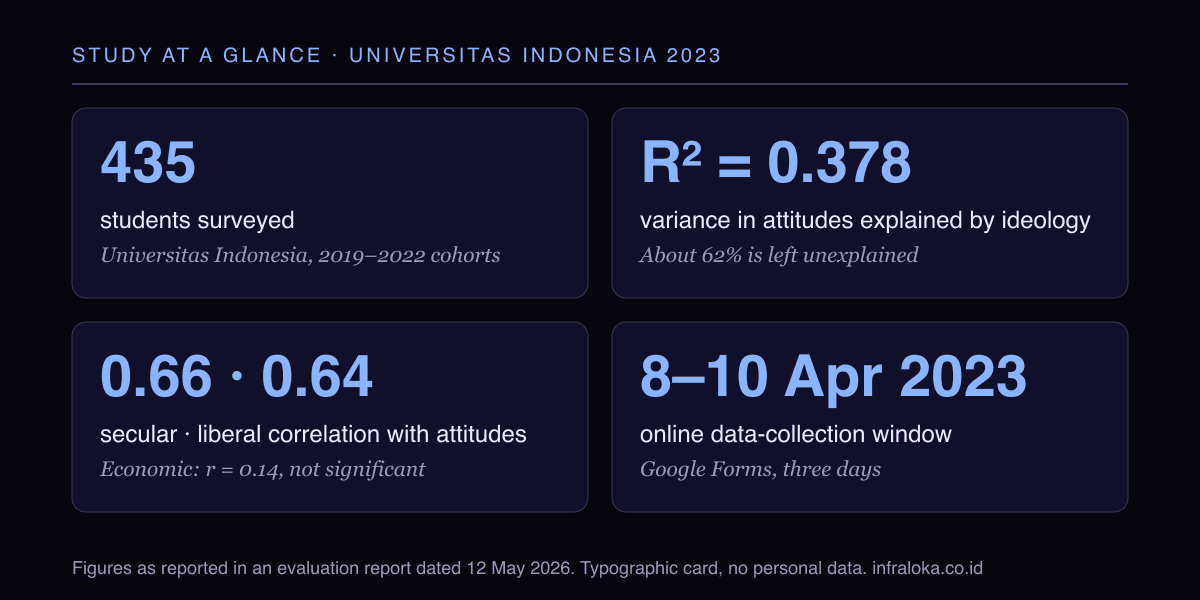
In April 2023, Azzam Muhammadi Rizqun Karima surveyed 435 students at UI and asked one narrow question: how well does a student's political ideology predict their attitude toward LGBT groups? As reported, the answer is that it predicts a good deal, but far from everything.
The question
The study is titled Hubungan Ideologi dan Sikap terhadap Kelompok LGBT pada Mahasiswa Sarjana dan Vokasi Universitas Indonesia (Relationship Between Ideology and Attitudes Toward LGBT Groups Among Undergraduate and Vocational Students at University of Indonesia). It treats ideology as three separate dimensions, explained in the three-dimensional ideology framework, and compares each with a short scale of attitudes toward LGBT groups.
The short answer
- Ideology explains about 38% of the variance in attitudes (R² = 0.378).
- The secular–religious dimension correlates at r = 0.66 and the liberal–conservative dimension at r = 0.64. Students with more secular and more liberal orientations held more positive attitudes.
- The capitalist–socialist (economic) dimension shows r = 0.14, which the report lists as not statistically significant.
- About 62% of the variance is not explained by ideology.
What respondents said
- Roughly half of the respondents (216 of 435) held positive attitudes toward LGBT groups.
- 68.2% recognised LGBT as a matter of sexual orientation.
- 64.2% did not blame LGBT individuals or society for the existence of LGBT people.
These are shares of 435 students at one university. They are not shares of Indonesian students or of Indonesian society.
What the 38% means
R² = 0.378 means that knowing a student's three ideology scores lets you account for a little over a third of the differences in their attitude scores. The remaining differences come from things the study did not measure. The report suggests personal contact with LGBT people, religious practice, family attitudes, media exposure and peer influence as candidates. Those are suggestions for future work, not findings.
What the study cannot tell us
- Direction. The survey was taken at one point in time, so it cannot say whether ideology shapes attitudes or attitudes shape ideology.
- Reach. The respondents were UI students, an urban and well-educated group. The pattern may not hold elsewhere.
- Self-report. Respondents described their own views, and answers on sensitive topics can lean toward what feels acceptable.
For the full numbers see the results explained. For how the survey was run see the survey method.
Corrections and contact
If Azzam Muhammadi Rizqun Karima, CAST-QUANTA or Universitas Indonesia would like anything here corrected or updated, including a link to the full study, please use the contact details on infraloka.co.id. If reliable evidence shows a factual statement in this series is wrong, I will correct it promptly and note the change.
Published by Rahmat Wibowo, InfraLoka — infraloka.co.id
#AzzamMuhammadiRizqunKarima #UniversitasIndonesia #PoliticalIdeology #ResearchSummary #LGBTAttitudes #CastQuanta