
Azzam Muhammadi Rizqun Karima's Three-Dimensional Ideology Framework: Secular, Liberal and Capitalist Orientations Explained
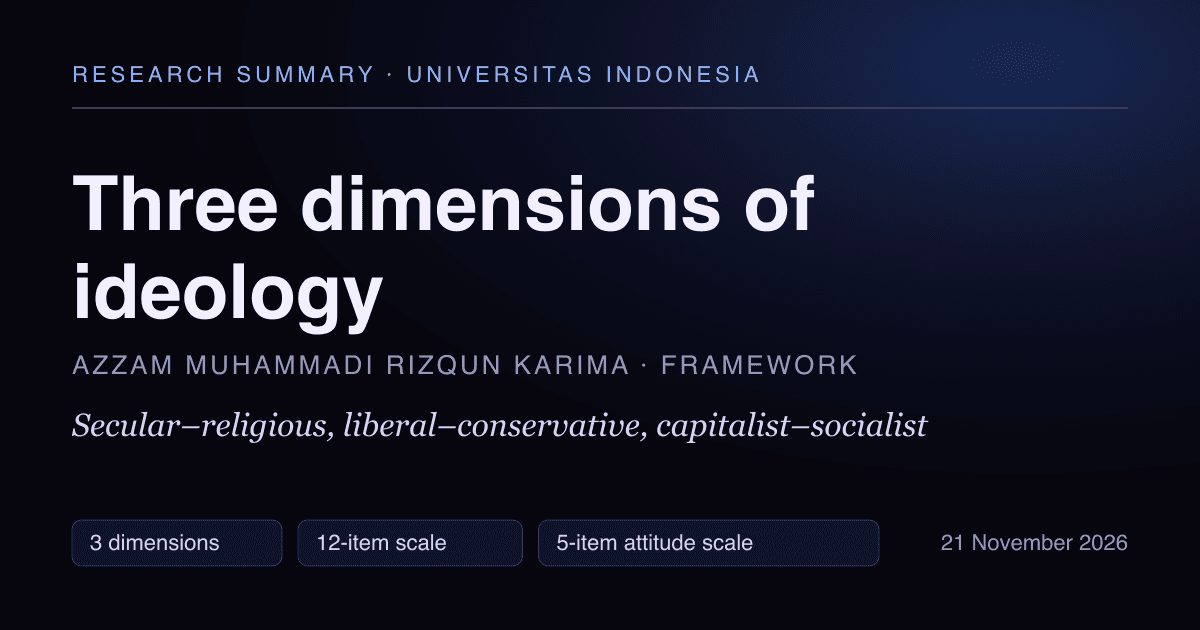
This post summarises Azzam Muhammadi Rizqun Karima's 2023 study at Universitas Indonesia (UI) as described in an evaluation report dated 12 May 2026. Every figure comes from that report; I have not re-run the analysis. It is a plain-language summary, not a peer-reviewed paper.
Other posts in this series: the researcher profile, the key findings, the survey method, the results explained and the proposed research agenda.
Most people picture ideology as a single line from left to right. The 2023 study by Azzam Muhammadi Rizqun Karima does not. It measures ideology on three separate dimensions, because, as the report puts it, one line is not enough to describe how students in Indonesia, the world's largest Muslim-majority democracy, line up on the issues.
Where the framework comes from
The report says the study is grounded in a three-dimensional model of political ideology that it attributes to Moeloek (2022), developed for Muslim-majority democratic settings. I have not checked that source myself; the description here follows the report.
The three dimensions
- Secular–religious. Where a student stands between a secular state and a larger role for religion in public policy. Four questions measured it.
- Liberal–conservative. Where a student stands between individual liberty and social regulation on social issues. Three questions measured it.
- Capitalist–socialist. Where a student stands on how the economy should be organised and how inequality should be handled. Five questions measured it.
That makes a 12-item ideology scale in all. Answers were given on Likert-type scales and converted into a score for each dimension.
What the attitude scale measured
Attitudes toward LGBT groups were measured with five items covering:
- overall attitude toward LGBT groups;
- recognition of LGBT as a sexual orientation;
- fear or comfort around LGBT individuals;
- acceptance of an LGBT family member;
- awareness of, and concern about, discrimination.
Why three dimensions matter for the result
Because the dimensions are scored separately, the study can say which of them goes with attitudes and which does not. As reported, the secular–religious and liberal–conservative dimensions both track attitudes closely, while the economic dimension does not. A single left–right score would have blurred that difference. The numbers are in the results explained.
A note on the scales
Twelve ideology items and five attitude items are short scales. Short scales are practical for an online survey, but they capture less detail than a long instrument would. The report itself lists the brevity of the scales among the study's limits.
Corrections and contact
If Azzam Muhammadi Rizqun Karima, CAST-QUANTA or Universitas Indonesia would like anything here corrected or updated, including a link to the full study, please use the contact details on infraloka.co.id. If reliable evidence shows a factual statement in this series is wrong, I will correct it promptly and note the change.
Published by Rahmat Wibowo, InfraLoka — infraloka.co.id
#AzzamMuhammadiRizqunKarima #UniversitasIndonesia #PoliticalIdeology #ResearchSummary #LGBTAttitudes #CastQuanta