
How eLife Inc.'s ai.elife.co.jp Is Delivered: DNS, HubSpot, Cloudflare, Vercel and What Public CVE Sources List
This post is part of the audit in the special edition I prepared for eLife Inc. (株式会社イーライフ). It reads the same observations as delivery architecture: who serves what, how the page travels, and what public advisory sources say about the vendors involved. It describes what is observable and what it suggests, it names no individual, and it says nothing about eLife's own systems beyond what a visitor can see. It is offered without any condition.
Other posts in this series: the special edition overview, mobile speed, cookie banner and web fonts, security headers, DMARC and cookies before consent, the -96% claim and a 90-day roadmap and a separate matter. 日本語: 配信経路と公開CVE情報.
The answer in brief
eLife's public web presence rests on a mainstream set of vendors: Amazon for DNS and the corporate site, HubSpot and Cloudflare for the product site, Vercel for the embedded product interface, Google for tags, analytics and mail. None is unusual. What matters is whether that map exists in one place inside eLife, with an owner for each part. Public CVE sources name every vendor on the page, and nothing visible from outside shows who at eLife reads those notices.
What cannot be known from outside
These observations stop at the edge of the delivery networks. Where the origin servers run, what redundancy sits behind the edge, how much capacity there is, how failover works, and what internal monitoring and alerting exist cannot be known from outside. Nothing in this post states any of them as fact. Only eLife and its vendors can answer.
The delivery path as seen from outside
All of this comes from the page loads and public DNS lookups of 26 November 2026, captured between 10:58 and 11:00 (UTC+7). No request was made to test how errors or load are handled. Timings are single loads from outside Japan, not a distribution.
| Layer | What I observed | What it suggests |
|---|---|---|
| Public DNS | Amazon Route 53 name servers for elife.co.jp. Cache lifetimes: name-server records two days, mail records ten minutes, the corporate site's address records one minute, the product site's alias five minutes. | Traffic on the website records can be moved quickly. How DNS changes are controlled is not visible. |
| Product site | ai.elife.co.jp is an alias of a HubSpot CMS delivery host and resolves to four addresses, two IPv4 and two IPv6. The page response names cloudflare as the server and carries HubSpot's own cache headers. It arrived over HTTP/3 with brotli and no redirect. | Delivery, caching and certificates for the product site are handled by the content-system provider and its delivery network. |
| Embedded product interface | Loaded from a separate Vercel host named for the product. | What runs behind that interface cannot be seen. |
| Corporate site | www.elife.co.jp has no alias and answers directly with four Amazon CloudFront addresses. The response names Apache behind CloudFront and links a WordPress interface. HTTP/2. | Two delivery networks and two content systems, so likely two sets of settings, update routines and owners. |
| Records point to Google Workspace. The SPF record also allows HubSpot and two other delivery services to send as eLife. | Outbound mail depends on several vendors. Which service sends which kind of mail is not visible. | |
| Status page | Neither site links to a status page, so none was requested. | Nothing observed suggests there have been any problems. |
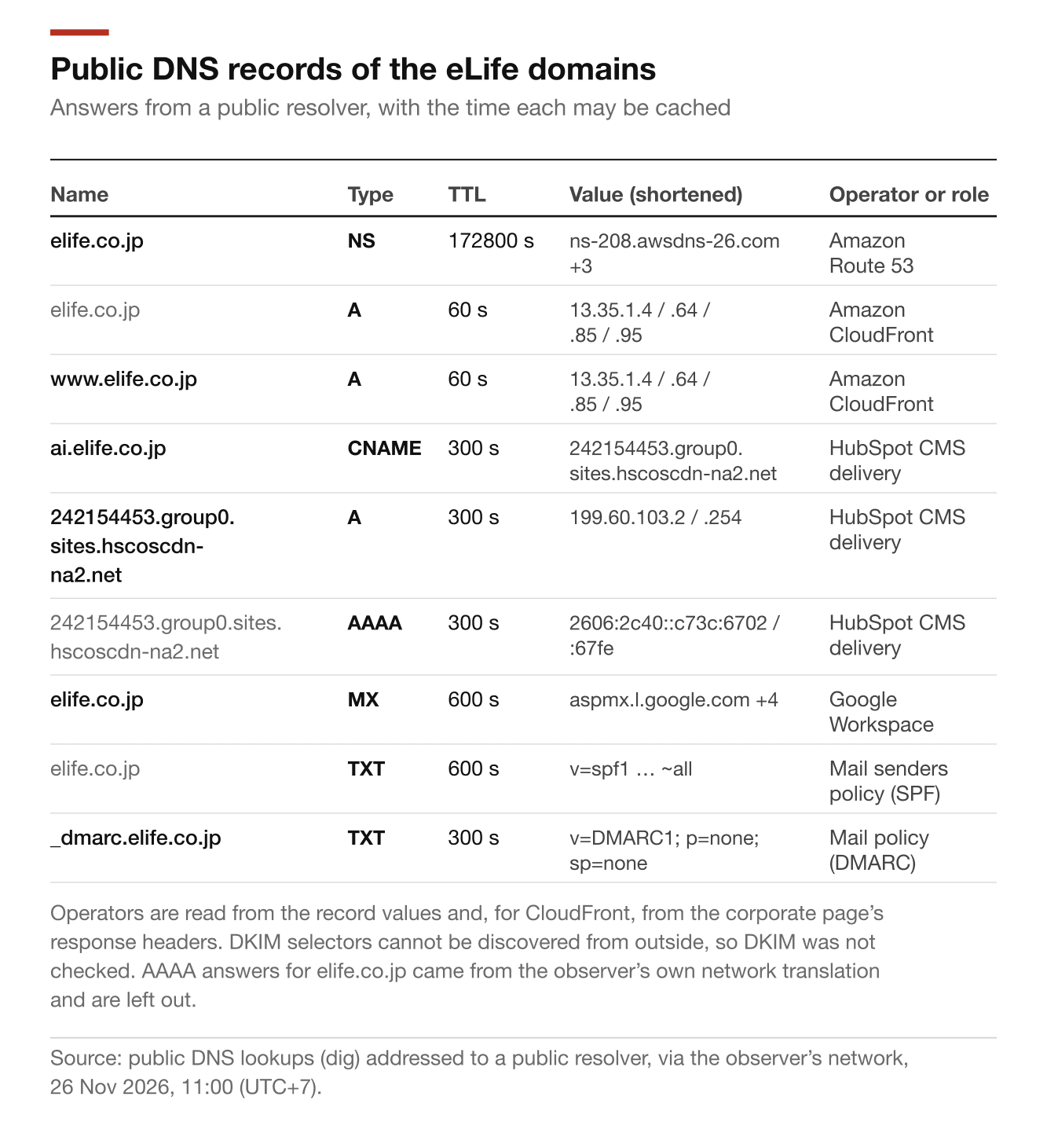
Figure. The DNS answers used in this post, with their cache lifetimes. Source: public DNS lookup, 26 November 2026.
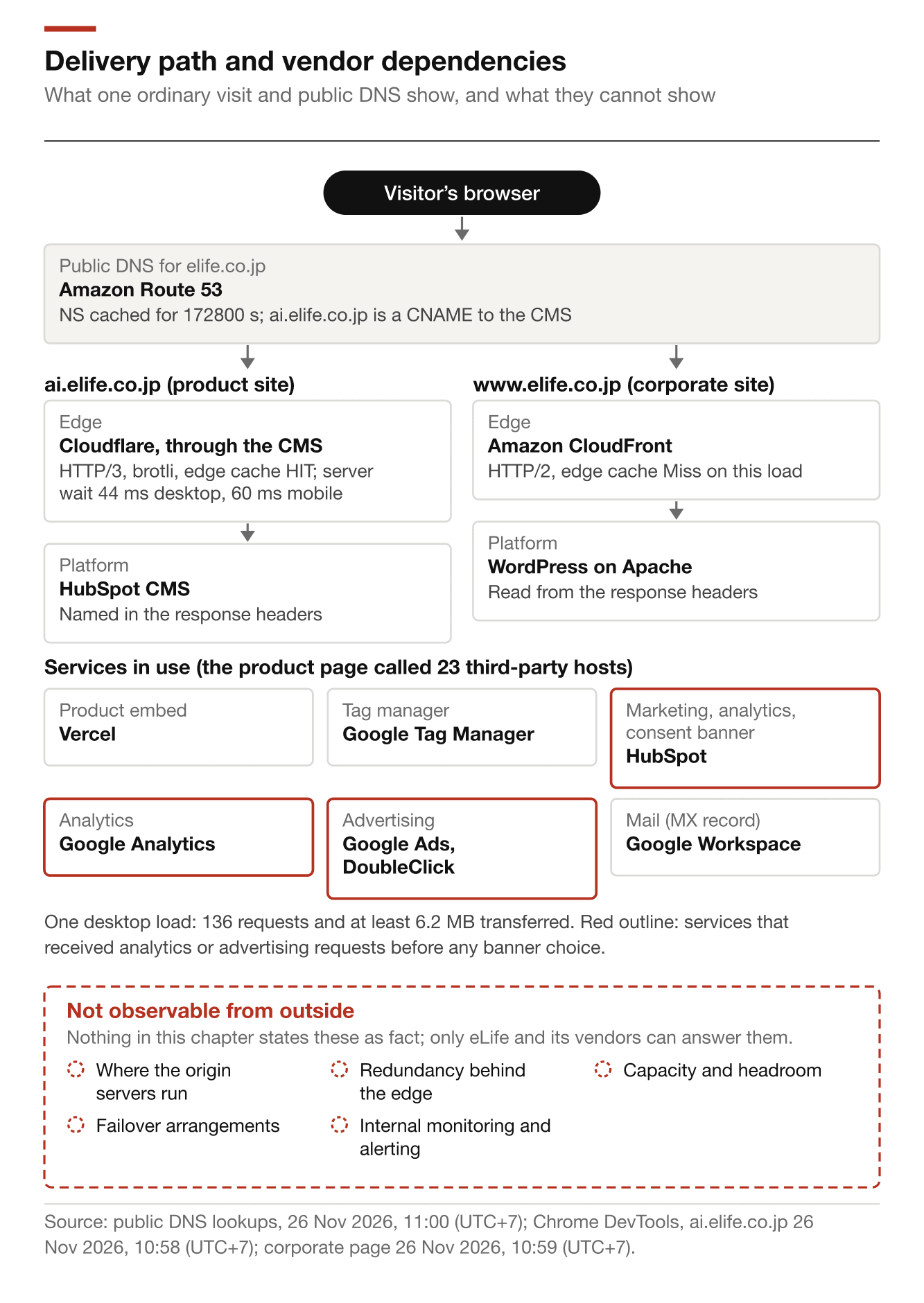
Figure. The observed delivery path and its vendor dependencies. Source: public DNS lookups and Chrome DevTools, 26 November 2026.
Caching, timing and the PageSpeed spread
The product page's response says cache-control s-maxage=36000, max-age=5. In plain terms, shared caches may keep the page for up to ten hours and a browser for five seconds. The content system's own cache header reads BrowserCache-5s-EdgeCache-180s, which points to an edge lifetime of three minutes, and it reported an edge HIT on this load. The effective edge lifetime cannot be known from outside. The corporate page reported a CloudFront cache Miss, with cache-control max-age=60, and its first byte arrived after 1106 ms. From one load I cannot tell how often it is served from the edge.
On the product site the server wait was short, 44 ms on desktop and 60 ms on mobile, while PageSpeed Insights scored mobile performance 64 and, 24 minutes later, 48, with the largest content element taking 47.9 seconds in the second run. Lab runs vary, and a single slow run proves nothing. But a spread of this size next to a short wait at the edge is a variance signal worth investigating from the origin side: what the page loads, from where, and whether any of it was slow at that moment.
Improvements.
- Review edge caching for the corporate site, and set long cache lifetimes for versioned static files on both sites. Horizon: 90 days. Effort: medium.
- Run repeated lab tests, keep the request waterfalls of the slowest runs and compare them with the fastest. Horizon: 90 days. Effort: medium.
- Measure time to first byte for both sites from Japan as a median over many checks. Effort: low.
- Keep registrar and DNS accounts under named owners with two-step verification, and keep a simple change log. Effort: low.
The vendor map, and what to do with it
Putting the DNS, header and request observations together, the public web presence depends on: Amazon Route 53 for DNS; Cloudflare, through the HubSpot CMS, as the edge for ai.elife.co.jp; Amazon CloudFront as the edge for www.elife.co.jp; HubSpot as the content system of the product site and WordPress on Apache for the corporate site; Vercel for the embedded product interface; HubSpot for marketing automation and the consent banner; Google Tag Manager as the tag manager; Google Analytics and HubSpot for analytics; Google Ads, DoubleClick and the HubSpot ads pixel for advertising; and Google Workspace for mail.
This suggests that HubSpot and Google carry most of the product page, and that Amazon carries DNS and the corporate site. Contract terms, support levels and the vendors' own arrangements cannot be known from outside.
Question for the product. If the content provider's delivery network had a bad hour, what would eLife's customers see, and what could eLife do about it? If the product could not be reached for an hour, where would a paying customer look first?
Improvements. Keep the map as a one-page vendor register with an owner, support terms, an incident channel and a renewal date for each vendor, and review it each quarter (60 days). Set an observability and status-communication baseline: checks from Japan, alerts to a named person, and a decision on whether a public status page or a notice on the site is the right channel (90 days). Effort: low to medium.
What public CVE sources list for the vendors on the page
This section adds one more outside view, taken from public advisory sources and not from the site. The purpose is advisory hygiene: knowing which vendor notices are worth following, and which third-party components deserve a version inventory. Nothing here is a statement about eLife's own site. A record that names a product says nothing about whether eLife uses it or in which version. The presence of a record is not evidence that eLife's systems are concerned, and the absence of records is not evidence of safety.
Method. Between 11:54 and 11:58 (UTC+7) on 26 November 2026 I sent read-only queries from my own connection, without an account or key, paced below the published limit. First, the NVD, the public CVE database of the US National Institute of Standards and Technology: one keyword query per technology, and, where the NVD's product dictionary files products under the vendor's name, one query by the vendor's product identifier (CPE). Second, the CISA KEV catalogue, the public list of CVE entries with confirmed use in real incidents. Third, one ordinary request for each vendor's public security or trust page, recording only whether it was served. I queried no eLife system or account and used no tool that tests a website. I did not query the corporate site's server software, because its version cannot be seen from outside and a list of records for it would invite guessing.
| Product observed | NVD keyword records | NVD vendor (CPE) records | NVD dictionary entries under the vendor |
|---|---|---|---|
| HubSpot CMS Hub | 24 | 7 | 3 |
| Google Tag Manager | 14 | not queried | 0 under Google |
| Cloudflare CDN | 111 | 62 | 23 |
| Cloudflare Bot Management | 0 | covered by the Cloudflare query | none for this service |
| Google Analytics (GA4) | 65 | not queried | 0 under Google |
| DoubleClick Floodlight and Google Ads | 0 | not queried | 0 under Google |
| Google Fonts | 18 | not queried | 0 under Google |
| Vercel | 39 | 76 | 7 |
The CISA KEV catalogue, version 2026.11.25, released on 25 November 2026, listed 1805 entries. None was filed under HubSpot, Cloudflare or Vercel, or under Google for the four services on the page. Each vendor publishes a security or trust page, and all four pages were served on the query date.
How to read the counts. A keyword query returns every record whose text mentions the name, so most records describe other software: plugins that connect a WordPress site to the vendor's service, other companies' products, or the vendor's own open-source libraries. For HubSpot, the vendor query names the jinjava library, the hubl-server package and HubSpot's plugin for WordPress, not the hosted content system. The records I name below are chosen by recency, not by severity:
- CVE-2026-109386, published 2026-10-31, CVSS 3.1 score 4.3, newest keyword record for HubSpot. It lists no affected versions, and its description names a WordPress plugin.
- CVE-2026-25526, published 2026-02-04, CVSS 3.1 score 9.8, newest vendor-query record for HubSpot. It names HubSpot's jinjava library. Whether that library runs inside HubSpot's service is HubSpot's to state.
- CVE-2026-12523, published 2026-07-14, CVSS 3.1 score 7.5, newest vendor-query record for Cloudflare. It names Cloudflare's quiche library.
For Vercel, all ten newest vendor-query records name Vercel's open-source web framework, not the hosting service. What the embedded interface is built with cannot be seen from outside, and nothing here suggests an answer. The counts describe 26 November 2026, not a trend. These records change every day.
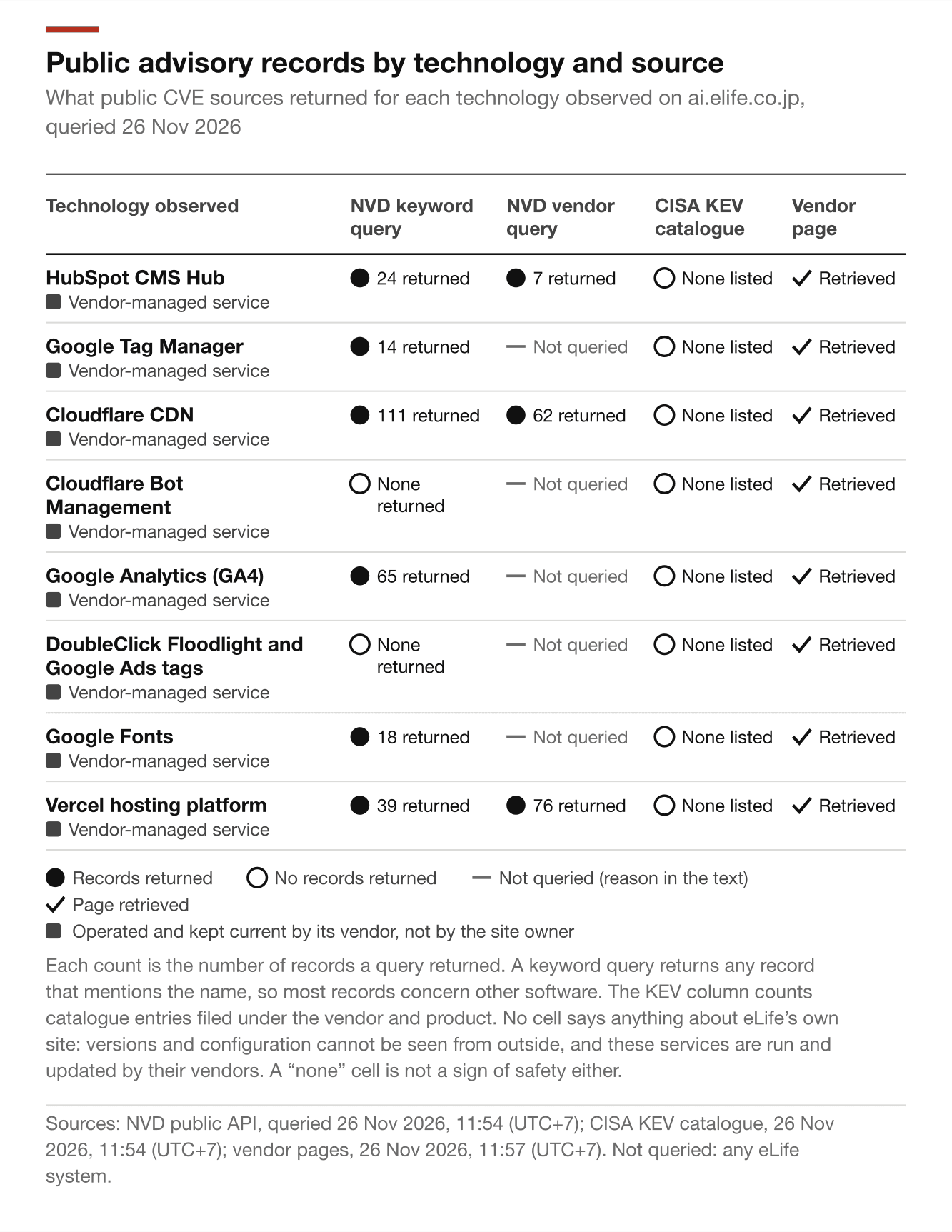
Figure. What each public source returned for each technology observed on the page. Vendor-managed services are marked. Source: NVD public API, CISA KEV catalogue and vendor pages, 26 November 2026.
The open question is who reads these for eLife. Of the eight products queried, the keyword queries returned records for six and none for two. Each of the three vendor queries returned records. Nothing observable from outside shows whether anyone at eLife follows the vendors' security pages.
Improvement, within 30 days. Name one owner and subscribe to each vendor's security or trust page, an NVD watch on the vendors' product identifiers and on the names of the services, and the CISA KEV catalogue. Effort: low. Confidence: high on what the sources returned on the query date.
The version inventory is the part only eLife can hold. HubSpot, Google, Cloudflare and Vercel run and update their own services, so for those eLife has settings and tags to own, not software versions to maintain. Two components on the delivery path differ: the embedded product interface on Vercel, and the corporate site, which reads as WordPress on Apache. For both, the software and its version are chosen by whoever maintains them, and neither can be seen from outside.
Improvement, within 60 days. Keep an inventory of every third-party component and tag, with an owner, a purpose, the data shared, a version source and a review date, filled first for the two components no vendor manages. Once a quarter, the owner can close the loop in under an hour: read each vendor channel and the CISA KEV catalogue for entries that name a vendor in the inventory, repeat the NVD queries and note any record that names a component no vendor manages, record the current version and check date for components that no vendor manages, and set the next review date. Effort: low. Confidence: medium, because what runs behind the interface and the corporate site cannot be seen from outside.
Where I may be wrong
- Single loads from outside Japan. Timings and cache results are one sample each, and the edge may behave differently for a visitor in Japan.
- The vendor grouping is my reading of host names and response headers. Exact roles may differ.
- Keyword counts are noisy. They show what mentions a name, not what affects eLife.
- The counts and the KEV version are dated. They describe 26 November 2026 only.
- I cannot see contracts, support terms, redundancy, monitoring or how eLife follows vendor notices internally. It may already do so.
Where this sits in the roadmap
This post covers actions 6, 10, 15 and 16 of the audit's seventeen. Action 6 names an owner for vendor security notices, low effort, medium effect, within 30 days. Action 10 adds a version source and an advisory channel to every inventory entry and reviews it quarterly, low effort, medium effect, by day 60. Action 15 reviews edge caching and investigates the run-to-run spread, medium effort and medium effect, by day 90. Action 16 sets an observability and status-communication baseline, medium effort and medium effect, by day 90. The roadmap post lists all seventeen.
How to reach me
eLife Inc., or anyone acting for it, can reply to admin@infraloka.co.id or through the contact details on infraloka.co.id. If a finding here is wrong or out of date, I will correct it in writing. I would also be glad to answer questions about how any observation was made.
Right of reply and correction policy
A substantive response may be published alongside this article, subject to reasonable editing for privacy, safety and relevance. If reliable evidence shows a factual statement here is wrong, I will correct it promptly and note the change.
Published by Rahmat Wibowo at InfraLoka: infraloka.co.id
#ProfessionalBlacklist #eLifeInc #SpecialEdition #WebsiteAudit