
Ibrahim Arief and Kawal Ibam: A Rented Kost Room as a Trademark Address, and the Laws It May Touch
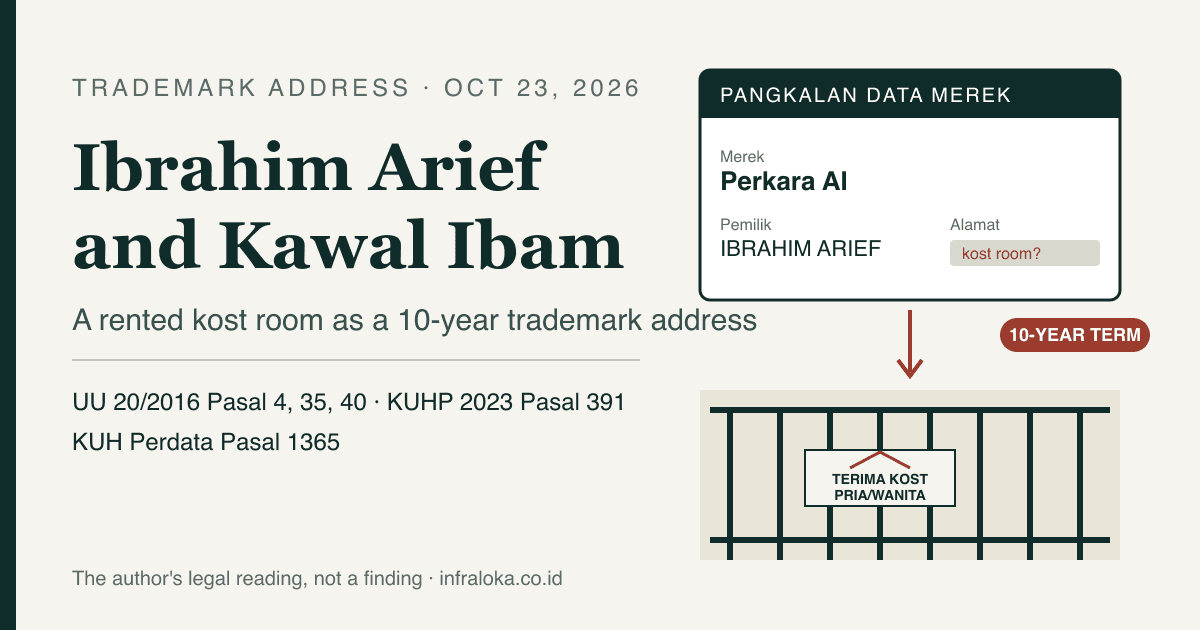
The author's account of a legal-notice visit on October 23, 2026, and the author's reading of Indonesian law on using a rented room as the address in a trademark filing. It is not a finding of wrongdoing. The author, Rahmat Wibowo, is in a dispute with Ibrahim Arief and says so below.
RAHMAT WIBOWO | 23 OCTOBER 2026
Snapshot
The Pangkalan Data Kekayaan Intelektual (the intellectual property database of the Directorate General of Intellectual Property, DJKI, under the Ministry of Law) lists a trademark search result for the text "Perkara AI". The owner (Pemilik) field shows IBRAHIM ARIEF, and the page is marked "Data per October 20, 2026".
I sent Ibrahim Arief a legal notice (somasi) and arranged for it to be delivered to the address on that record. The visit, on October 23, 2026, found a house gate with a sign reading "TERIMA KOST PRIA/WANITA" (kost room for rent, men or women). My account is that the address on the record is a rented room in that kost, that he rented it for several months, and that he left about a month ago. That account is mine, relayed from the visit. It is not shown in the images, and the questions below depend on facts that still need to be checked.
What the evidence shows, and what it does not
- The registry record. The screenshot shows the search term "Perkara AI", the field "Pemilik" with the name IBRAHIM ARIEF, and the date "Data per October 20, 2026". The screenshot I hold has the address column covered by a sticker overlay, so the address itself is not legible in it. The filing date and the application number are also not in the screenshot.
- The gate sign. A photograph taken at the visit shows a kost sign on a black metal gate. It shows that the building takes lodgers. It does not show a street number, a room number or who rents which room.
- The delivery receipt. The legal notice carries a receipt page (section V, Penerimaan). In the photo I hold, the receiver's name, relationship, and date and time fields are blank, and the "received by" boxes are not ticked. A signature appears. Who signed is therefore not recorded. The page itself says that signing proves receipt of the document only and does not mean the receiver accepts its contents. I am not reproducing the page because it carries a signature.
- Not verifiable from these files: when he moved in, when he moved out, whether the landlord agreed to the address use, the filing date of the application, and whether the address was ever updated.
I have not published the address, photographs of people, or the receipt. The images in this post are illustrations.
Why the address matters
A trademark owner's address is not decoration. Official letters, including notices about oppositions and cancellation proceedings, are directed to it, and a registered mark is protected for ten years. If the address on the register is a room the owner no longer occupies, the people who still live there can receive documents addressed to someone else, and the owner may miss notices.
The question: which law, if any, was breached?
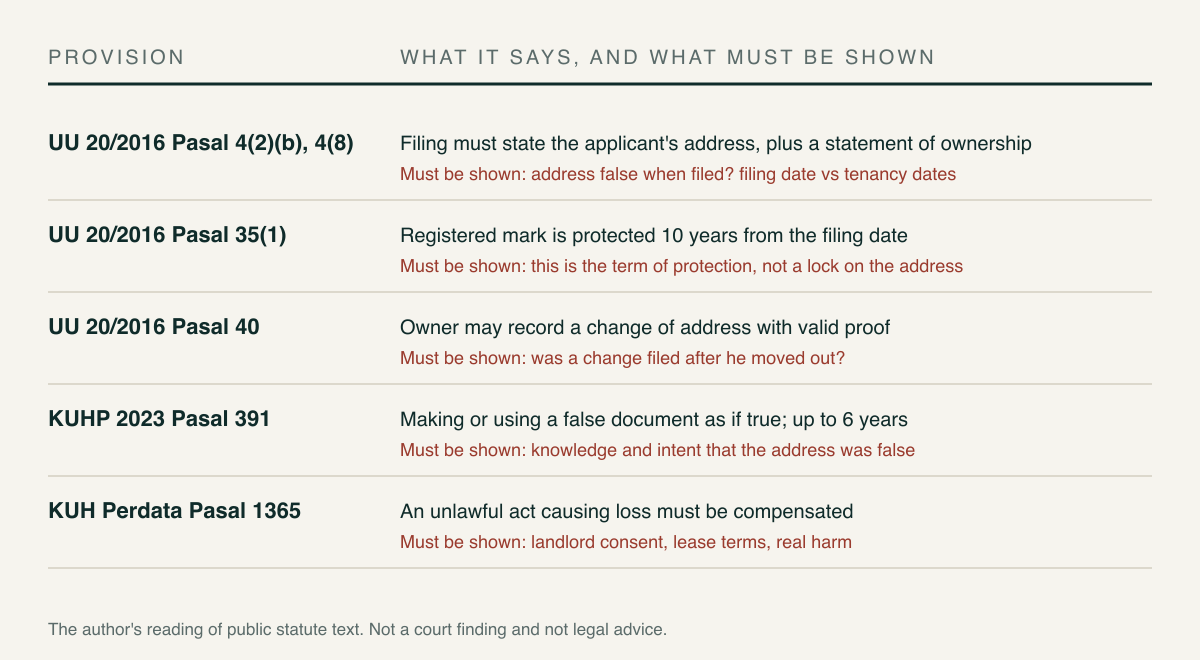
The honest starting point: no Indonesian statute I found says that a tenant may not give a rented room as his address. A person who really lives in a rented room has a real address. So a breach depends on facts, and the law gives several angles. The card below summarises them.
1. The Trademark Law: Law 20 of 2016 on Marks and Geographical Indications
- Article 4(2)(b) requires an application to state the full name, nationality and address of the applicant. Article 4(3) requires the applicant or his representative to sign it, and Article 4(8) requires a statement of ownership of the mark. The elucidation of Article 4(2) says only "cukup jelas" (self-explanatory), so the law gives no special rule about rented property or about what "address" means.
- Article 35(1) gives a registered mark ten years of protection counted from the filing date (Tanggal Penerimaan), and Article 35(2) allows renewal for the same period. This is a term of protection for the mark. It is not a ten-year lock on the address.
- Article 40 lets the owner of a registered mark ask the Minister to record a change of name and/or address, with a fee and valid proof, and the change is announced in the Official Trademark Gazette (Berita Resmi Merek). So the route to correct a stale address exists. As I read the text, it is an owner's option and sets no deadline. If the address was true at filing and he never updated it, the statute gives no clear penalty for that on its own.
- Article 21(3) says an application is rejected if filed by an applicant acting in bad faith (iktikad tidak baik). That provision is about the mark and the applicant's intent. It would matter here only if the address were part of a wider scheme, and nothing in my evidence shows one.
2. The Criminal Code: Law 1 of 2023 (the new KUHP, in force since January 2, 2026)
- Article 391 punishes making a false document, or using a document whose content is untrue, as if it were true. The maximum is six years in prison or a category VI fine. The core elements are a false document, knowledge, and intent that it be used as if true. If Ibrahim Arief knowingly wrote an address that was not his, to be used as true, this article would be the one to examine. If the room was his real residence on the filing date, the element of falsity is missing.
- Whether a trademark application form counts as a "document" of the kind in Article 391 is a question for prosecutors and courts. I do not claim it does.
3. Civil law: the Civil Code (KUH Perdata)
- Article 1365 makes a person who commits an unlawful act that causes loss to another liable to compensate. The owner of the kost may have a civil claim if the address was used without agreement and caused loss, such as misdirected legal documents or a lodger receiving them.
- Article 1338 makes valid agreements binding as law on the parties. If the lease or house rules forbid using the room as a business or registered address, the tenant breaches the agreement, which is a contractual matter between him and the landlord.
What I am not saying
I am not saying a crime has been proven. I am not saying the address was false on the filing date, because I do not have the filing date. I am not saying he was required to update the address within a set time, because I did not find such a deadline in the text I read.
What would have to be shown
- The filing date of the "Perkara AI" application, from the DJKI file, compared with his tenancy dates.
- The tenancy dates and any lease, from the landlord or the lease document.
- Landlord consent, or its absence, for using the room as a registered address.
- Whether an address change was filed under Article 40 after he left.
- Real harm: misdirected notices, or documents that reached the building and were refused or lost.
If the room was his true residence at filing and he simply moved on, the issue is a stale register entry, which Article 40 lets him fix. If the evidence shows he knowingly gave an address he had no right to use, the criminal and civil routes above become relevant, for the authorities and the landlord to decide.
What cuts the other way
- Young founders and students often live in kost rooms. Giving the place where you actually live as your address is normal.
- Moving out is not a wrong. A register entry that goes out of date is a common administrative problem.
- The record in my screenshot does not show the address, so the match with the kost rests on my account of the visit.
- The unsigned fields on the receipt cut both ways: they do not prove delivery to him, and they do not prove he was absent.
- I am a party to the dispute. I have a conflict of interest, and a reader should weigh this post with that in mind.
Context and related reading
This post is separate from the Chromebook case and from the other records on this site. The dispute behind it is set out in the Chromebook case and personal dispute separation, the Kawal Ibam fallacy audit and the police complaint summary.
Limits and right of reply
- This is the author's opinion and legal reading, built on public statute text and three files from a visit on October 23, 2026. It is not a court finding, not an official document of any authority, and not professional legal advice.
- Statute wording was checked against the Pasal.id text of Law 20/2016, which marks itself as not yet reviewed. Check the official gazette text before relying on any article in a legal filing.
- The author's account of the tenancy (several months, left about a month ago) is not verifiable from the files I hold.
- Ibrahim Arief, or anyone acting for him or for the kost, may reply or request a correction at admin@infraloka.co.id, including to give the tenancy dates, the filing date or an address update. Verified replies and corrections will be published here.
Sources
- Law 20 of 2016 on Marks and Geographical Indications, Articles 4, 21, 35 and 40 (Pasal.id, checked October 23, 2026). Official text: peraturan.go.id.
- Law 1 of 2023 (new KUHP), Article 391, as described by Hukumonline and regional police statements applying it.
- Indonesian Civil Code (KUH Perdata), Articles 1338 and 1365.
- DJKI Pangkalan Data Kekayaan Intelektual, text search for the mark "Perkara AI", screenshot marked "Data per October 20, 2026".
- Photograph of the kost gate sign and the legal-notice receipt page, October 23, 2026 (not reproduced).